A Brain Cap That Looks Like a Bicycle Helmet, and a Morning That Started With 22 Pills: Notes on War on the Rocks and a New Approach to Post-Traumatic Stress
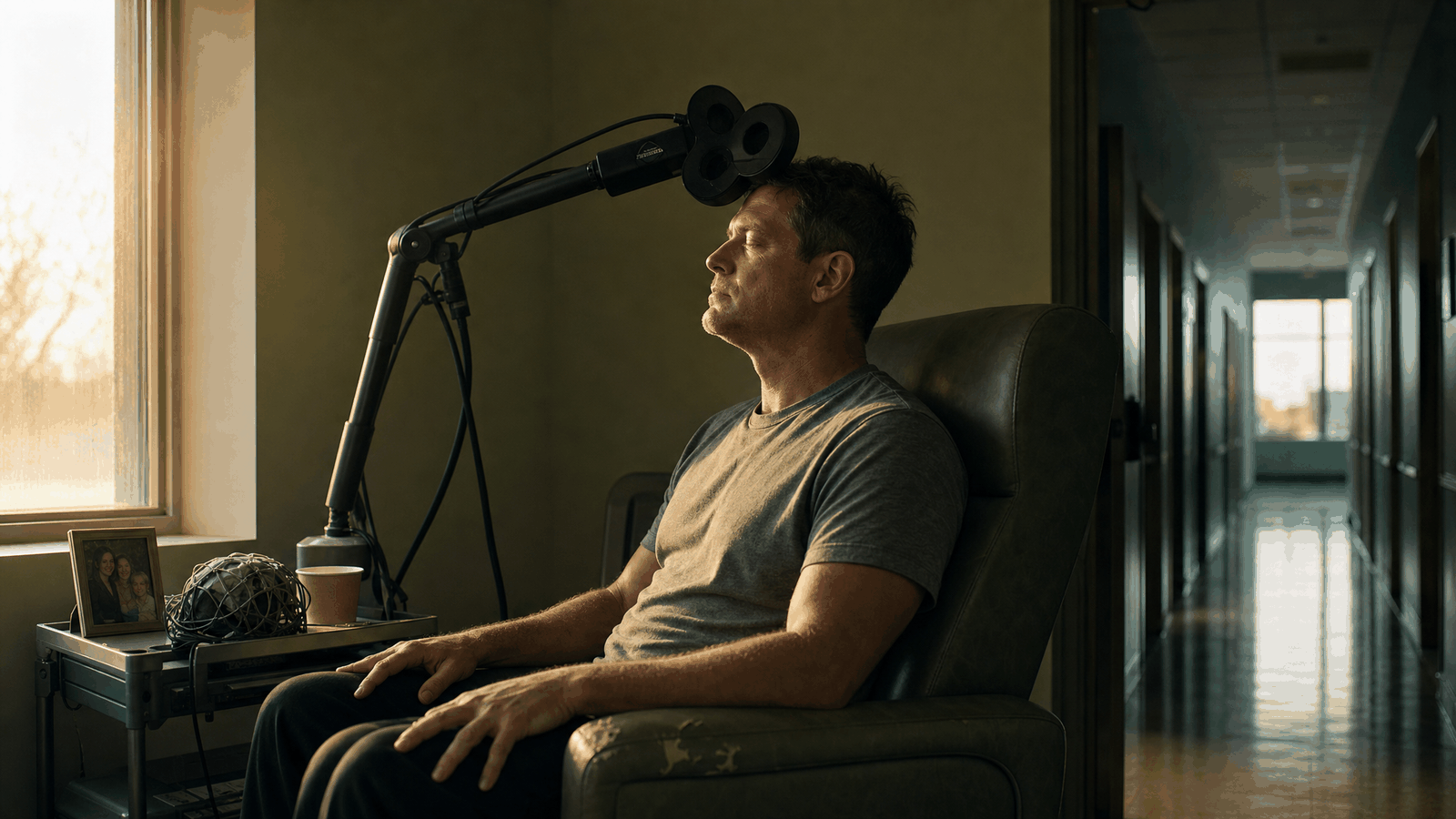
On 2026-10-22 War on the Rocks hosted Eric Juan and Jeff Linquist on EEG-guided transcranial magnetic stimulation for post-traumatic stress. These are listening notes: what holds up in the 52%, 68% and 170-morphine-equivalent figures, and where cross-trial comparison breaks down. Educational reading-method discussion, not medical or investment advice; talk to your own physician about treatment.
Contents
I went away, and the willows were soft with spring; I come back now, and the snow falls thick upon the rain.
—— Shijing, “Xiaoya: Cai Wei” (pre-Qin China; my own translation)
On the 22 October 2026 episode of War on the Rocks, host Ryan Evans sat down with two veterans: Eric Juan, a former Navy flight surgeon who later served as chief physician at Boeing, and Jeff Linquist, a Marine helicopter crew chief. Their subject was a treatment that uses an EEG to locate dysfunction and then transcranial magnetic stimulation to treat post-traumatic stress. The figures Juan put on the table: a seven-site, double-blind, sham-controlled clinical trial showing a 52% reduction in symptoms and 68% remission, against 11–13% for the two FDA-approved drugs he compared it with. Linquist said that before his 2014 treatment he was taking 22 pills a day, roughly 170 morphine milligram equivalents; today it is 15 to 20. The condition those numbers rest on: the 52% and the 11% come from different trials with different patient populations. Nobody has put the two groups inside one study.

The strongest version of their case
What persuaded me first was not a number. It was that they told a complete story, one you can go back and interrogate.
Start with the technology. TMS — using a magnetic field to trigger neural activity through the skull — has been FDA-cleared for depression for years, and Juan says response rates hover near 50%, with some studies reaching 60–65%. The team of neuroscientists, psychiatrists and neurosurgeons behind this approach asked something simple: if every brain is different, why is every stimulation protocol the same? So they added an EEG. Juan’s analogy stayed with me — an electrocardiogram is an electrophysiological picture of the heart, and an EEG is one of the brain, except it isn’t a still image. It’s a dynamic recording at millisecond resolution, showing how regions talk to each other. What they look for is disruption in that network, and that’s what they aim the stimulation at.

The hardware sounds almost comic. A unit smaller than a suitcase, something like a bicycle helmet on the head, a sophisticated image in ten to thirty minutes. The treatment side is a figure-eight MagVenture coil, 1.8 Tesla, placed over the medial prefrontal cortex. Juan calls it first-order physics: a magnet can deliver energy across a solid barrier, so it can induce an action potential through bone. Then came my favourite passage of the hour. We are engineered as healing organisms, he said — put two ends of a broken bone together and it knits, put two wound margins together and they close, and the brain is similar. Give it a prescribed pulse rate and it begins to synchronise again. Their job is to restore a baseline, and biology does the heavy lifting.
Then the evidence chain. A breakthrough device designation in 2024, clearance this year, seven or eight years from phase one to submission, two sites expanded to seven, one interruption from COVID. Juan stressed the design: double-blind, randomised, sham-controlled. And chief scientific officer Leslie Prichep found an electrophysiological marker present in the active group and absent in sham, correlated with symptom change — still under journal embargo, so he couldn’t reveal it. His benchmarks: the two approved drugs for post-traumatic stress (generic Zoloft and Prozac) produce 11–13% symptom reduction; VA researcher Brian Shiner looked at how often psychotherapy drives patients into remission and found 0% and 4.7%; their trial saw 68%.
The sharpest evidence, though, is Linquist’s body. He walked in, said nothing, sat down, and a physician named Dr. Jin looked at him and said: you must be exhausted. Then listed his symptoms, one after another. He teared up, because years of therapy had told him to think differently, to suck it up, to fix his sleep hygiene — and he had tried hard, and he was failing, and he had started to believe the problem was him. He thought he would become one of those angry veterans nobody wants to be near; he was wrecking his family, his friends, his finances, every relationship he had. This was the first time someone said: I can see something broken in there, and I can help. His own words: like being told you can’t run because your ACL is torn.
The first night of treatment he slept so hard he snored. His wife didn’t believe he had taken nothing; they argued, and he threw her the pill bottle. The second night she drove their son to school and came back to find him still asleep. Three weeks later he told the doctors he was down to one Norco and one oxy and planned to quit over the weekend. They warned him about withdrawal — he had detoxed before, he said, and this didn’t feel like that. The four-hour alarm simply started going off without him reaching for anything. Half the medication, he admitted, had been for pain, and half had been for checking out of his life. His wife Bev walked into the clinic and said the line that made Juan break down on the recording: I got my husband back, this is the man I married ten years ago.
Standing on the other side: where the numbers don’t tighten
I wrote six question marks in my notes.
First, the hardest one. Neither 52% versus 11% nor 68% versus 4.7% was produced inside a single study. The drug figures come from other sponsors’ trials, with their own inclusion criteria, their own scales, their own baseline severity. Shiner’s 0% and 4.7% are worse to compare: that is real-world VA psychotherapy, where people miss appointments and drop out and nobody schedules the sessions for them. Setting that against a trial remission rate is setting an unmonitored clinic against a research protocol with a coordinator who calls to remind you. The direction may be right. The multiple cannot be read that way.

Second, sham control is hard in this field. Stimulation on the scalp produces sensation; subjects often guess their arm. Juan said himself that conventional TMS has repeatedly failed to separate from sham for post-traumatic stress — a double-edged sentence. It shows they achieved something others didn’t, and it tells us the base rate of success here is low, and in a low-base-rate field the first successful trial is exactly the one that needs independent replication.
Third, the biomarker is embargoed. In the episode it carries real weight, upgrading “patients report improvement” to “we measured a change in brain function.” I can’t read the paper yet, so I don’t know how the marker is defined or whether it was pre-specified or found in the data afterwards. That difference is large enough to change the strength of the whole claim.
Fourth, Linquist’s story contains everything a sham arm exists to control for. The clinic opened on a Saturday for one man. A physician named his symptoms before he spoke. On the phone was a brother he felt he had let down for years, saying don’t embarrass me, do it for everyone else, go find out whether this is real. If any placebo could reach that strength, it would be this combination. It doesn’t make his improvement fake. It makes the share attributable to the machine impossible to count.
Fifth, the roughly 5,000 patients across three states and the live dashboards. Juan gave warm credit to Ohio state senator Frank Hoagland, a former SEAL who carried a laptop around showing people taxpayer dollars at work, and who pushed the bill through after being told it couldn’t be done. I admire the transparency. But those dashboards hold before-and-after scores of people who received treatment, with no control arm, no blinding, and dropouts outside the denominator. That is administrative transparency, and using it as efficacy evidence tilts optimistic.
Sixth, incentives. Juan works for the company, the company drove the trial, and he is also the man who sent Linquist in. He was candid about why: his generation of friends, the ones he escorted home from Iraq in 2003 and the ones who survived it, had tried medication, talk therapy, EMDR, transcendental meditation, and he would look at anything with a plausible mechanism. I believe that. It doesn’t change the fact that this episode is also lobbying material — the trip to Washington was to talk coverage with the VA and insurers. And the most effective part of lobbying material is the passage that made him cry.
Which side holds, and the condition it turns on
My read splits into two layers.
That the treatment beats sham under controlled conditions, I’m inclined to accept. Seven sites, double-blind, randomised, sham-controlled, through an FDA submission, is a machinery that is expensive to fake — not because people won’t try, but because faking it at seven sites, through independent statisticians, past a regulator, costs more than it returns. You can hear the data discipline in how Juan describes the trade: expanding from two sites to seven bought geographic diversity and generalisability, and cost time in startup and training, because data integrity outranks schedule in an FDA study.
That it is four times better than drugs and more than ten times better than psychotherapy, I don’t think holds — not yet. Cross-trial comparison is not head-to-head comparison. The missing condition is specific: one study placing both treatments in the same population on the same instrument, or, short of that, a real-world report publishing those 5,000 patients’ before-and-after scores together with the dropout rate. They already hold the data for the second one. It is the fastest proof available to them.

Let me take two more layers from the reader’s chair, because this scene — good news arriving with good numbers — shows up in investment reading about once a month.
The first discomfort: the numbers look great, so why don’t I trust them? Usually your unease comes from an instinct you can’t articulate — you were handed two numerators and never shown the two denominators. The denominator under 52% is screened, monitored trial subjects; the denominator under 4.7% is real people who miss appointments. My own habit now is to ask one question of any multiple: were these two numbers measured in the same room? If not, I demote the multiple to a direction and use it to rank what I check next, never to conclude. This works the same way on earnings calls, where a company’s favourite move is its own metric this quarter against a peer’s different metric last year.
The second discomfort: there is a life-changing human story in front of me, so what do I do with it? I keep the story and the numbers in separate columns. The story column records mechanism — it tells me what this thing looks like if it works. Linquist’s shape was: sleep first, then the pill alarm starts getting missed, then he is present. That’s a sequence I can go and check, and if large-scale data shows sleep improving after symptoms rather than before, story and mechanism don’t match. The number column records only instruments and denominators. The mistake I used to make was letting the story vouch for the numbers, so the more moving the story, the less likely I was to look for the denominator.

The most grounded thing in the hour came from Linquist. This is no magic, he said; it slows the processor down so you can sleep and concentrate, and you still have to do the work. He tells everyone who walks in: if you’re going out to the bar every night, I’ll see you in six months. After all those objections, that line stands up better than the numbers do. A treatment that opens by telling you it won’t fix your problems is easier to verify than one that promises to fix everything.
Further reading
- War on the Rocks, episode of 22 October 2026, hosted by Ryan Evans with Eric Juan and Jeff Linquist
- Wave Neuroscience’s public FDA trial information and its 2024 breakthrough device designation
- Brian Shiner’s VA research on psychotherapy remission rates in post-traumatic stress
- The CDC’s morphine milligram equivalent conversions and the 100 MME per day risk threshold
- Existing literature on TMS response rates in depression, and the post-traumatic stress trials that failed to separate from sham
- Leslie Prichep’s biomarker paper, under journal embargo at recording time and worth revisiting once published
One Thing to Take With You
One idea: many problems that have been stuck for years are missing a precondition — having the capacity to work on them at all. After Linquist started sleeping, nothing fixed itself. The family relationships, the medication, the finances all took a decade and are still in progress. But before he slept, he couldn’t touch any of them. Repair the condition that lets you start, and the problem becomes workable. Get that order backwards and the effort lands on air.

Here’s something I’ve tried. This week, pick one person you know is in a low place, and don’t ask whether they’re okay — they’ll say they’re fine; I’ve given that answer myself. Instead, find them one concrete next step first: the time, the place, who they’ll be seeing, all settled. Then call and say something close to what Juan said to Linquist: I booked it for you, go, and don’t make me look bad.
This article is an educational discussion of investment method. It is not advice to buy or sell any individual security, offers no target prices, and does not analyze any current holding. Investing carries risk; make your own decisions or consult a qualified professional.
Comments
Loading comments…