A $50,000 Underwater Drone: Ulysses Wants to Make the Ocean a Permanent Worksite
Notes on the 15 October 2026 episode of Cheeky Pint, where Ulysses cofounder Will O'Brien discusses the cost structure, supply-chain bottlenecks and defence procurement behind underwater robotics. Educational commentary only; no investment advice and no stock recommendations.
Contents
- A surfing trip that came back with a job list
- They ran the numbers on seagrass first
- One job done, and the ocean turned out to be full of the same shape
- The Guinness quality standards on his phone
- The crew is the bill
- Saltwater doesn’t give you broadband
- What’s blocking them is a factory they haven’t built
- ”A hundred times cheaper — doesn’t that settle it?”
- ”Every frontier story sounds good — how do you tell which is real?”
- Further reading
- The one thing worth taking away
The sea is everything. Its breath is pure and healthy. It is an immense desert where man is never alone, for he feels life stirring on every side.
—— Jules Verne, Twenty Thousand Leagues Under the Sea (1870)
On the 15 October 2026 episode of Cheeky Pint, Ulysses cofounder and president Will O’Brien said his company can sell an underwater vehicle to a navy for as little as $50,000, against roughly $5 million for the autonomous underwater vehicle the US Navy buys most of today — a hundredfold gap. He also said the company’s constraint sits in manufacturing rather than sales: demand exceeds supply and they are turning contracts down. The gap applies to the base vehicle; O’Brien himself narrowed it to about one order of magnitude once advanced sensing and navigation go on.

A surfing trip that came back with a job list
Ulysses didn’t start in a lab. One of O’Brien’s cofounders was on a surf trip, met a marine biologist, and heard what her days looked like: taking photographs underwater, planting seeds, collecting water samples, every task by hand. He had been building aerial delivery drones at Manna, and his reaction was that someone could build the underwater equivalent to do all of it.
The first job they picked was seagrass restoration — replanting degraded seabed.
They ran the numbers on seagrass first
This part surprised me. Seagrass gets almost no airtime, and O’Brien’s own framing is that coral is the good-looking friend who gets all the attention while seagrass is the one you should be talking to. His figures: seagrass covers 2% of the seafloor and holds 20% of the ocean’s carbon, and around 20% of commercially important fish stocks depend on it as habitat.

Then the urgency. On current projections, he said, several critical fish stocks could be wiped out around the 2040s, while billions of people rely on fish as their main source of protein or income. Overfishing drives part of it and habitat loss drives the rest. The ratio that stopped me: we restore these ecosystems 100 to 1,000 times slower than we lose them.

One job done, and the ocean turned out to be full of the same shape
Seagrass restoration breaks into steps: map the seabed, work out where seagrass is and isn’t, run a habitat suitability model to pick restorable areas, find the plants that are flowering and setting seed, collect, then deposit the seed where it’s needed.
Halfway through, O’Brien said, it was obvious the ocean is full of similarly shaped problems. Find a mine, repair a pipeline, inspect a cable — the skeleton is go there, find it, act on it, come home.
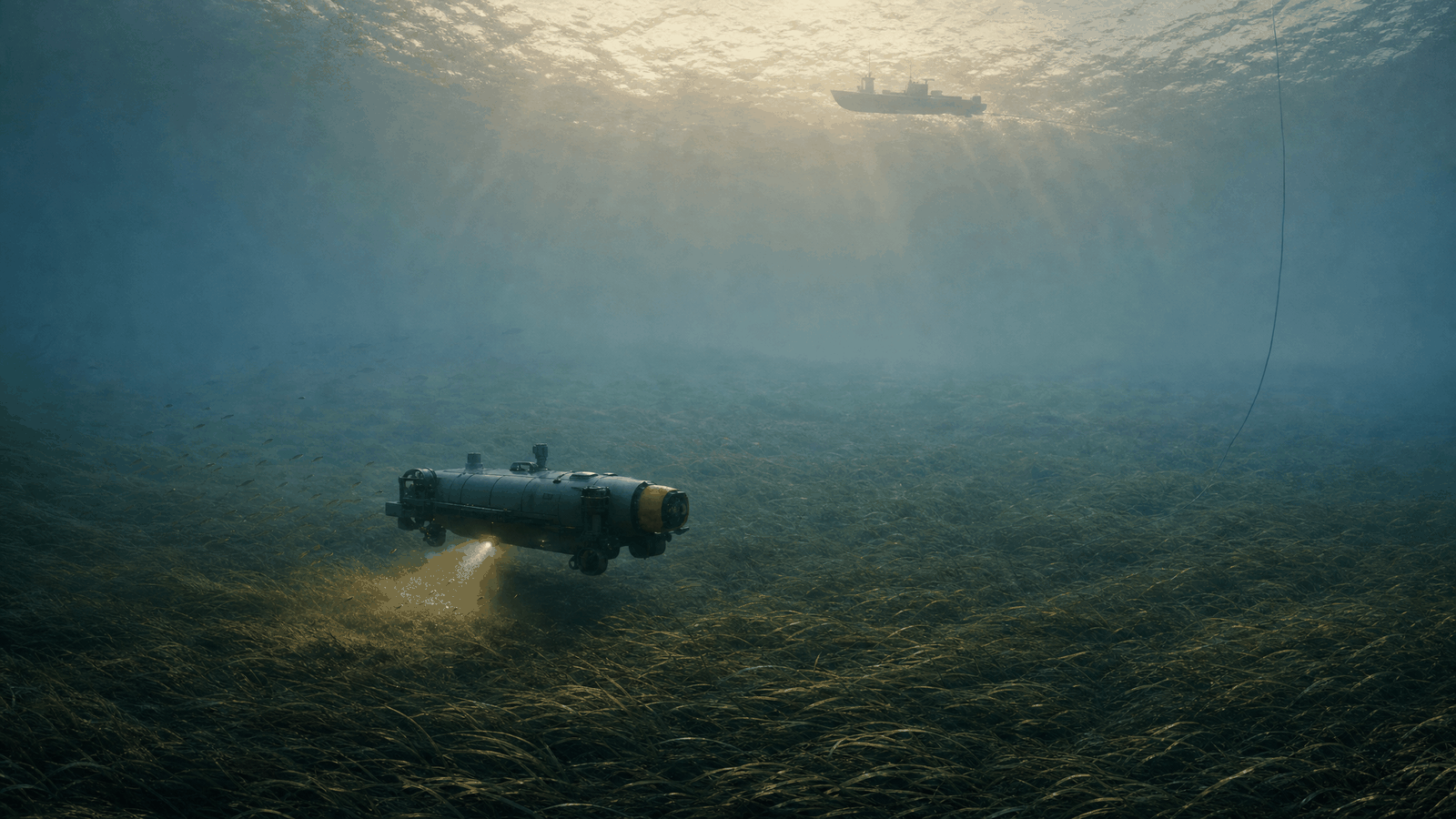
So they reasoned from first principles. An ocean robotics company needs full three-dimensional access to the domain. Drag is lower on the surface, so most transit should happen there: hence Leviathan, an autonomous surface vessel with 2,000 nautical miles of range, which carries the underwater vehicle Mako out and drops it in — O’Brien’s line is that Leviathan drops the kids off to school.
One early decision paid off later. Before Mako, he said, underwater vehicles mostly gathered data rather than manipulating things, and a vehicle built to physically act underwater looks very different. They also wanted one general-purpose body for many jobs, so Mako is built from Lego-like blocks: extra battery packs for another 150 nautical miles, a different rear thrust module for speed, stereo cameras for 3D imaging, a sonar front module for bathymetry. When the US Navy and offshore energy developers came knocking, the vehicle didn’t have to be redesigned.

The Guinness quality standards on his phone
The first twenty minutes are about Guinness, and I assumed it was small talk. O’Brien points out that Guinness was running an in-house research team as early as the 1890s — hire very smart people, tell them to find a problem. One problem was the lipid content of hops, a major determinant of pint quality; judging a batch meant sampling hundreds of hops and losing a few percent each time, which hurts in a high-volume, low-margin business. William Sealy Gosset’s answer became small-sample statistics, published in the early 1920s under the pseudonym “Student” because the company didn’t want competitors knowing it employed researchers. We still call it the Student’s t-test.
He keeps the Guinness seven-point bar standard on his phone and read it out: crafted presentation, consistent freshness, counter visibility, correct gas, correct temperature, clean lines, clean glassware. A company filed under “beer” whose growth came from technical innovation, and hardly anyone tells that story.
The crew is the bill
How does important subsea work get done today? Charter a large ship at a few hundred thousand dollars a day — and there’s a backlog just to get the ship. To work underwater you lower a tethered vehicle and operate it remotely from screens, in shifts.
The shifts are the point. Labour rules cap a person at roughly eight hours, but once the ship is out you want twenty-four, so each station needs three people. Each group has a manager, then the captain, the second mate, the person cooking the spaghetti, and — once you pass eight people on a US-departing vessel — a doctor. You end up with a crew of dozens at hundreds of thousands of dollars a day, and O’Brien says that shape repeats across almost every subsea task.

Take the crew out and the bill changes shape. Two side effects come with it: you can sail in worse sea states, and you can move faster through the water, which crewed operations avoid because people get seasick.
Saltwater doesn’t give you broadband
Corrosion and pressure are the two external forces. Coatings and anodising handle some of the corrosion. Pressure scales with depth: “full ocean depth” is a technical 6,000 metres, the deepest trenches reach about 10,000, and Ulysses works to 1,500 metres with crush testing to 2,200 — which is where most of today’s subsea economic activity sits.

The hardest problem, he says, is communications. Acoustic links give you something like 10 KB per second over five kilometres, which he compares to a dial-up modem. That bandwidth can’t carry video back to a human operator, so decisions have to happen on the vehicle — which is why they put a NVIDIA 5090 and an Intel CPU onboard, roughly a hundred times the onboard compute of other autonomous underwater vehicles.

He was candid about where the autonomy actually is: draw a polygon, it generates a lawnmower track, and if it sees a rock it goes over or around. Complex autonomous behaviour hasn’t started, and most of their missions don’t need it yet. The surface vessel closes the loop: Leviathan recovers Mako, charges it wirelessly underwater, and relays live diagnostics over Starlink. Future surface craft are meant to carry replacement modules, vending-machine style.
What’s blocking them is a factory they haven’t built
O’Brien is blunt about the present: the main problem is building things, demand outruns supply, they’re saying no to contracts, and the daily questions are how to stand up a factory and which parts of the stack to pull in-house.
Why build inertial navigation and sonar themselves? Scale and lead time. About 20 million aerial drones get built each year, against maybe 1,000 to 2,000 underwater ones. They coaxed an annual figure out of one supplier: 100 to 200 units a year, while Ulysses wants a few hundred vehicles next year and perhaps a thousand. The numbers don’t meet, so they lean on electric-vehicle, aerial-drone and consumer-electronics supply chains that ship in the millions, and avoid maritime ones. The first vehicle was 80% off-the-shelf parts; they’re on generation five. Of four cofounders, one works on nothing but manufacturing.

On the customer side it’s the US Navy (mine countermeasures) and offshore wind. California’s floating offshore wind has a specific headache: the power cable hanging in the water catches abandoned nets and lines, and those lines snare dolphins and whales, which is one of the loudest local objections to the projects. Ulysses proposes mapping those cables daily, checking structural integrity and snagged lines, and cutting the lines off with an implement they’re building. Both buyers run long procurement cycles, though O’Brien argues the contracts are sticky once won, and that the shape suits a venture-funded company able to fund R&D and wait.
”A hundred times cheaper — doesn’t that settle it?”
That was my first reaction too, so I went back and pulled the number apart.
First, the definition. $50,000 is the base vehicle, and O’Brien himself narrows the fully-equipped gap to roughly ten times. Ten times is still a real advantage, but a hundred and a ten imply different market sizes.
Second, and less discussed: once the price drops, the thing capping revenue changes identity. Turning contracts away means the ceiling is written on the production line rather than the sales funnel, so the numbers worth watching become yield, ramp rate, and the annual output of the narrowest supplier in the chain. That 100-to-200-unit figure is the real ceiling of the whole line.
Third, the failure condition. Vertical integration pulls cost and lead time under your control and pulls quality risk in with them — a self-built inertial navigation unit that drifts puts a vehicle off-course in the water, and defence buyers forgive that slowly. The same facts support a different reading: cheaper access might reveal that nobody was willing to pay for the work in the first place. The way to tell is to check how much of the turned-down demand comes back.
”Every frontier story sounds good — how do you tell which is real?”
Someone announces the SpaceX of something every few months. O’Brien offered a framework I found useful. Frontiers develop in three stages: an expedition phase, where people go and return for one high-value reason — furs and pelts in the American West, satellites watching the Russians in space; then persistence, when railroads or reusable launch drop the cost of being there; and only then do new industries appear.
Hold any frontier story against that and two questions fall out: which stage is it in, and who is paying for the single high-value reason. For Ulysses the answer is navies and offshore wind, both with real budgets, which puts it at the tail of the expedition phase. Judging whether it reaches persistence means watching logistics rather than vision: underwater wireless charging, Starlink diagnostics, module swaps. Those three are the prerequisites for staying out there with nobody nearby.

He also named the friction. The single biggest barrier, he says, is green tape: a seagrass project in Australia they have wanted to run for years, in an important location and potentially the largest of its kind, stuck in approvals. Cutting technical cost by a hundred times does nothing to permitting time.
Further reading
- Cheeky Pint, 15 October 2026, with Will O’Brien of Ulysses — the source of every figure and quotation above.
- Works in Progress (worksinprogress.co), the magazine mentioned in the episode.
- The origin of the Student’s t-test, which is the Guinness research story the episode tells.
- Subsea cables: the episode notes roughly 200 worldwide, most outages caused by anchor dragging, with Ireland’s west coast as a concentration point between the US and Europe.
The one thing worth taking away
The line that stayed with me: cutting the per-attempt cost of something changes which things are possible, not just how cheaply you do the same thing. Subsea work goes undone because a few hundred thousand dollars a day means every trip needs its own justification; drop that and a job like “inspect the cable every single day” comes into existence for the first time. The domestic version is more obvious — we think we lack willpower when we lack the small move that lowers the threshold.
Here’s something I’ve tried. List three things you meant to do last month and didn’t, and for each write one sentence about the exact moment you gave up. Not “I was lazy” — a physical step: I’d have had to leave the house, I was waiting for a reply, I’d have had to clear the desk first. Then take the cheapest of those three obstacles and remove it: meet the person somewhere on a route you already walk, put the gear by the door, send the message without waiting for an answer. At the end of next month, count how many times you did the thing.
This article is an educational discussion of investment method. It is not advice to buy or sell any individual security, offers no target prices, and does not analyze any current holding. Investing carries risk; make your own decisions or consult a qualified professional.
Comments
Loading comments…