Jensen Huang on BG2Pod: Does the AI Capex Pencil Out, and What Breaks in 2027
Listening notes on the 15 October 2026 BG2Pod interview with Jensen Huang: why compute demand keeps compounding, why land, power and shell are next year's real constraint, and how fungibility turns into financeability. Educational, not investment advice; no stock picks or price targets.
Contents
- What the episode covers
- Seven things I underlined
- 1. The case for a billion times more compute lives in the word “exploration”
- 2. The unlock last year was the exoskeleton around the model
- 3. Ten thousand agents and $4m of compute for a millennium problem
- 4. Alignment is a forever problem, so safety is containment plus out-of-band monitoring
- 5. The constraint moved to land, power and shell
- 6. Fungibility eventually reads out as financeability
- 7. Consensus moved 100–200% in a year; the stock moved 20%
- Taking it further
- ”The headlines sound great, so how would I know this isn’t a bubble?”
- ”He sells the shovels — how much of this do I believe?”
- ”I don’t invest — what’s in this for me?”
- Worth a look
- The one thing to take away
The road to Shu is hard, harder than climbing to the blue sky… The earth gave way, the mountain crumbled, brave men died; only then were the sky-ladder and the plank road linked together.
—— Li Bai, “The Hard Road to Shu” (Tang, c. 8th century; my translation)
On 15 October 2026, BG2Pod hosted Nvidia CEO Jensen Huang, and Brad Gerstner and Bill Gurley asked the blunt version of the question: do these trillions of capex come back? Huang’s answer was that the thing blocking the buildout has changed hands — it sits with land, power and shell rather than chips, while Nvidia’s content inside a single gigawatt has gone from roughly $18bn to above $40bn. The line I keep coming back to is his claim that you don’t have to extrapolate the top two model labs into multiple trillions of revenue for the math to work, because those labs account for about a third of his business. He reported those figures himself, he sells the shovels, and the whole chain assumes no global depression and that power and permits keep up.

What the episode covers
This is Huang’s third appearance on BG2Pod. In the ten days before taping he had been at the White House state dinner and the superintelligence summit, and the day before he had taken his parents to his National Medal of Science ceremony — five of the six people on stage were born outside the United States, his father went out and bought a brand new suit on 24 hours’ notice, his mother a new dress. That stretch isn’t small talk. It sets the register for everything after it: he talks about this as a national engineering project, not as a ticker.
Both hosts invest for a living, so the questions all press on one line — how the money comes back. Why compute demand keeps climbing, whether the 43 gigawatts slated for next year can physically be built, whether lab revenue can keep doubling, and what keeps Nvidia where it is.
Seven things I underlined
1. The case for a billion times more compute lives in the word “exploration”
Huang takes this apart cleanly. Ask ChatGPT something and it mostly recites what pre-training encoded, with a quick search to ground it. Ask it to do something interesting and it has to reason step by step, open several branches, roll them out, look back at which path held up, prune the rest, keep going. He points out that this is why good strategists like strategic optionality: prune too fast and you kill the answer, prune too slow and you burn resources. All that thinking costs orders of magnitude more compute than regurgitation — and because it now does useful work, we hire it for more jobs. Both ends compound.

2. The unlock last year was the exoskeleton around the model
Model scaling continues, he says, but the past year’s big unlock sat in two places: memory and tool use. Memory covers working memory and the offline part — the compaction we do in our sleep, where what doesn’t matter fades and what matters gets rewired into the knowledge graph. Tool use means teaching these systems the tools humans already built: simulators, design compilers, Photoshop, AutoCAD. His image for it: a robot that walks into your house is more likely to use the tools already in the house than to build one from scratch. So the corporate move gets concrete — connect the model to your own ground truth, then to the tools you already run on.

3. Ten thousand agents and $4m of compute for a millennium problem
On Navier–Stokes, Huang’s reading is that nobody solved it from nothing: it came off a foundation of mathematicians and prior work, with exhaustive AI exploration poured on top. Then he offers a neat proof by contradiction — if the breakthrough hadn’t required a vast search space, someone would have found it earlier, because people are pretty smart. So the fields sitting at a tipping point are short of exploration, not insight. Gerstner adds the arithmetic: roughly $4m of compute, ten thousand agents working together, and the same job gets five to ten times cheaper over the next few years.
4. Alignment is a forever problem, so safety is containment plus out-of-band monitoring
Some argue AI is uncontrollable because perfect alignment is impossible. Huang grants the second half. His example is “be successful in life” — the mission takes one sentence, and the ways to pursue it are infinite, shaped by culture and background and where you grew up. His conclusion: if safety requires perfect alignment first, we never get there. The alternative is engineering. Start with containment, zero trust, minimum rights, and widen the boundary as testing earns it. Add monitoring that runs out of band, because any intelligent system behaves differently when someone is sitting there watching. His analogy is the car: brakes, airbags, ABS, lane-keeping were never a separate package bolted onto the engine — the whole car is the car’s technology. So when he says accelerate AI, he means accelerating the safety and security technology too.
5. The constraint moved to land, power and shell
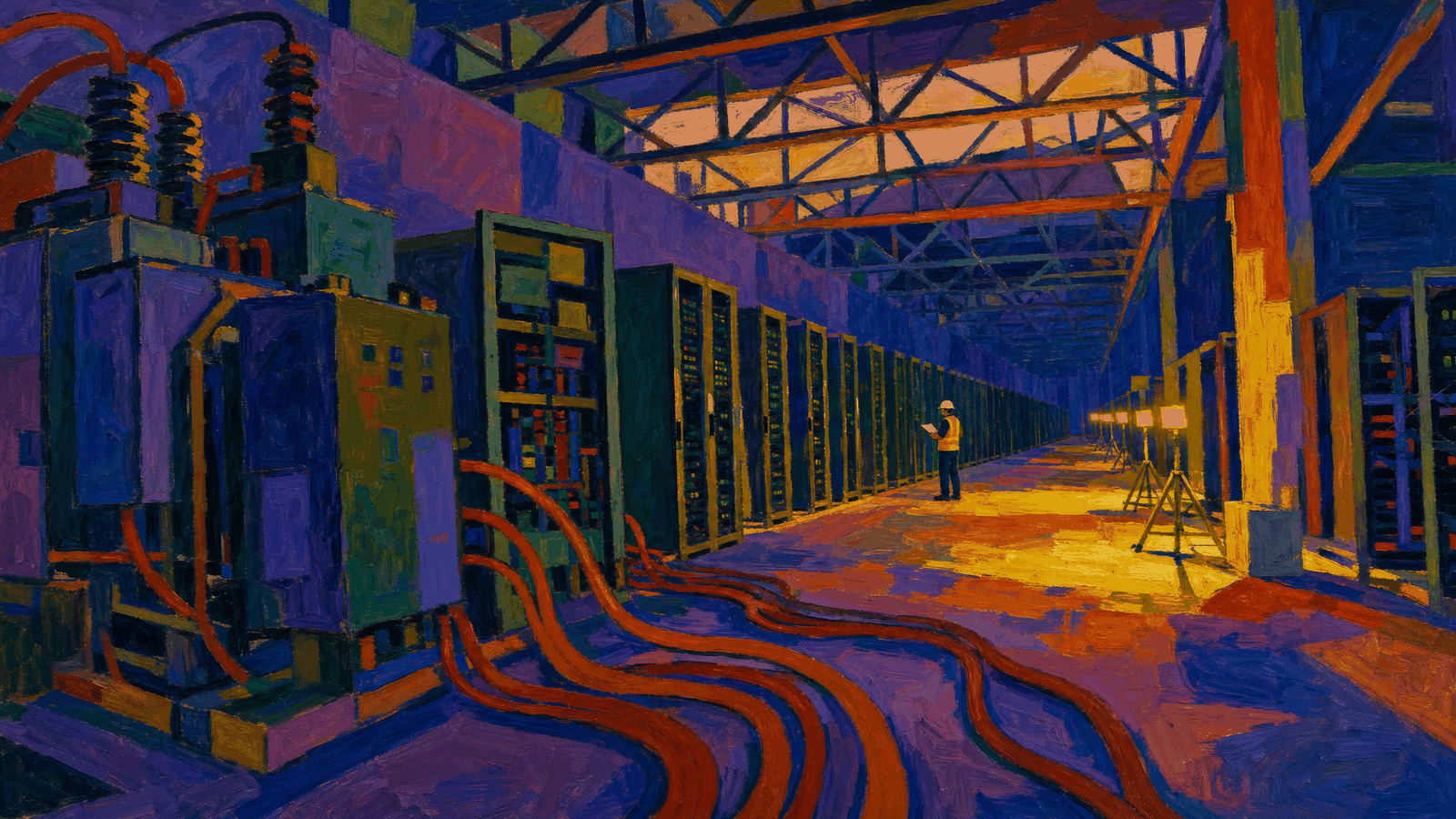
Gerstner cites Dylan Patel’s estimate: 43 gigawatts of new AI compute next year, more than all the AI compute that exists today. Huang says the demand is there and more. The hard part is moving from digital to physical — land permitting, new generation brought online, and finding the people who can actually build a $50bn data centre, whose skills are not fungible. Nvidia’s answer is spread: every contract manufacturer in the world works on his behalf, every route to market connects to his architecture, so when one state or one community stalls, the supply chain adjusts. The 2 gigawatts announced in Australia is, in his framing, about $80bn. Then the honest part — he says he doesn’t love that answer, because it means the United States couldn’t keep up.
6. Fungibility eventually reads out as financeability
Here is the commercial core. His chain runs: general-purpose, therefore fungible; fungible, therefore low risk; low risk, therefore rentable and financeable; financeable, therefore lowest total cost of ownership. Specialization, he says, is the enemy of fungibility and of durability — nobody knows whether the next dollar goes to pre-training, post-training or agentic inference, and his platform runs all three. His thought experiment lands the point: you have to place a $100bn order, sight unseen, on a next-generation system. On whom? His answer is that Vera Rubin earns that trust because Grace Blackwell was excellent, and that at this scale you can’t benchmark anyway — just building the thing is a miracle. He gives TSMC 100% of his wafers on the same logic: the only partner he can plan five years out with.

7. Consensus moved 100–200% in a year; the stock moved 20%
Gerstner puts up a chart. A year ago, sell-side consensus had Nvidia flat or shrinking in 2027; consensus now has it growing 74%. In twenty-odd years of doing this, he says, you rarely see consensus off by that much — and the stock is up 20%, trading at 13 to 14 times earnings. Huang leaves the share price alone and walks to two growth vectors decoupled from hardware sales. One is software licensing: most enterprises have no IT or software department to operate these factories, so they need someone on the SLA. His back-of-envelope is a couple of thousand dollars per GPU per year, applied to half of roughly 20 million GPUs a year. The other is revenue share with clouds that lean on him for offtake, ecosystem and financing. He notes himself that both sit on top of installed base — no installed base, no licence; no offtake, no revshare.

Taking it further
”The headlines sound great, so how would I know this isn’t a bubble?”
Numbers this big make me flinch first and think second. The episode handed me something better than the flinch: ask which slice is being extrapolated. Most of the “does it pencil out” arithmetic takes two frontier labs’ annualized revenue, projects it to several trillion, finds it can’t get there, and concludes the thing pops. Huang swaps the denominator. Classical compute — data processing, simulation, fraud detection, recommenders — is about a third of his business and already growing 30–40% a year. Five or six labs together are about another third. The last third is thousands of startups renting, 80% of them on open models, going after verticals the frontier labs don’t touch. Whether that split holds is checkable: find the primary source for whichever revenue line you care about, and see who reported it and when. If your worry turns out to rest entirely on two companies’ revenue curves, that’s the signal your stress test is aimed at the wrong place.

The other half of the test is watching where the constraint went. When chips were short, everyone watched chips. The binding constraint now is power and permits, which means “how much longer” is a question for grid interconnection queues and county boards, not for the fabs. Constraints move, and the people tracking them often stay at the old address.
”He sells the shovels — how much of this do I believe?”
I reminded myself three times during this episode that the speaker is long the trade. Being interested doesn’t make him uninformative; it changes which sentences are worth keeping. “Content per gigawatt went from about $18bn to above $40bn” is the kind of claim future filings can embarrass. It carries a cost. “Superintelligence means every county wins” carries none. My own habit is to split an interview into two piles: specific claims that facts can overturn, which I keep and check later, and vision, which I treat as evidence of what he’s pushing rather than as a forecast.
By that logic the most credible stretch was the one he said he disliked — if America can’t build it, he builds it elsewhere. That’s good news for his business and bad news for the national story he’d been telling all hour, and he said it anyway.
”I don’t invest — what’s in this for me?”
Two pieces, I think. The exoskeleton one first: most of the past year’s progress came from memory and tool use, and both live outside the model. Translated into office language, the value sits in whatever ground truth you have that nobody else does, plus the tools you already work in. You own both already.
The second is the Keynes exchange. In 1930 he predicted the economy would grow eightfold in a century and the work week would drop to fifteen hours. The first half landed; we’re working eighty. Gerstner’s read is that he underestimated the human spirit — work and discovery are purpose. Huang goes further and disagrees that we’ll end up with more time: cheap intelligence opens more opportunity, and ambitious people chase it. His line that stuck with me is that the more he learns, the more he realizes there is to do, because every thing you learn opens a new door. Worth holding onto if you were expecting the dividend of this wave to be free afternoons.
Worth a look
- The BG2Pod episode of 15 October 2026 with Brad Gerstner, Bill Gurley and Jensen Huang — the source of every quote and figure above.
- Keynes, “Economic Possibilities for our Grandchildren” (1930) — the original fifteen-hour-week prediction, and how he got there.
- The Clay Mathematics Institute’s statement of the Navier–Stokes millennium problem — for why the problem is hard.
- Any utility’s interconnection queue data — more useful than chip headlines if you want to track the land-power-shell constraint.
The one thing to take away
The idea I’m keeping: when you want to know whether something will stall, go find the hardest thing to replace, not the most expensive thing. Chips cost the most, and next year the blockers are transformers, permits, and people who know how to build a hall. Expensive and scarce are different properties, and stalls happen on the scarce side. The constraint keeps moving, so this isn’t a one-time call — it’s a question to re-ask on a schedule.

Something I’ve tried, if you want it: pick one thing you’ve been trying to move and can’t — a house move, a job change, a renovation, a kid’s homework habit. Write down, in one sentence, where you think it’s stuck. Then find someone currently doing the same thing and ask them one narrow question: “the last time you got stuck, which step was it?” Put their answer next to your sentence. I’ve done this a few times, and the two matched less often than I expected — and that gap was exactly where my effort would have gone to waste.
This article is an educational discussion of investment method. It is not advice to buy or sell any individual security, offers no target prices, and does not analyze any current holding. Investing carries risk; make your own decisions or consult a qualified professional.
Comments
Loading comments…