From Orbit to Seabed: I Had Defense Tech's Scoreboard Wrong — Notes on Valley of Depth, Oct 13, 2026
On October 13, 2026, Valley of Depth hosted the CEOs of Varda, Firestorm, and Bedrock Ocean. These are my listening notes on moving from 'whose machine is better' to supply, repair, and observability. Educational reflection only — no investment advice, no prices or trades discussed.
Contents
In the art of war: it rests on gathering wealth, so that no wealth can match yours; it rests on judging craft, so that no craft can match yours; it rests on making arms, so that no arms can match yours.
—— Guanzi, “The Seven Methods” (Warring States period; my own translation)
On October 13, 2026, Valley of Depth recorded a space and defense update from the New York Stock Exchange, where hosts Mo and Jack brought on three CEOs: Will Bruey of Varda, Dan Magy of Firestorm, and Matt Thurman of Bedrock Ocean. Bruey said Varda had closed a $251M Series D and had just become the first company in history to fly multiple commercial re-entry vehicles at once; Magy’s comparison was that the US will build a few hundred thousand drones this year, Russia and Ukraine seven to ten million each, and China an estimated thirty million; asked whether the Strait of Hormuz is clear right now, Thurman answered that he has no idea, and neither does anyone else. Those three passages moved my understanding of this industry off hardware specs and onto the supply line — with the caveat that all three men were speaking right after raising money, so I keep their forecasts in a separate pile.
I Had the Scoreboard Sitting on Machine Specs
For the past two years I read defense tech news with my eyes on the spec sheet: range in kilometers, degree of autonomy, how many flights a heat shield survives. A company like Varda I filed under “who can bring things back from orbit.” The Pentagon’s tournament-style drone buy — vendors show up with hardware, soldiers fly it, high scorers get orders on the spot — I read as a technology bake-off.
The error was specific: I put the outcome of a long conflict on the performance of one machine. The episode took that apart with details from three different companies.

Supply, Repair, and Observability Kept Coming Back
Round two of that tournament looks like a technology win: every long-range entrant hit a target 15 km out, where in round one only 24% reached 10 km. Then the hosts noted that the Army now calls trained pilots at the squad level the gap, rather than the drones. Add the Wall Street Journal piece on an Army desert test where drones failed in the heat, with a line that stuck with me: leave an iPhone under that sun and it stops working too.
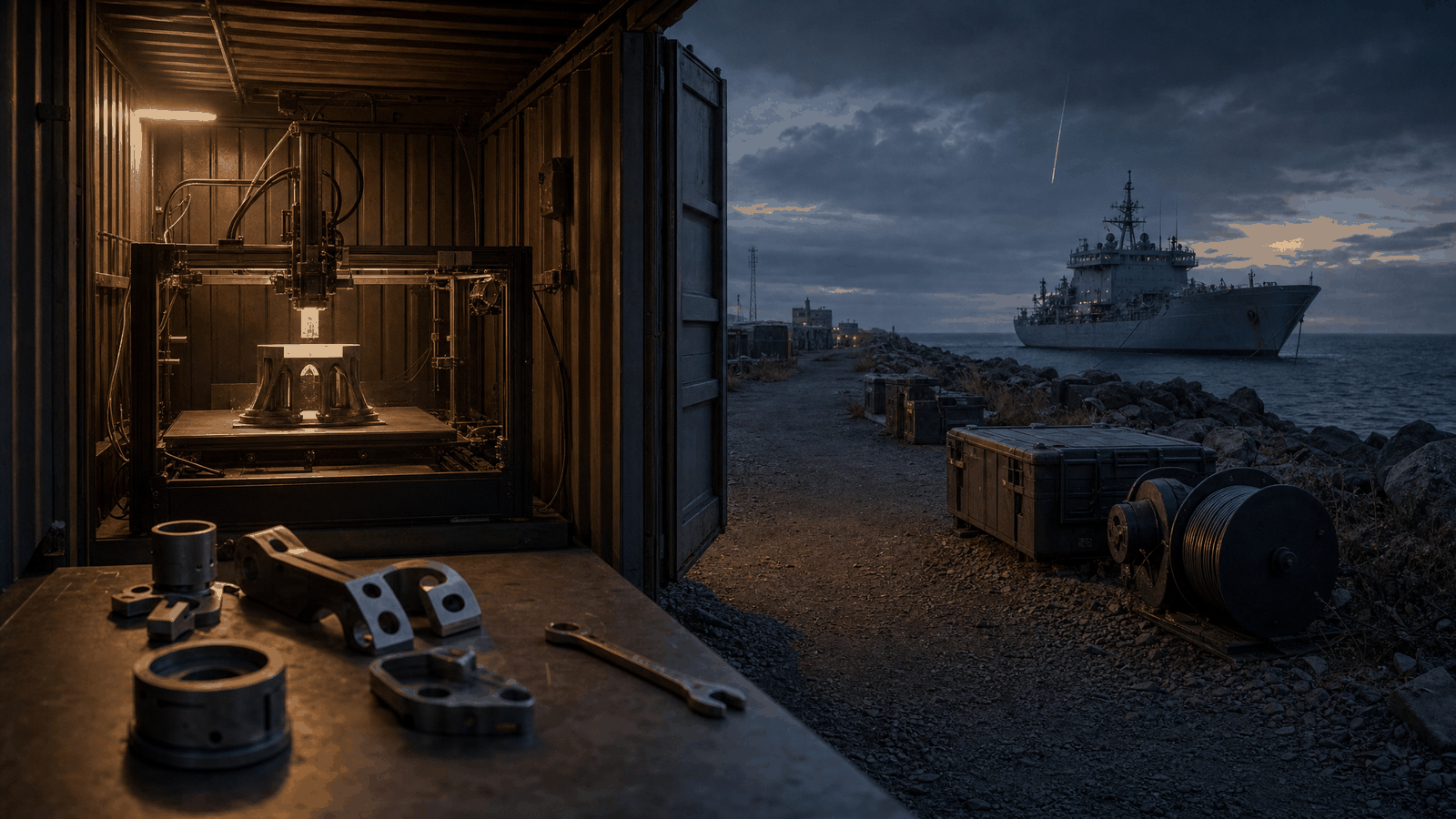
Magy’s experience was blunter. Firestorm passed every challenge in round one and scored 10 out of 100 on manufacturability, because the evaluators told them they didn’t believe in 3D printing — and roughly 80% of drones in Ukraine today are printed. He said something I wrote down: every war is an away game. On day one the enemy goes after your means of production, and if you have one big factory, they will blow it up. So Firestorm put HP’s industrial printers — machines about the size of a motorcycle, not the desktop kind — into expandable 20-foot containers, and says it can train someone to 80% competency in under two hours.

The part that landed hardest was the USS Essex. They put a container aboard for the transit from San Diego to Hawaii and printed for twelve straight days, turning out over 1,200 unique parts beyond the drones; the method was a QR code on the machine so passing sailors could scan it and ask for something. Magy estimated it saved the Navy around half a million dollars in a two-week deployment, and the most popular item was a non-conductive wrench, because nobody wants to get shocked. That deployment also taught him the Navy barters parts underway, flying four people boat to boat to trade. Meanwhile the Army waits four to five months for drone repair parts; broken gear means no training, and no training means no capability.

Bruey gave another version of the same story. Varda’s product is a re-entry vehicle carrying two businesses: reformulating existing drugs in microgravity, and selling a recoverable Mach 25 environment to government customers as a hypersonic wind tunnel. He pointed at the space companies that died in the ZIRP era, where the platform had no business on top of it. Inside Varda the pull runs both ways — engineers treat the formulation scientists as their ticket off the planet, since every new formulation means another flight. His image for the heat shield: service it like a brake pad, and accept that some of it ablates away.

Thurman took the scale below the waterline. He called the seabed the most unobserved place in the universe. The legacy method is a diesel ship leaving port at $100,000 a day, with data reaching the user weeks or months later; Bedrock drops autonomous vehicles from any vessel of opportunity and sends edge-processed insight back the moment one surfaces. European allies have no commercial mine countermeasure capacity, Russia’s GUGI operates underwater in the Baltic, and interference with a subsea cable shows up only under persistent monitoring. His Hormuz answer was the honest one: he doesn’t know, nobody does, and that is why the company exists.

How I Look at It Now, and Where I’m Still Unsure
When I look at a hardware company now, I ask three questions first: can you resupply when the line breaks, who repairs it on the day it breaks, and can you see your own battlefield. A company with concrete answers to all three earns a look at its spec sheet.
You may have had the same hesitation I get: the interviews are this specific, so should I act on them? The episode hands over its own antidote through Magy. Ukrainian peers told him the US is six months behind, and he takes that with a grain of salt, because they are using drones as diplomatic currency and protecting their own industry. If he discounts his peers, I discount his own passage about Firestorm going from a three-billion to a twenty-billion-dollar company. My practice is to split a guest’s talk into two piles: verifiable events and numbers (how many days, how many parts, which ship, which score) go into the pile I check later, and descriptions of the future get marked unverified, to revisit in three months.
The closer question is probably this one: a position is underwater, so how do I judge whether the structure broke? Bruey’s read on Virgin Orbit and Astra was that the platform had no business on top of it. So my check became “who pays for the business sitting on this platform, and for how long,” in place of asking how rare the technology is.
The open parts I’ll write down too. Varda’s own milestone is the first human injected with a microgravity-enabled drug, which sits downstream of clinical trials on a timeline Varda doesn’t control. Bedrock’s demand comes from European gray-zone pressure right now, and Thurman himself worries that budget noise hasn’t become force structure, fearing it takes a paradigm shift to move. Firestorm’s movable-factory demand comes from six or seven different groups of US forces naming the same problem — his line was that his wife has to tell him something six times — a strong signal that still needs another round of capital to become regional production, and that round hasn’t happened.
Worth a Look
- Valley of Depth, episode recorded October 13, 2026 at the NYSE, with Will Bruey (Varda), Dan Magy (Firestorm), and Matt Thurman (Bedrock Ocean)
- Paul Graham’s post arguing the test of most military hardware is whether the Ukrainians want it, and former US Ambassador Michael McFaul’s reply that they mostly prefer their own weapons now and need interceptors from abroad
- Results of the Pentagon’s three rounds of tournament-style drone procurement, including the phase three solicitation
- The Wall Street Journal report on drones failing from heat in an Army desert test
- CSIS estimates on sustainment duration, cited by Magy in the episode
帶得走的一件事
Capability is visible and supply is not, and supply decides how many days the capability lasts. All three businesses in this episode are, at bottom, patching that invisible line.
Here’s something I tried that you could do today: pick one thing you rely on daily — your commute, your home internet, the piece of your job only you can do — and write down how you’d get through day one if it broke, then day three. Writing mine for home internet, I found that day one works on a phone hotspot, day three is fine, and day seven had no answer; that sheet of paper is why I ordered a second line that week.

This article is an educational discussion of investment method. It is not advice to buy or sell any individual security, offers no target prices, and does not analyze any current holding. Investing carries risk; make your own decisions or consult a qualified professional.
Comments
Loading comments…