Thai Floods and Hard Drives: Why the Cheap Land Was Cheap
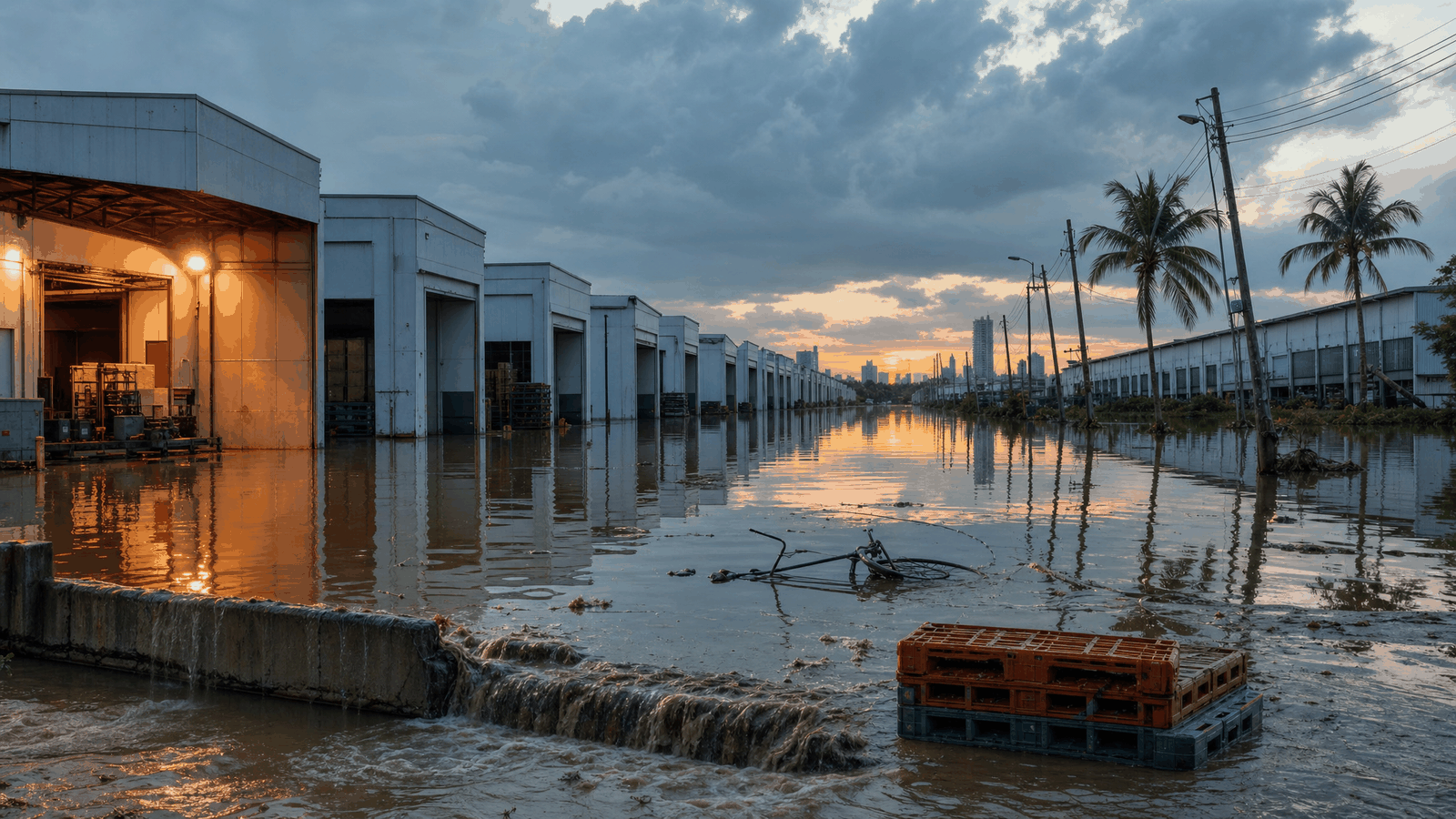
Notes from the 6 October 2026 episode of Supply Chained on the 2011 Thai floods and hard drive factories. A two-sided look at climate risk and insurance incentives in siting decisions — educational notes, not investment advice, no tickers or price targets.
Contents
How great a thing is water, in its benefit and in its harm!
—— Sima Qian, Records of the Grand Historian, “Treatise on Rivers and Canals” (Western Han; my translation)
In the 6 October 2026 episode of Supply Chained, Tim Culpan of Culpium and John of Asianometry go back to 2011, when the Thai floods drowned the world’s hard drive assembly base. John’s account: the Thai government used large tax breaks plus big tracts of land close to Bangkok to pull Seagate and Western Digital in, and that land happened to be floodplain. After the water receded, neither company moved its capacity, because 2009–2010 was the peak of hard drive production and NAND flash was arriving — nobody writes a fresh cheque to duplicate a line in a market that is about to shrink. Tim adds that he sees no evidence local climate risk weighs much in siting a factory; power and water availability come first. That whole calculation holds while demand is growing. Once a layer consolidates into a few hands, the same arithmetic starts understating the risk.
First, the strongest version of their case
The hard drive was invented in California, but John says that as the industry grew, the makers found they could not keep building the things in the United States. Seagate was among the first to push what looked like low-value assembly work out to Southeast Asia. Singapore came first, and for a while Singapore was the world’s largest supplier of drives. Then the work spread: some to China, with the two big landing spots being Thailand and Malaysia — Western Digital went to Malaysia, while in Thailand Seagate arrived first and Western Digital followed.
What Thailand got was final assembly. Spindles, heads and the rest shipped in from the United States, Japan and China, got put together on those estates, and shipped back out. The estates were government policy, built at a scale John describes as a city, and at the time it looked like a fine piece of industrial policy: hard drives and automotive parts became the two pillars of Thai industry, and both grew this way. He notes the hit to auto component makers gets discussed far less than it should.

The pitch was concrete: tax breaks, plus a lot of usable land, close to Bangkok. Here Tim drops the line that made me laugh — “floodplain, available land, possibly not a coincidence.” The land sat empty and cheap for the same reason it goes under water.
Then 2011. A La Niña year, rains starting early, two tropical storms, one of which doubled back; John calls it a weird year. The estates had flood walls, and the walls were not enough. Western Digital took the worst of it. Seagate, with its plant in the north of the country, sidestepped the whole thing. There was a political fight too: should the government have released the dams earlier? It held the water back to let farmers finish the rice harvest. Later research found the release timing made little difference to the outcome.

The strongest part of the episode comes after. Both companies stayed, and neither really decentralised. Western Digital duplicated the handful of critical tools Malaysia lacked — John remembers slider equipment — and did not do much beyond that. Why? Because production had peaked in 2009–2010. After the iPad, laptops moved to NAND flash, and the consumer drive was on its way out. Ask a company in a shrinking market to spend new cash on a backup plant up a hill where it never floods, and the return will not compute. John’s phrasing is that they had bigger fish to fry: the flood lifted drive prices, they enjoyed two or three good years, and then the centre of gravity moved from consumers to the data centre.

Tim connects this to the investor’s problem, and this is the part worth keeping: much of the loss is insured. Once insurance is in the picture, the CEO’s arithmetic becomes — there is a one-in-fifty-year flood risk here, but I am covered; cheap land, cheap electricity, cheap labour all show up in my margin. So go ahead. Insurers price the risk into premiums, of course, but the party pricing it and the party deciding are two different parties. Tim says the heavier siting factors are power and water, and both of those can be solved with a pipeline or a power station.
Now stand on the other side
The first thing that breaks is the denominator. The episode supplies its own counterexample: they are recording in September 2026, and Thailand flooded again the week before. Fifteen years, two events. Tim puts it plainly — with warming, the hundred-year flood shows up every couple of years. An expected loss built on “once a century” and one built on “once a decade” differ by an order of magnitude, and a siting decision, once poured in concrete, cannot be revised.

Second, the price already contains the risk. Land that is empty, large, close to the capital and cheap to rent, all at once, on a crowded delta plain — the reason is written in the topography. Treating it as a government subsidy books the same money twice: once as rent saved, once on the assumption that the downside belongs to the insurer.
Third, insurance pays for the loss, not for the customer. The episode leaves this alone, so I will add it. When a plant stops, somebody still has to ship, and a qualified alternate supplier absorbs that share. Once a customer has validated a new source, whether they come back is a separate decision. The benefit of the 2011 price spike landed on the side that stayed dry — Seagate in the north and Western Digital’s losses are two faces of one event. So “the industry enjoyed two or three good years” needs unpacking by company; the industry ledger and the company ledger are not the same ledger.
Fourth, the 2011 judgement that the market was shrinking so duplication was not worth it turned out wrong. John says it himself: drives were cheap and declining then, and today is another story — the data centre took the demand and drives are tight and expensive. The reason they skipped the cost of decentralising rested on a bad forecast. The cheque was right; the logic under it was broken, and broken logic does not repeat its luck.
Fifth, the “more events, smaller impact” forecast has an unmet precondition. Tim’s reasoning: acts of God arrive more often, but the chain is spread across the world, so when one site is hit there are backups elsewhere, and a reporter ten years from now will note fifteen affected locations where there used to be three. I agree with half of it. In the same conversation he says he sees no evidence climate risk enters siting decisions. So if decentralisation happens, it is a by-product of demand growth, politics and tariffs, with nobody budgeting for resilience. By-products are reliable during growth. Once a layer consolidates into a few capital-intensive players, the same logic reverses. Hard drives are the live example: the field narrowed from many names to a few, and any single plant’s share of global output is no lower than it was in 2011.
Which side I land on, and the condition that decides it
Tim hands over the test himself, and I will use it as the dividing line: what percentage of this component is made in the affected place. That turns a disaster headline into a number you can look up, and it also states each side’s precondition. The optimistic case — financial arithmetic is enough, leave the weather to the insurer — holds while that percentage is falling: demand grows, capacity expands, new plants go up elsewhere, concentration dilutes. The pessimistic case holds while the percentage climbs: the layer consolidates, capital intensity rises, no new entrants arrive.

Drives were in the first regime in 2011 and the second one in 2026. So my reading of “they stayed in Thailand and nothing bad happened” is this: the market was about to shrink and nobody wanted new capacity, so the cost of not decentralising was waived. Using a lucky outcome as proof that the siting method was sound is the inference I try to avoid.
Which brings us to the situation readers actually face. The news says a region flooded and a plant is down, you happen to hold something related, and the market opens in an hour. I ask three questions first, and all three are answerable:
What share of this component is made there. A rounding error is noise; more than half earns an evening of your attention.
Is my company the buyer or the seller here. Buyers eat the cost, sellers may eat the price increase — Seagate and Western Digital stood on opposite sides of one flood, with opposite returns.
How long before customers leave. Where parts need qualification, switching takes time, and two weeks down is a different story from two quarters down.
One pothole I have fallen into myself: reading “damaged” straight through as “bearish”. By the time the headline lands, the market is often already guessing who picks up the orders, and the guess runs against the mood of the story. My habit now is to write the victims and the beneficiaries on the same sheet of paper before deciding anything.
Worth reading alongside
- Supply Chained, episode of 6 October 2026 (Tim Culpan with John)
- The Asianometry video on floods and factories that set this conversation off
- Government post-mortems and academic reconstructions of the 2011 Thai floods (the episode’s takeaway: dam release timing had limited effect on the outcome)
- Long-run hard drive shipment statistics, to check the 2009–2010 peak yourself
- News coverage of the September 2026 floods in Thailand
One thing to take away
A cheap price usually tells you why it is cheap. That land was empty, large, close to Bangkok and affordable for a reason written into the word “floodplain”. Treat it as a free gift and you have booked a risk as revenue.
Something I have tried: take one choice you made recently that felt like a bargain — the cheap apartment, the cheap plan, the job that pays oddly well, the contract that came together too easily — and write one line on paper: why is this cheap. If you can name something concrete (the owner needs out, the company is buying market share, that seat turned over three times last year), you know what you are buying. If you cannot, go ask one person who has been there; one sentence will do.
This article is an educational discussion of investment method. It is not advice to buy or sell any individual security, offers no target prices, and does not analyze any current holding. Investing carries risk; make your own decisions or consult a qualified professional.
Comments
Loading comments…