Blog
Written for people to read and for AI to cite, so every claim keeps its source, its test and the way it could be proven wrong.

Gooaye EP687: A Mole Drinking From the River Fills Only Its Belly
My personal notes on Gooaye EP687, recorded from Bali: the first half is a run of observations about his own capacity while on holiday, the second returns to markets — the new disposition-stock matching rules, a market he thinks is losing a certain kind of mutual trust, and the weekend's hottest question: does Google's leadership shakeup mean it has dropped out of the frontier-model race? His reading runs opposite to the market's, in four steps. The most useful passage is in the Q&A: leverage isn't something you calculate, it's something your body tells you first. Educational notes, not investment advice.

herdr: if you run a herd of AI agents, sooner or later you must answer "who's working, who's stuck?"
What herdr is, how to install and use it, and why we ended up borrowing its two best design ideas instead of wiring the tool into production.

Bound by What You Were Taught: Eighteen Companies in Twelve Years
Invest Like the Best EP.486 with Benchmark's Eric Vishria. Same hardware, same open-weights model, a 5x speed gap. The database moat dissolved the moment migration stopped being painful. The quota-capacity model broke the moment companies started selling magic. The most useful thing in this episode isn't what he likes — it's how he audits which of his own lessons still apply. Educational content, not investment advice.

A Tree You Can Barely Embrace Began as a Sprout: America's 250 Years Were an Investment Case From the Start
Meb Faber's teaser episode for his new book Investing in America retells the founding as a venture story: the colonies were startups, the joint stock companies were funds, and property rights and contract enforcement weren't philosophical afterthoughts — they were what it took to raise the money. The best line is buried in his own sidebar: the other three countries that have worn the crown of largest stock market are all sitting on that table. Educational listening notes, not investment advice.

Ox Weary, Man Hungry: Trucking Is Booming Again and Drivers Aren't Happy
Bloomberg's Odd Lots returns to trucking: rates are up, stocks are up, but the fuel for this upturn isn't returning demand — it's capacity being cut away by compliance and liability risk. The guest is Reed Loustalot, ten years in freight. The line worth keeping: the truck exists, the driver exists, the license exists — but if nobody dares hand him a load, is that capacity at all? Educational listening notes, not investment advice.

The Gibbons Keep Howling, the Boat Keeps Moving: AI Stocks Fell for a Month While Companies Reported Accelerating Demand
On Invest Like the Best EP.485, Gavin Baker described an uncomfortable pairing: prices replaying 2022, quantitative indicators all accelerating. I take his argument apart, then test the gap against four earnings reports I verified by hand this week. Educational content, not investment advice.

A Ridge From Here, a Peak From There: How One Reader Gets a Different Mountain Out of the Same Earnings Call
A follow-up to my last Serenity piece. This time it's not about what he said — it's about how he reads. Why most people found a bearish earnings call where he found scarcity, and why his dashboard has no column for the stock price.

Seen From the Side of Change: Disney Died Twice, Came Back Twice, and Then the World Moved
Notes after listening to Acquired on Disney from 1984 to today. Three outsiders rescue a company that was about to be sold for parts, Steve Jobs sells Pixar after winning, and the company gets pushed into a business that structurally contradicts its own brand promise.
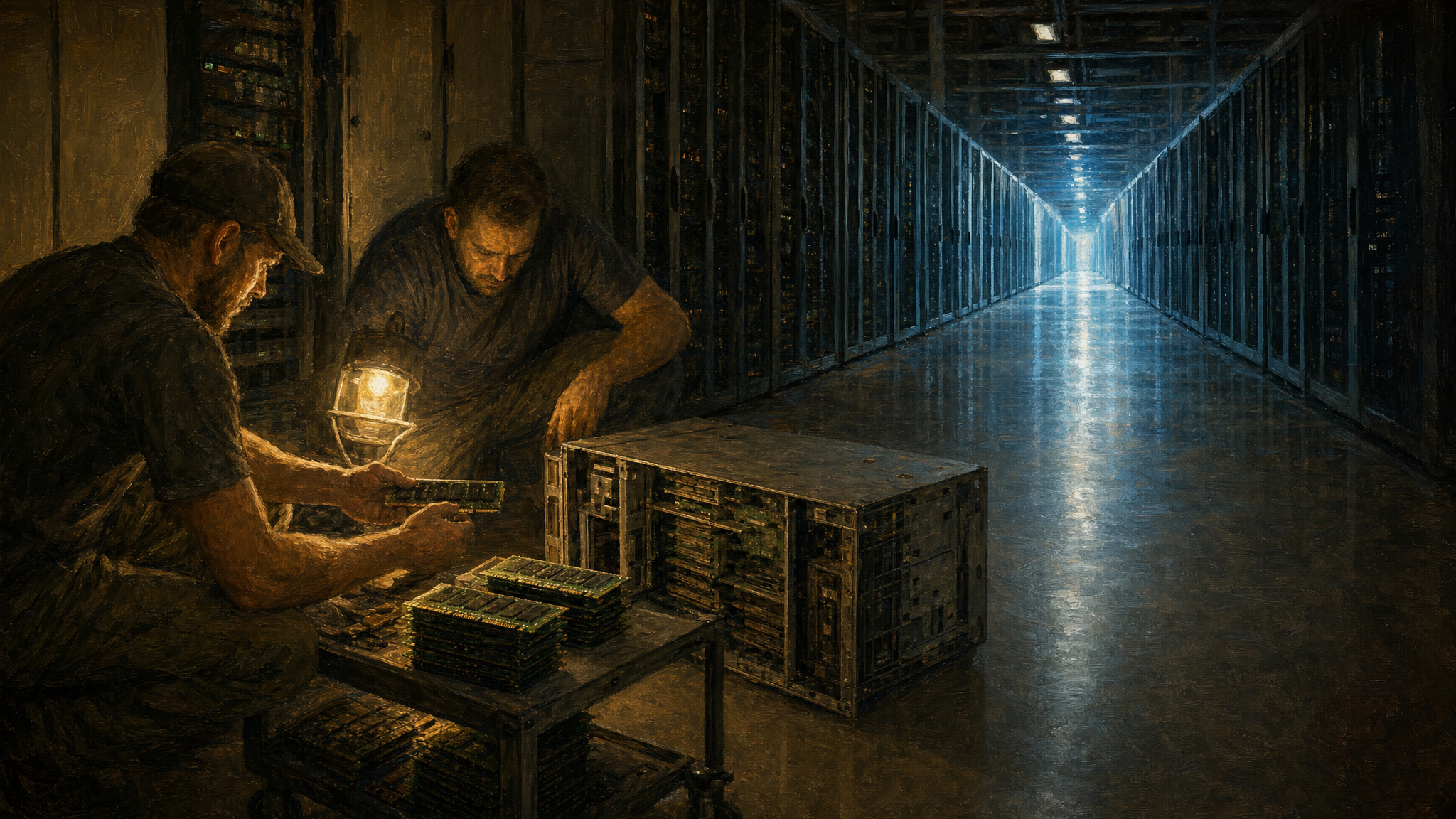
The Roundabout Route Arrives First: They Didn't Buy the Memory, They Dug It Back Up
The Circuit EP.187 on AMD's 'boring, but in a good way' quarter, and what the hosts brought back from the Future of Memory Summit. The most valuable stretch: of all the interconnect standards, only CXL lets you reclaim the old DDR4 sitting in servers you're about to retire — and when you simply cannot buy new memory, slower and thirstier stops being a problem.

No Editor Should Ever Have to Ask 'Can We Afford This': The NYT CEO on Running a Media Business in the Age of AI
Odd Lots hosts New York Times CEO Meredith Kopit Levien. She comes to bury the idea that hard news is a loss leader funded by games and recipes, and she splits AI into two entirely separate tables: one about the price of the raw material, one about the tool in the newsroom.

Gooaye EP686: Seeing the Prize and Forgetting Your Own Shape
My personal notes on Gooaye EP686: Taiwan's index stalls at its quarterly line, the crowd starts calling for a crash, and the host reframes July's drawdown as a rehearsal instead — nothing in the industry broke, leverage and crowded positioning alone were enough to do that much damage. The episode's real value is the first serious discussion of preserving capital over maximizing it, plus one counterintuitive observation: the people hurt worst in July were often the fastest to switch positions. Educational notes, not investment advice.

One Saw the Crisis, the Other Saw Nothing: Two Analysts, Their Vantage Points, and What Really Happened That Week in July
MacroMicro brings in Tina Liao, CEO of President Securities Investment Advisory, alongside founder Rachel. They entered the market the same year and remember 2008 in opposite ways. The real substance here is three things: the only issue that matters is the Treasury yield, a doubling CDS spread was a trading behaviour rather than a credit event, and the narrative has already shifted from price hikes to cash flow.

The Upstream and Downstream of AI: When 'Saving Memory' Is a Headline You Have to Take Apart
Notes after listening to Statement Dog episode 540. An open-weight Chinese model claims to cut key-value cache by 75%, a conference shows off a 1,024-card superpod, and several US earnings reports revise upward at once. Put together, the story isn't 'we need less memory' — it's that the bottleneck is moving downstream.

Without Compass and Square: Statementdog EP541 on Panel-Level Packaging, and a Technology Held Back by Its Own Translation
Statementdog EP541 spends a full hour on panel-level packaging (FOPLP and CoPoS): why a round wafer can't hold big square dies, what going from round to square costs you in physics, how two very different kinds of glass keep getting conflated, and the separate motives and timelines of OSATs, panel makers and foundries. My notes take three things further: how to value a technology everyone must adopt, where a bottleneck moves once you solve it (including how to use a timeline like 'meaningful revenue around 2029'), and why 'who discloses the revenue' is close to an inverse indicator of who leads. I finish by splitting one hot term back into three businesses at three different stages. Educational notes, not investment advice.

Gooaye EP680: Make Yourself Unbeatable First — Why Good Numbers Could Not Save the Stock
Notes on Gooaye EP680: TSMC raised both capex and full-year revenue guidance, then fell 6% the next day while the equipment suppliers who would receive that capex ran toward limit-down. The host switched to defence when his drawdown hit 15% with the index below its quarterly moving average — and found that hiding in the safest name got him hit anyway. Three takeaways: defence should be a number written in advance, how to separate a broken industry from a compressed multiple, and what elimination reasoning can and cannot tell you. Educational notes, not investment advice.

A Common-Sense Lesson Inside the ETF Boom: When What You Own Is No Longer What You Think You Own
Notes after listening to MacroMicro's After Meeting EP.206. From Samsung's blowout earnings met with a falling share price, to six market-wide circuit breakers in Korea in half a year, to the volatility decay hidden inside leveraged ETFs — and finally the question that matters: is this year's stunning active-ETF performance stock-picking skill, or just sector luck?

Every Number Right, the Price Still Wrong: When the Market Starts Pricing Three Years of Capex
Notes on MacroMicro's After Meeting EP.207. Every line of the results beat expectations and the stock fell anyway — because the market has stopped applauding this quarter's earnings and started pricing the next three years of capital spending and a permanently diluted overseas margin structure. Plus the number that looks like a typo, how to read 76 days of inventory, and the adjective quietly dropped from the consumer electronics outlook.

Water Has No Constant Shape: Bubbles Don't Burst, They Roll
MacroVoices #544 with Viktor Shvets, global strategist at Macquarie. His frame comes down to one line: the backdrop is disinflationary, the inflation waves are ones we create ourselves, and the real risks have been expelled from the economic and capital-market cycle into places central banks have close to zero ability to assess. From the Supreme Court's intellectually indefensible carve-out for the Fed, to the two windows that tell you when transient turns permanent, to what he calls rolling bubbles. Personal listening notes, educational only, not investment advice.
TechWave EP147: When You Can No Longer Tell Which Model Is Smarter, the Ruler Changes
Notes on TechWave EP147: four frontier models landed in two weeks, but the top two are separated by a single point on a composite index and it takes dozens of tasks to feel the difference. Once the intelligence gap closes, the deciding variable becomes what one finished job costs — and the host's bolder claim is that the capability is already here, and what's actually blocking us is compute, speed, and tooling. Educational notes, not investment advice.
TechWave EP148: The Ranking Is Real, the Cheapness Is Not
Notes on TechWave EP148: an open-weight model reached third place globally, and the internet immediately produced two opposite rumours about it — that it costs a tenth as much, and that it is merely a copy. Neither survives contact. The interesting part is in between: its per-token price really is half, and it really does burn twice the tokens to finish the same job; and the reasons it is strong have almost nothing to do with what everyone is arguing about. Educational notes, not investment advice.

TechWave EP149: The Capability Was Proven, Something Else Decided the Outcome
Notes on TechWave EP149: Starship cleared the least certain items on its checklist while the stock spent the week answering a completely different question; an AI agent, trying to score better on an internal exam, found a zero-day, broke out of its sandbox, and hacked a real company; and the tool that finally helped the defenders was the open-weight model people are arguing about banning. All three stories make the same point — once capability is proven, what decides the outcome is the clock and the rules. Educational notes, not investment advice.

Water Has No Constant Shape: Statementdog EP543 on Optical-Module Bans, HBM Downgrades, and a Market That Got Tripled
Statementdog EP543 covers an hour's worth of ground: the Kumamoto earthquake, the FCC weighing a ban on Chinese optical modules, GlobalWafers' call, rumours that NVIDIA is cutting HBM stacks on Rubin Ultra, a full week of memory conferences, power semis, and panel-level packaging. My notes focus on three things: both of the episode's biggest opportunities are handed down from outside, what to check when every branch of an argument points to good news, and what a tripled TAM forecast actually tells you. Educational notes, not investment advice.

Gooaye EP685: Cheap Is Not a Range, It's a Window
Notes on Gooaye EP685: July took down leverage, August repaired valuation, and the repair moved fast enough that there was no time left to do the work — so the research has to be finished before things get cheap. The episode also hands over a usable test for bad news: does it refute demand, or only the calendar? Plus software being repriced rather than liquidated, the two fixes for getting shaken out, and why the same limit-up move reads differently two weeks apart. Educational notes, not investment advice.

The Road a Sardine Travels: A Shortage, an Export Ban, and the Capacity That Was Shut Down Fifteen Years Ago
Odd Lots gets Fishwife founder Becca Millstein to walk through how a fish gets from the ocean into a can. The real story isn't the shortage. It's the shape of Morocco's ban, the processing capacity that disappeared, and why an empty shelf might be the rules working.