The Road a Sardine Travels: A Shortage, an Export Ban, and the Capacity That Was Shut Down Fifteen Years Ago
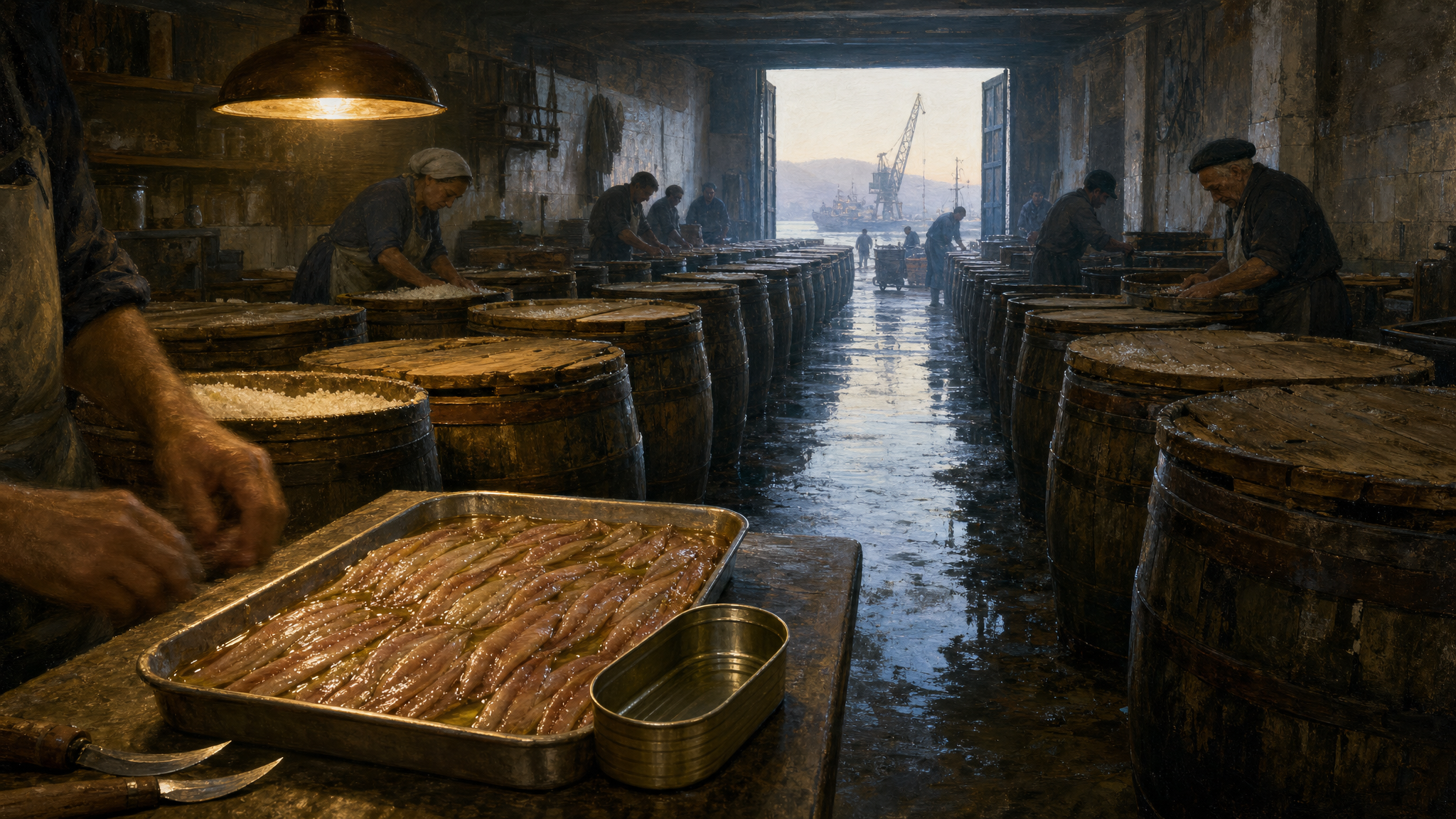
Odd Lots gets Fishwife founder Becca Millstein to walk through how a fish gets from the ocean into a can. The real story isn't the shortage. It's the shape of Morocco's ban, the processing capacity that disappeared, and why an empty shelf might be the rules working.
Contents
If the seasons of husbandry be not interfered with, the grain will be more than can be eaten.
If close nets are not allowed to enter the pools and ponds, the fish and turtles will be more than can be consumed.
If the axes enter the hills and forests only at the proper time, the wood will be more than can be used.
—— Mencius, King Hui of Liang, Part I (4th c. BC)
A “close net” is one with a fine mesh. Mencius’s point is simple: fine mesh catches more this year and nothing next year. Twenty-three centuries later, that sentence has grown into closed seasons, export bans, and an empty slot on a supermarket shelf. This episode is about everything sitting behind that slot.
What this episode is about
Odd Lots brings in Becca Millstein, founder and CEO of Fishwife — the premium tinned fish brand with the hand-illustrated packaging that sits on the shelf looking more like a gift than a groceries item.
The starting point is a news story: Morocco has banned sardine exports, citing declining catches. Morocco supplies something like half the world’s sardines.
The tone is set in the first minute, though. Tracy Alloway says she doesn’t really eat fish and has never in her life eaten a sardine; Joe Weisenthal then recalls the first time he invited Tracy over for dinner, politely asked about dietary restrictions, was told “I eat everything, I’m just not a big fish person,” and promptly served poke bowls. From there the conversation drills down: how a fish gets from the ocean into a can, and whose hands, whose balance sheet and whose policy it passes through on the way.
Original episode: Bloomberg’s Odd Lots, “How a Sardine Gets From the Ocean to a Can,” 7 August 2026, with Becca Millstein, founder and CEO of Fishwife.
The notes I took
Morocco banned frozen sardines, not canned sardines — and that distinction is the whole story. Morocco has canneries and canning infrastructure of its own, but historically a huge share of the raw material was exported frozen; she says roughly 90% of the sardine raw material in Spanish canneries came from Morocco. Blocking the input while leaving the finished good alone keeps the processing step at home and protects a meaningful domestic canned-sardine export industry. By the end of the episode it has become a diplomatic matter, with Spain trying to get Morocco to the negotiating table.

An empty shelf is not necessarily bad news — the most counterintuitive stretch of the episode. When you see a fishery capped or closed, she argues, that is responsible fisheries management actually working: people notice the fish aren’t there in the numbers or the sizes expected, so they stop and let the stock rebuild. She points to many examples of fisheries closing for three to five years and, within that window, recovering to the point of being certified sustainable again. So when a shelf empties, work out which kind of empty it is: the rules biting, or the rules failing.

And overfishing probably isn’t the main culprit here. She leans on the Marine Stewardship Council and the Monterey Bay Aquarium’s Seafood Watch, noting the fishery currently carries a yellow rating with regulation and enforcement judged to be in place — which points her toward climate. Three mechanisms plausibly run at once. Warming water pushes forage fish like sardines, which are extremely temperature-sensitive, toward colder or deeper water that commercial boats struggle to reach — so there may not be fewer sardines, just sardines that aren’t where the fishermen are used to catching them. Warmer water can also mean more active predators in the area. And thinner, less calorie-dense plankton produces leaner sardines, which are not the ones anybody wants to catch. She is careful to say these are still theories, and that fisheries science moves slowly: the roughly 46% drop in the Moroccan catch was only observed starting in 2023.
The American canning industry was almost entirely shut down fifteen years ago. Her estimate is five or so left in the lower 48, plus several more industrial ones in Alaska. The causes stack: stringent FDA rules introduced about fifteen years ago that many small canneries couldn’t meet, decline in the Pacific sardine and anchovy fisheries, and the arrival of very cheap processing capacity in Asia. Joe adds a fact he’s been carrying since a trip to Alaska: even US-caught Alaskan salmon has quite likely taken a detour through China to be processed. And that cheap capacity still comes looking for you — Joe says his Instagram feed keeps serving him B2B ads from Chinese sardine plants whose copy reads, more or less, “are you dealing with the Moroccan sardine shortage?”
Her zero-to-one didn’t run on demand. It ran on capacity nobody else wanted. When she started in 2021 the category was flat to declining; she called American processors and got asked why she was doing cans at all when pouches were booming. Precisely because nobody was competing for the line time, she never hit the trap that kills most emerging food brands: minimum order quantities. Her first partners were micro canneries in Oregon and Washington, small enough to have no MOQ at all. The first Spanish cannery’s minimum was around 20,000 units — so she ordered 20,000 tins of sardines with preserved lemon, and they lasted her most of the year. Those European family canneries were typically running one or two shifts a day, five days a week, with slack on the line. They wanted the American market and couldn’t do the marketing that building an American market requires. That isn’t procurement. It’s a trade of capabilities.
In a long-lead-time industry, the hardest problem for a fast-growing brand is demand planning. She has never sourced from the Moroccan fishery — Fishwife’s sardines come from two MSC-certified fisheries, Cornish and Iberian — yet as inventory vanished from the market her sardine velocities first went to two or three times what they had been, then to four or five. Retail buyers started calling to say their sardine shelf was wiped out, could she step in. The problem is that this supply chain requires telling canneries what you need a year out, then six months out, then three, so they can secure the raw material. Their answer was to air-freight: expensive, margin-compressing, and not the environmentally preferable option, but worth it to catch the demand and bring in new customers — a call they made many times over. Joe points out the same force one shelf over in food inflation: if ground beef is going to cost $20, you might as well spend $30 and get steak. When the commodity supply chain is impaired, demand spills upward into the premium one.
Pricing power comes from something verifiable, not from packaging. She takes the anchovy chain apart in detail: boats fish about six miles from shore with purse seine nets, the catch goes straight onto ice, then to the anchovy auction, where each lot is marked with a number for size, damage and fattiness. A third-generation member of the cannery family does the bidding; what he wins is processed three blocks away — headed, tailed, and layered with rock salt into barrels for anywhere from twelve to thirty-six months, with longer curing meaning higher grade. Only after it comes out, is cleaned and de-boned, does the pink anchovy everyone recognises emerge from what otherwise looks like an ordinary little silver fish — she notes that people seeing one for the first time often assume it’s a sardine. The cost of that method is shelf life: salt-cured anchovies keep about a year, against five to seven years for the rest of their tins. She adds that brand collaborations are not pay-to-play at all and take six months of work, and that instead of paying influencers flat fees — she’s been quoted $30,000 to $40,000 for one post — they run an affiliate programme and seed product.
Some thoughts this left me with
1. This episode points the bottleneck at a layer I don’t usually look at: processing, not raw material.
The question I normally ask about an industry is which layer breaks first when demand doubles. Instinct sends you upstream — not enough fish. This episode puts the answer in the middle: even with enough fish, somebody has to put it in a can. And that layer was shut down fifteen years ago, for reasons (regulation, fishery decline, cheap offshore processing) that have nothing to do with today’s demand.

The second step matters more: that layer does not rebuild itself just because demand came back. The European family canneries she describes are multi-generational, not venture-backed, happy with 5% growth a year and fine with flat. Nobody there is trying to scale in two years and exit. The hardest part of her job, she says, is getting these partners to wrap their heads around order volumes tripling and quadrupling year over year.
So the question I want on my checklist isn’t “which layer is tightest.” It’s “who holds the decision to expand, and does that person want to?” Tight capacity owned by someone who wants to expand is a cycle problem; it resolves itself. Tight capacity owned by someone who doesn’t is a structural problem, and it can last years. Both show up in the accounts as rising gross margin, but they last for very different lengths of time.
The falsifier is clear too: if capital starts buying up or building this kind of capacity, the structure begins to loosen. She notes that this category has seen fewer meaningful new entrants than many others with comparable heat — which is exactly the number to watch.
2. Noise and structure are unusually easy to separate in this episode.
Sardine prices will rise and one day come back down. That’s a price level. That’s noise. The shape of the ban isn’t: frozen raw material blocked, finished cans not. That is a country deciding to keep the processing value-add at home. It has identifiable beneficiaries — domestic canneries and the jobs in them — so it has reasons to persist, and it has already escalated into a diplomatic file.
My test is the same one I always use: if this number reverses, does the story break? Sardine prices retracing doesn’t break Fishwife’s story. Morocco extending the ban to canned product, or dropping it entirely after negotiations, does.
And the episode leaves several checkable things behind, each with a direction and a window: whether the ban extends or lifts, how the Spanish talks land, whether recovering fisheries re-certify a few years out, and her own line that she expects her sardine prices to go up. Set against those, “climate change is affecting fisheries” can never be wrong — which is exactly why it carries no information.
3. There are two kinds of gross margin decline, and this is the good one.
She volunteers that the air freight compressed their gross margin, repeatedly. On the numbers alone, that’s margin deterioration. But it’s a deliberate decision to spend current margin to acquire customers, and what triggered it was demand being too strong, not too weak. The other kind of margin decline is passive: input costs rise and can’t be passed through, or price gets cut to defend volume.
The two look identical on an income statement. Telling them apart means either management says so, or you look at the direction of volume — margin falling while volume explodes and margin falling while volume stalls are opposite events. This is where I most often take the lazy route: see the margin line go down, dock points.

Her farmed-versus-wild salmon answer belongs in the same box. She chose farmed for reasons that have nothing to do with taste and everything to do with cash. Wild means seasonal purchasing — the whole world buying the same fish in the same window, in one enormous lump of cash. Farmed harvests year-round, so the cash outlay is far smoother and pricing is less volatile. A decision that looks like a quality choice is underneath a working-capital choice. That’s a useful reminder for every “why don’t they just use better inputs” question I ask: the answer is often not in the product, it’s on the balance sheet.
Where to look this up
- Original episode: Bloomberg’s Odd Lots, “How a Sardine Gets From the Ocean to a Can” (7 August 2026), with Becca Millstein
- The Marine Stewardship Council publishes its certified fishery list, so the status of the Cornish and Iberian sardine fisheries can be checked directly
- Monterey Bay Aquarium’s Seafood Watch publishes its ratings (green/yellow/red) along with the reasoning, if you want to verify the “yellow” rating mentioned
- The FAO’s periodic State of World Fisheries and Aquaculture report carries stock-status and aquaculture-share statistics — useful for checking claims like “farmed is 70–80% of the salmon we eat”
- Morocco’s export ban is public policy, and the subsequent Spain–Morocco discussions leave a trail in official and press channels
- The tariffs mentioned (the 15% rate on EU goods, and the long-standing import duty on tuna packed in olive oil) sit in the published US tariff schedule
- The passage from Mencius at the top is my own footnote to the episode, not part of the show
Disclaimer: This is a personal set of listening notes, written for educational purposes. It is not investment advice, an offer, or a solicitation. Countries, companies, policies, figures and prices mentioned come from the publicly released episode and other public sources. Nothing here recommends any specific security, offers a price target or an entry or exit point, and no forecast of any commodity price or policy outcome is intended. Investing carries risk; make your own judgments based on your financial situation and risk tolerance, and consult a qualified professional where appropriate. Copyright in the quoted material belongs to the original programme — please listen to the original and support the creators.
This article is an educational discussion of investment method. It is not advice to buy or sell any individual security, offers no target prices, and does not analyze any current holding. Investing carries risk; make your own decisions or consult a qualified professional.
Comments
Loading comments…