Spread Out to Stay Alive: War on the Rocks on the Army's C2 Reboot
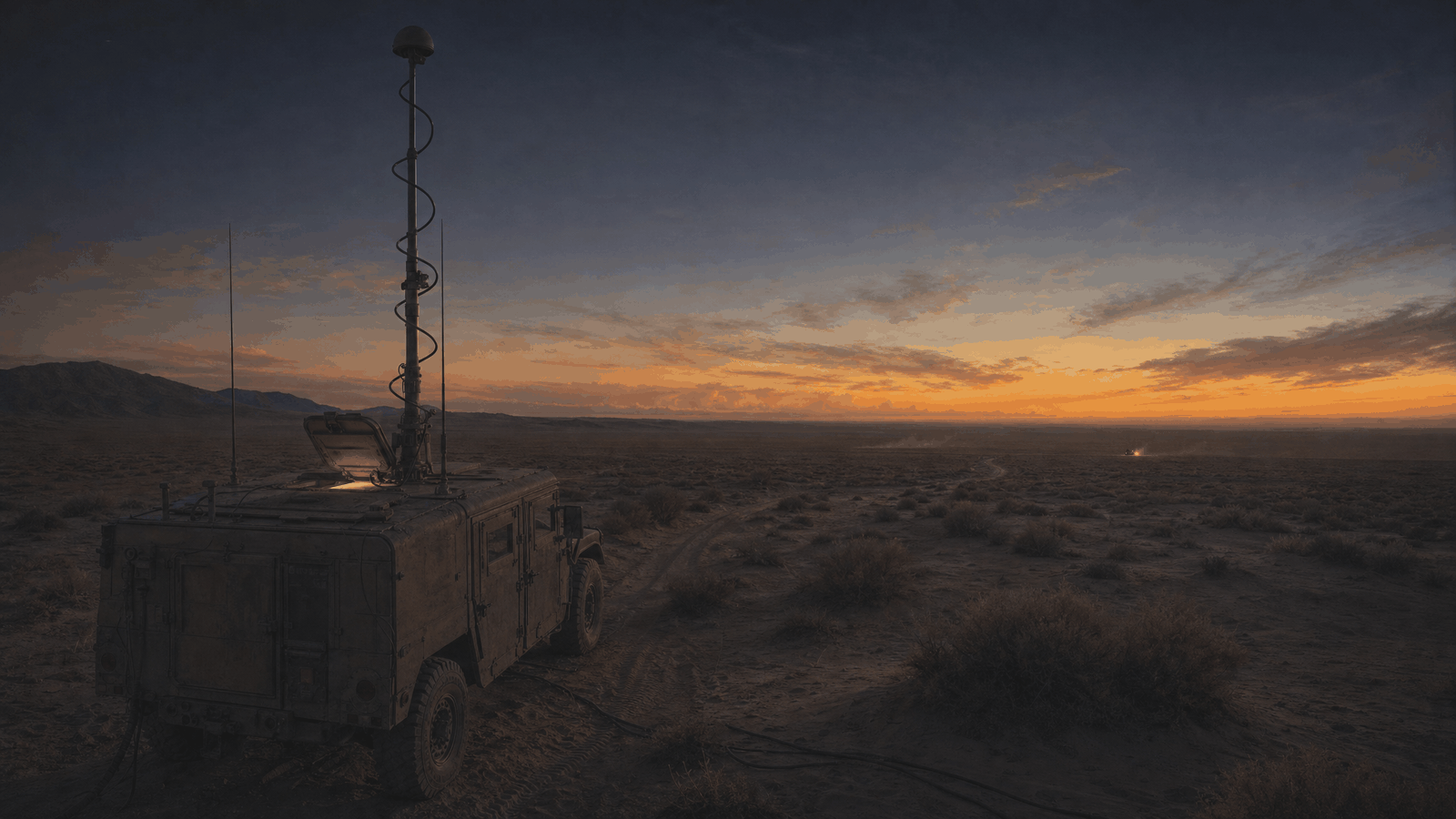
War on the Rocks, recorded 2026-11-04 at the AUSA annual meeting, with Lt. Gen. Matthew W. McFarland (I Corps) and Maj. Gen. Patrick J. Ellis (4th Infantry Division) on Next Generation Command and Control. Listening notes on which of the four layers holds pricing power, the limits of training-ground numbers, and command discipline once you can see everything. Educational, not investment advice.
Contents
- The starting point: one box per warfighting function
- August 2026: the prototype division finishes a lap
- Now: growing from division to corps
- The problem on the same wire: if you emit, you die
- If you’re wondering what this has to do with your portfolio
- Seeing everything and deciding to act are two different things
- Worth a look
- One thing to take away
A general is not governed by heaven above, nor by earth below, nor by men between.
—— Wei Liaozi, “Discourse on War” (Warring States; my own translation)
The 4 November 2026 episode of War on the Rocks was recorded on the sidelines of the AUSA annual meeting, where host Ryan Evans sat down with Lt. Gen. Matthew W. McFarland, commanding general of I Corps, and Maj. Gen. Patrick J. Ellis, commanding general of the 4th Infantry Division, to talk about the Army’s Next Generation Command and Control effort. Ellis said fire mission processing volume at the division level has gone to nine or ten times what it was, and that a last-minute fragmentary order to turn south and fight south was planned, rehearsed, synchronized and executed in about twelve hours with no commander in the same physical place. Those numbers come from National Training Center rotations and from Project Convergence Capstone 6, which finished in August — training-ground results, so hold them as that rather than as combat results.
The starting point: one box per warfighting function
Ellis described the Army’s old command and control as stovepiped: a system for every warfighting function, a box talking to a box, one for fires, one for intelligence, one for sustainment. The Army decided that had stopped working, took the problem to industry, and industry came back with a whole-stack answer. They cut it into four layers — transport at the bottom, which has to move the ones and zeros from any point on the face of the earth to any other; an infrastructure layer that pulls every system’s data into one coherent data layer; and applications on top, installed one by one the way you do on a phone. Taking a modern software development cycle and laying it over Army command and control is the design claim behind the whole thing.
McFarland described what it buys him: decision speed, which they call decision dominance. It rests on assured, resilient transport, so any point on earth can talk to any other. His example was Ellis the month before — connected on an aircraft flying to Indonesia, connected on a boat off the Indonesian shore, connected on the ground in Indonesia, all while tied into the corps headquarters at Joint Base Lewis-McChord and his own division headquarters at Fort Carson, Colorado. Over-the-horizon comms was a hard problem for the Army five years ago, and one of the two generals said it with a little self-mockery: we talked to a guy on the moon in 1969.
August 2026: the prototype division finishes a lap
The 4th Infantry Division was named the Army’s prototype division. Ellis draws a sharp line between experimentation and prototyping: experimentation asks whether you should do a thing at all, while prototyping means the Army has already decided, and told the division to go make it work. Project Convergence Capstone 6, which wrapped at the training center in August, closed out that lap.
The hardest number in it is fire mission volume, nine to ten times what the division could do before. Ellis kept his claim narrow: what he does hasn’t changed, the staff processes and the way they do business are the same, and the technology laid on top lets the same work move much faster. The common operating picture changed something else — he sees what his subordinate commanders see, so he no longer has to pull them into one physical location. “We always knew that was bad,” he said. “Now we don’t have to do that anymore.” He jumps onto their picture and they draw on it and show him. In that last big fight at the training center, spread across the whole box, the fragmentary order to turn south came in late, and planning, rehearsal, synchronization and execution took about twelve hours with commanders scattered everywhere.
McFarland added the staff layer. Some units still run a Napoleonic battle rhythm; now the staff estimates across the warfighting functions are generated automatically, humans still check them for accuracy, and the commander has a dashboard where he watches progress, sees the enemy, reads the terrain. The fourteen-hour meetings with a crowd huddled together lose a chunk of their agenda, because the information is already ready and valid.
Trainability surprised them. These young soldiers and officers got their first iPad at four — Ellis says they deny it — so the closer the architecture and the apps feel to what they already use, the faster they pick it up. One soldier showed up a week before the rotation deployed, went to the training center, and ran the division’s fires enterprise inside an application he had never personally used. A week was enough.
Now: growing from division to corps
The proven capability is being fielded to I Corps at Joint Base Lewis-McChord. Corps is the operational level, the operational warfighting headquarters for the Pacific, and the scale is different from a division’s: command posts from Honshu, Japan all the way down to Brisbane, Australia, and the job of tracking sustainment and munitions from the continental United States to the point of need at the tactical level where Ellis is. McFarland’s phrase is letting divisions “fight free” inside the corps area of operations — the corps gets predictive about what its subordinate units will need, strikes in what they call the corps deep area, and buys the division freedom of maneuver so Ellis can stay on his tactical fight.
Part of how the capability climbs is people. The 4th Infantry Division has started passing up lessons learned, and moving the people who built expertise up to the corps to help carry this from division to corps level. The 25th Infantry Division is running a somewhat different version.
The problem on the same wire: if you emit, you die
Evans put the tension on the table. Coming out of Afghanistan everyone was told the future battlefield would punish emissions, and Ukraine has played that out brutally over the last few years. So how do you trade distributed information sharing against survivability?
McFarland’s answer is that this enables disaggregated, distributed command posts and forces, with the ability to aggregate quickly, mass, and then disaggregate again — survival comes out of staying spread. Ellis took the technical side: give commanders multiple options, several ways out. He told a story about a low Earth orbit satellite receiver on top of one vehicle going down, with the other half of the node 1,500 meters away. The soldier noticed his computer was a little slow, called the other node, heard that their Starlink was down, and they connected over radio frequency to get back out — and the software had already rerouted the network by itself, which nobody there knew.
Vehicles inside a node were scattered up to 1,500 meters apart. Every 24 hours every one of those vehicles moved; every 48 hours the whole box of vehicles moved to a new area. The comms gear in the headquarters is the same gear the dismounted soldiers carry. The needle-in-a-haystack era is over, Ellis said; now you’re looking for a needle in a stack of needles. The opposing force commander at the training center had plenty of tools at his disposal and never found a command post node, and he was frustrated about it. Sharing data means emitting, and they admit that; the path they picked was raising the noise floor and hiding inside it, rather than trying to drop below it.
If you’re wondering what this has to do with your portfolio
A headline says some company landed a big defense software contract, the stock has already run, and you want to know whether to chase it. The episode doesn’t answer that, but it hands you a few clues about where things sit, and that’s the part I’d keep.
The first clue is the layering. The four layers are very different businesses. Transport has the hardest physical constraints — LEO terminals, multi-waveform radios, antennas — and when one path dies you need a second, so volume and redundancy are bound together. The data layer is integration engineering, with long contracts and high switching costs. The application layer runs on phone logic, anyone can write one, and a soldier inside the division produced one over a weekend that got certified into the environment. The chokepoint test surfaces on its own: which layer breaks first when demand doubles, and still holds pricing power after it breaks. The layer a soldier can write over a weekend does not.
The second clue is the timeline. The prototype division closed a lap in August, fielding to the corps is happening now, the 25th ID is on a different version — this is a line that is still growing, and one procurement is not a line. When a headline shows up I’d ask three things: which layer the company sits in, whether what it won is prototype-stage validation or fielding-stage volume, and what the next checkable milestone is (the next Project Convergence, the next corps to be fielded). The numbers in this episode point at the same caution: nine to ten times, twelve hours, zero command posts found by the opposing force, all produced under training center conditions. Capability gets validated in a different place from revenue.
Seeing everything and deciding to act are two different things
This is the section I sat with longest, because it maps onto watching the market. Evans asked about centralization versus decentralization: this toolset lets you turn people loose on commander’s intent, and it also lets you micromanage, and the argument has been running since the telegraph.
Ellis didn’t take the binary. He had five brigade commanders with five personalities; some needed more time to plan, some needed encouragement, some he just needed to get out of the way of. He framed it as a discipline problem for the commander: just because he can see those blue dots doesn’t mean he needs to maneuver a platoon, because that isn’t his job anymore. The division does shaping and strike — setting things on fire, breaking things, killing people in front of the brigades so they don’t have to.
His example is the one I liked best. In the last big fight at the training center a cross-attached battalion was supposed to secure the breach, and before it started Ellis told the commander: if you see an opportunity, go deeper than the breach, get us another terrain feature. That commander stopped working for one brigade, jumped into working with a different brigade, kept reporting back to his original brigade, and hopped between nets over radio-over-IP. Ellis could see his blue dot, so he didn’t need to bother him, and the trust moved faster because there was nothing to discuss first. The battalion took the terrain, the tanks passed through, and they were off to the races.
What I compare it to is watching my own screen. Live data puts every tick of every holding in front of me, and my record on the trades I made because I saw something is mostly worse than the times I left the plan alone. The word this episode gave me is discipline: once visibility goes up, decide first which things were never in my job to begin with. McFarland’s line lands on the same side — the visibility two levels up and two levels down is what he uses to get predictive about the sustainment and munitions his subordinate units will need, and have it ready.
Worth a look
- War on the Rocks, episode of 4 November 2026, hosted by Ryan Evans, recorded on the sidelines of the AUSA annual meeting
- The U.S. Army’s Next Generation Command and Control effort
- Project Convergence Capstone 6 (finished August 2026)
- The article Maj. Gen. Ellis wrote for War on the Rocks two years ago while helping architect this (mentioned in the episode; no title given)
One thing to take away
The person who can see the sailboat is already standing near you, and your job is to find them and hand them the real problem.
Ellis reached for the magic eye paintings at the mall to talk about change management: stare at one long enough and you see a sailboat, except not everybody can see the sailboat. So his question became how to find the people who can, and tell them, you’re going to be my guy. The first time he met the officer who ended up running everything that touches data in the division, he was calling to scuff him up about some side projects. A few weeks later Ellis signed into the division, brought him up, watched his palms sweat, and asked: you want a job? The answer was that he had not expected the conversation to go that way. Somewhere else in that division, a soldier got mad enough about the paper forms for preventive maintenance checks to write an app over a weekend, which was certified and deployed into the environment. And McFarland mentioned that one of Ellis’s best young soldiers at the training center had been an HVAC repairman before he joined — a 21-year-old specialist in an infantry battalion, leading the way on this. None of them were assigned the work. They were already doing it.
Something I’ve tried: pick one person near you — a colleague, a family member, a friend — and name one thing they do that nobody asked them to do, like cleaning up a spreadsheet, smoothing out some process, or answering everyone’s questions in some group chat. Today, say one thing to them: hand them a problem you’re genuinely stuck on, and ask whether they want to take it.
This article is an educational discussion of investment method. It is not advice to buy or sell any individual security, offers no target prices, and does not analyze any current holding. Investing carries risk; make your own decisions or consult a qualified professional.
Comments
Loading comments…