War on the Rocks | After the Iran War, What's Left in the Magazine
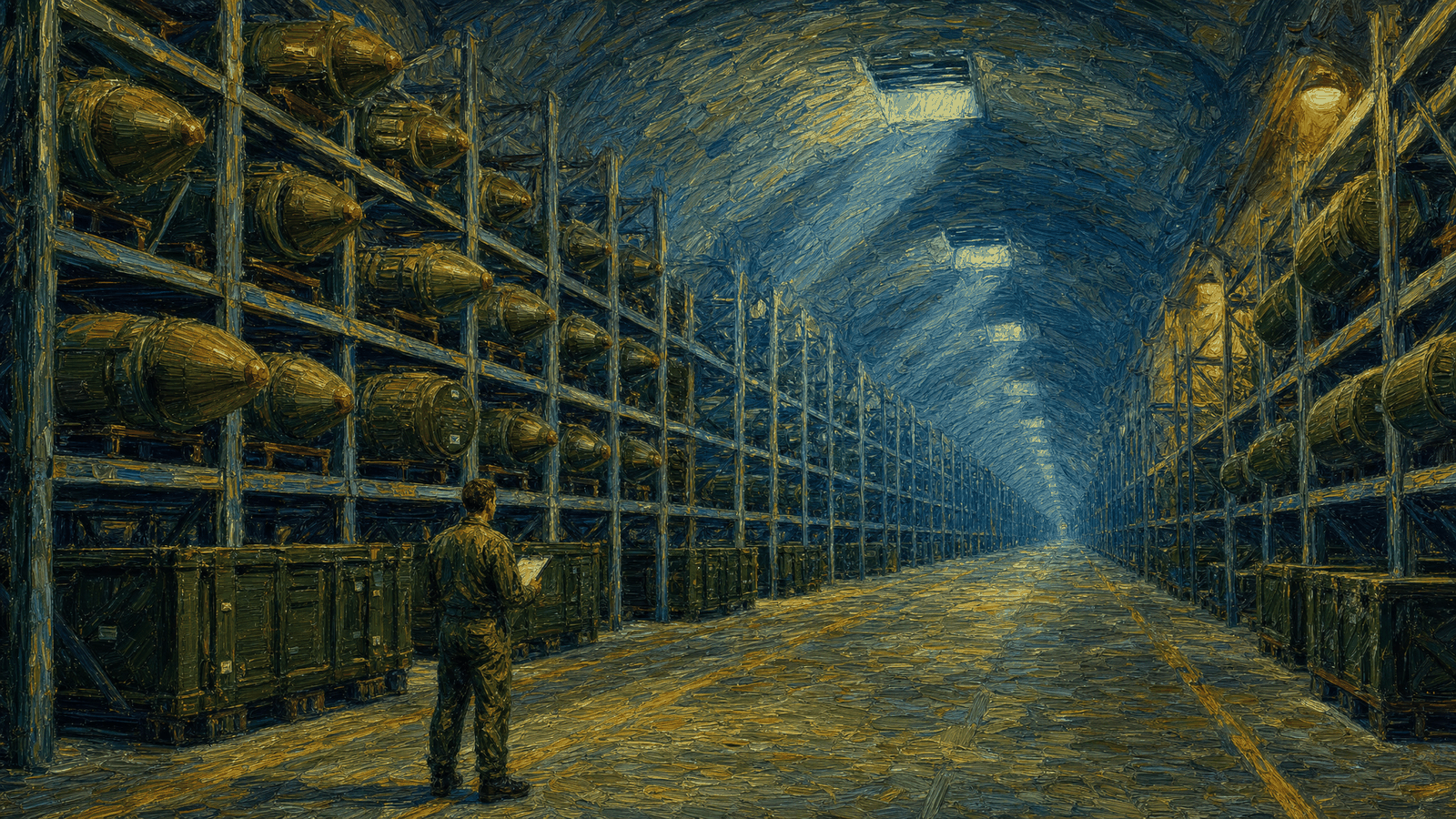
Listening notes on War on the Rocks, 2026-09-17, 'A Body Blow? The War on Iran and U.S. Military Readiness': interceptor stocks down 60%, why cheap drones don't close the gap, a carrier at sea for 200-plus days, and what China is watching. Educational reading notes, not investment advice, and not a recommendation on any security.
Contents
So the art of war teaches us to rely not on the likelihood of the enemy’s not coming, but on our own readiness to receive him; not on the chance of his not attacking, but on the fact that we have made our position unassailable.
— Sun Tzu, The Art of War, “Variation in Tactics” (Spring and Autumn period; translation by Lionel Giles, 1910)
What the episode is about
In the 2026-09-17 episode of War on the Rocks, host Ryan sits down with three defense analysts: Mark Cancian of CSIS, Stacie Pettyjohn of the Center for a New American Security, and Michael Eisenstadt of the Washington Institute. The question on the table is what “readiness” actually means, and what most of a year of war against Iran has done to it.
I expected a show for military hobbyists. Halfway through I noticed it runs on the same logic I use when I read a company’s capacity, inventory and depreciation — except here, running out of inventory kills people, and you can’t reorder.
The main points
1. “Ready” needs an object before it means anything. All three panelists open by dismantling the question. Readiness for a conflict with China is a conversation about munitions mix and forward posture; Cuba is a different ledger entirely. For twenty years the working definition was “ready to deploy,” because Iraq and Afghanistan wanted brigade combat teams that could go now. Readiness against a great-power adversary wants the opposite: conserve it, and train at the high end. One word, two contradictory uses.

2. The numbers: about half of seven key munitions expended, Patriot and THAAD down 60%, no substitutes. Cancian says that if you only look at CENTCOM’s books, Admiral Cooper’s “no concerns about munitions availability” holds up. Widen the aperture to INDOPACOM and the picture changes. Ballistic missile defense is the sore spot, and nothing else does that job. His line stuck with me: when you run out, you’re out — as the Ukrainians are finding out.

3. Pettyjohn’s counterintuitive call: ground-based interceptors are the wrong thing to worry about in the Pacific. In every wargame she has been in, the first thing the red team hits is the radars. With the radars gone, the size of the Patriot and THAAD stockpile stops mattering. The ship-based interceptors — SM-2, SM-3, SM-6 — are survivable, mobile, and can extend the regional air umbrella, and those have been drawn down too. Iran took out a billion-dollar-class radar in the opening days, and a THAAD radar in Jordan.

4. The allies’ queue will be longer than America’s. Gulf states have burned through their own interceptors. Every round coming off the line now has a line of customers behind it. Eisenstadt adds the cold part: those states have nowhere else to go. The stake here is the alliance itself — people getting shot at want to know whether you can cover them.
5. Cheap drones don’t fill this hole. Cancian sees a high-medium-low spectrum emerging, including a less expensive, less capable Patriot variant. Pettyjohn names the constraint: cheapness is harder on the defensive side, because interception needs a sophisticated seeker. A forthcoming report she wrote with a colleague models cheap drones in two missions against China — anti-ship, and striking coastal air bases. Assume interception rates like the ones Ukrainian drones meet going into Russia — 98% shot down — and the cost of an effective salvo sometimes exceeds the cost of an expensive missile. The value of these weapons is that you can build them fast and build a lot. A PAC-3, operating at the edge of several technology areas at once, is not something you make in a garage.
6. The joint force has bought around 500 LRASM. “Five hundred that’ll be gone in a day.” Eisenstadt follows with something closer to a method: bad news doesn’t get better with time. He reaches for October 1973, when Israel lost more than 2,500 soldiers in three weeks and had its force structure and doctrine exposed. Maybe some good comes of this one too, he says — then adds that digging out of this hole will take a while.

7. Wear is harder to replace than munitions. A carrier has been deployed for 200-some days; seventeen destroyers are holding the blockade line in the Gulf. Part of the fleet is built to be forward; the rest is doing back-to-back and extended deployments, which grinds down hulls and crews. The strategic bill: those ships are in the Middle East, not the Western Pacific and not the Caribbean. The PACAF commander has said next year’s exercises can’t run at this year’s scale.
8. Iran has been pruned into a harder shape. Eisenstadt reaches for the fruit trees in his front yard: you cut the secondary branches so the energy goes to the primary ones. This war removed much of Iran’s air force and navy — the less survivable, less productive parts — and left the best-protected and most effective components, the missiles and drones. They will double down there. That simplifies the targeting problem for the United States; the other face of it is that the adversary gets better at the one thing left, and the cost-exchange ratio on saturation attacks runs in their favor. Rebuilding drones takes months. Missiles take years.
Going further
”The budget got topped up and lines are expanding — is this my entry?”
This episode draws the road between “the money arrived” and “the thing exists” better than most research notes. The deputy secretary has been pushing capacity since he took the job, and there are more resources now. And then what? Lines don’t expand on command. Seekers, guidance sections, solid propellant — each has its own bottleneck layer, and the bottleneck usually isn’t sitting inside the listed prime contractor.
I’ve fallen into this myself: I saw the order number and discounted it, then found delivery scheduled three years out, with every quarter in between looking like nothing was happening. An order is an intention. Capacity is a physical limit. You can run the read in reverse: ask which layer breaks first, then who owns that layer, whether it can expand, how many years that takes, and whether the buyer still wants the product by then. When the break sits on a layer with pricing power, the story holds. When it sits on the prime’s assembly line, it’s usually a queueing problem.

“If the experts don’t know, what can I judge?”
The most human stretch of the episode is three people saying “I don’t know” into a microphone. How many anti-ship cruise missiles does Iran have left? Pettyjohn hasn’t heard, and suspects reporting bias. Eisenstadt offers range, or tunnels. Cancian says we know it’s enough to frighten shipping companies and insurers, and we don’t know whether what remains is harassment or something major. Their word for this war: not information-rich.
Listening to that, I thought about a mistake I make often — seeing an empty field and writing “none” in my head. Those are different things. My rule now: if a number has a second independent source that should have written it, I only call it zero when both are empty; if one side has it and the other doesn’t, I assume my reading broke. The episode hands you the example — three explanations for the missing anti-ship missiles, and not one of them is “therefore they don’t have any."
"What does a geopolitics story have to do with my positions?”
Most of the time, nothing, and I’d rather say that first. But there’s a portable structure here: the cost gets booked to a different ledger. The US military performed in the Middle East — air defenses suppressed, freedom to strike, very low casualties — and the invoice landed in the Indo-Pacific column: munitions spent, fleet reassigned, exercises shrunk. Ryan asks whether this hurt China. Pettyjohn’s answer is that China is content to sit and watch how the US fights, how it spends resources that won’t be replaced quickly, and where it pulls forces from.

The thing that might give Beijing pause is in the same episode: Iran has been pummeled and hasn’t conceded. Pettyjohn says that raises a question about Taiwan — how much a society will withstand to keep its independence. That variable appears on no firepower chart.
Back on our side of the table: a company’s beautiful quarter often books its cost somewhere else — deferred maintenance, overdrawn people, research quietly reallocated. I now ask one more question of a good result: who paid for it, and on which page is it written.
Worth a look
- War on the Rocks, 2026-09-17, “A Body Blow? The War on Iran and U.S. Military Readiness,” with Mark Cancian, Stacie Pettyjohn and Michael Eisenstadt
- Richard Betts, Military Readiness: Concepts, Choices, Consequences (1995) — the readiness classic the panel name-checks
- Brad Carson, “The Chicken Is Ready to Eat” — a pun carrying the point that “ready” means several things
- CSIS work tracking munitions expenditure, and the CNAS report on what cheap drones bring to a war with China (unpublished at recording)
- Post-mortems of the October 1973 war, the episode’s historical comparison for how fast a force changes after it gets hurt
The one thing to take away
The idea I’m keeping: “I’m ready” with no object isn’t a judgment, it’s a mood.
Cancian’s “ready for what” punctures a comfortable form of self-assessment — I have savings, I have experience, I have people, so I’m ready. Ready for which scenario? Which kind of consumption? Which supply runs dry first? Move the same preparation to a different scenario and it might last a day.
Here’s something I’ve tried, and it works outside investing: take something you’ve recently decided you’re ready for — a job change, a baby, caring for a sick parent, a big project — and rewrite it as a sentence with an object: “I am ready for ____.” Then write down the three things that run out first in that scenario. Usually not money: time, physical energy, or one particular person’s patience. Give each a number — how much is left, and how long one unit takes to replace. Some refill in months, some in years, some never. Mark those three separately, and which stretch you’re about to carry gets easier to see.

This article is an educational discussion of investment method. It is not advice to buy or sell any individual security, offers no target prices, and does not analyze any current holding. Investing carries risk; make your own decisions or consult a qualified professional.