Software in Silicon Valley, Hardware in LA: Notes from Odd Lots Live on American Reindustrialization
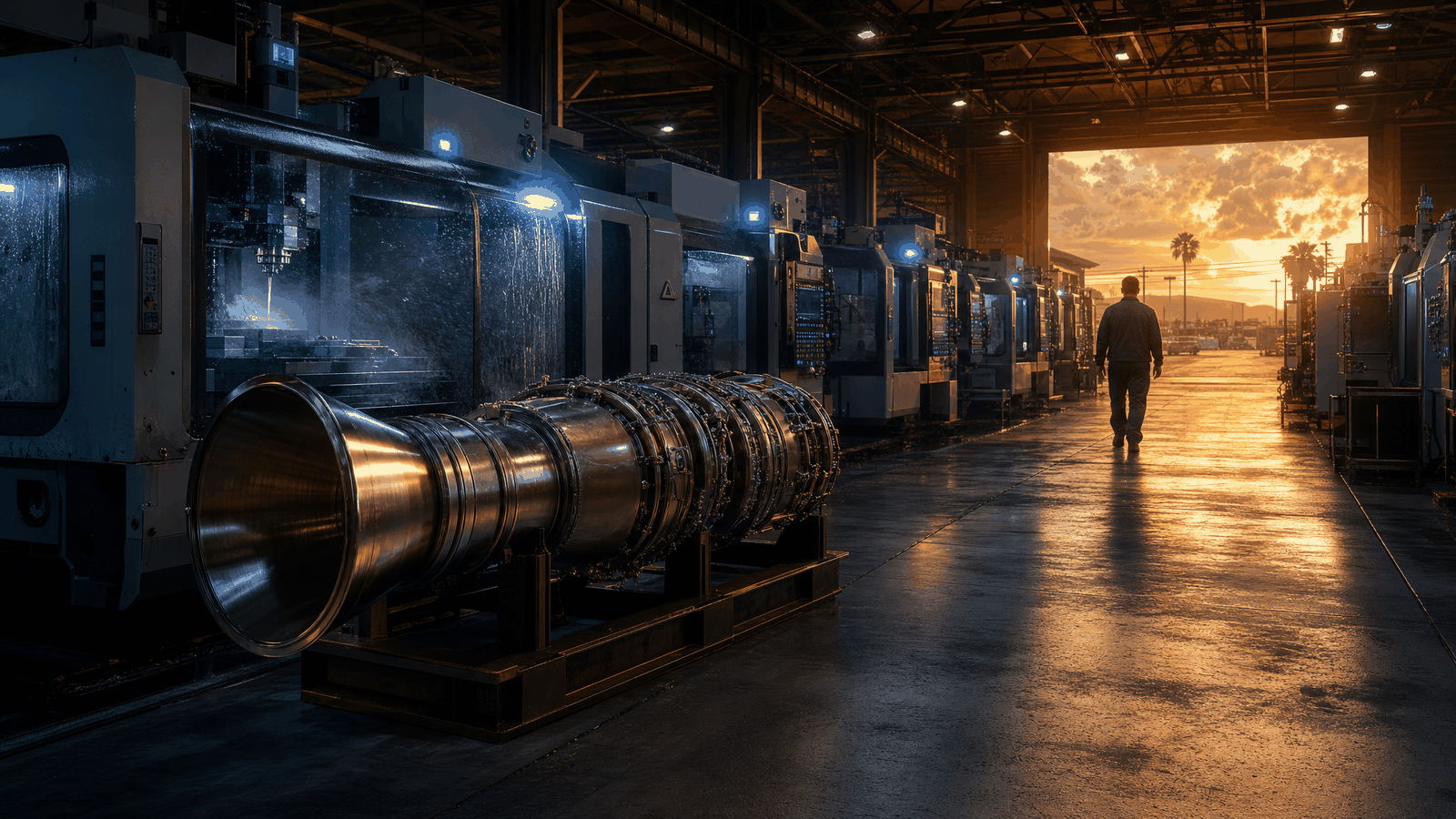
Listening notes on Bloomberg Odd Lots' live LA episode: where the bottleneck sits in autonomous factories, how to split in-house work from outsourcing, why tariffs cut both ways, and how to tell reindustrialization companies that build things from those that tell stories. Educational only; not investment advice and not a recommendation of any stock.
Contents
- What this episode covers
- Key points
- 1. One talks cycles, the other drops numbers
- 2. Joe’s pointed question: where’s the thing you built?
- 3. The autonomous factory is stuck on software
- 4. The other side of a cluster: poaching
- 5. Suffer through it yourself first, then hand it off
- 6. Tariffs: four inputs, a threefold gap
- 7. A question that went unanswered
- Further thoughts
- ”Reindustrialization” is everywhere. How do I tell who’s building?
- “Lights-out factories” are hot. Which layer is the bottleneck?
- A tariff headline hits. Who benefits?
- References
- One Thing to Take Away
Gongshu Ban carved a magpie from bamboo and wood. When it was finished it flew, and for three days it did not come down, and he thought himself the most skillful of men. Mozi said to him: “Your magpie is not as good as a carpenter’s linchpin. In a moment he whittles three inches of wood, and it bears a load of fifty dan. What benefits people is called skill; what does not is called clumsiness.” —— Mozi, “Lu Wen” (Warring States period; translated by the author)
A wooden bird that flies for three days, against a three-inch peg that holds a loaded cart together. The sharpest question the hosts asked on this episode was the same one Mozi asked.
What this episode covers
Bloomberg’s Odd Lots released a live recording on 2026-09-21, taped at the Vermont Theatre in Hollywood. Joe Weisenthal and Tracy Alloway talked with two people who build physical things in Southern California: Chris Power, founder of Hadrian, and Tom Mueller, founder of Impulse Space and SpaceX’s first employee, a rocket-engine engineer by training.
The topic was how Los Angeles is becoming a new hub for industrial tech, and along the way the conversation touched four things: how US manufacturing got hollowed out, what the humans in an autonomous factory actually do, when to build in-house and when to outsource, and whether tariffs work at all.
Key points
1. One talks cycles, the other drops numbers
Power offered a grand-history account. A great power rises on population and industrial capacity, wins or deters a war, and then gets lazy: it grows a financial industry and offshores the very thing that made it successful. The Netherlands handed off to Britain and Britain to America, and each handoff moved the world’s reserve currency, which by his count happens roughly every 150 years. His image for it was boxing. You think you’re Mike Tyson in his prime, but the other side sees Tyson right before the Buster Douglas fight. He added that in World War II German engineering was better than America’s, and America won on output and logistics: “We were China in World War II.”

Mueller just gave numbers. SpaceX launched 165 rockets last year, more than any country, and has put 10,000 satellites in orbit, three times everyone else combined. Then he turned it around: “So tell me again why we can’t build in the US?“
2. Joe’s pointed question: where’s the thing you built?
Joe admitted it was his most cynical question of the night. VCs and founders love going on podcasts to explain the decline of empires, so where is the thing you actually made?
Mueller answered with hardware in orbit. Impulse does in-space transportation. If you picture a huge launcher like Starship as a container ship pulling into an orbital “port,” Impulse supplies the delivery vans that carry the cargo onward from there. Three of its precision-maneuvering spacecraft are on orbit right now, and two of them just came within 200 meters of each other. Another product, Helios, is “a rocket on a rocket” that can raise a Falcon 9’s payload to the Moon or Mars by about five times.

Power answered with a product list instead: spaceflight components, entire missiles, and about 30% of a Virginia-class submarine (the US Navy’s nuclear-powered attack sub). He calls Hadrian “Foxconn to every defense brand,” building other companies’ designs under contract.
3. The autonomous factory is stuck on software
Tracy asked what the humans in an autonomous factory do. Press start and stop?
Power said outsiders see people moving parts around and assume it’s a humanoid-robot problem. In his telling, though, 90% of advanced manufacturing is two kinds of people: smart ones at a desk doing digital engineering, and smart ones on the floor “driving an incredibly dumb computer.” A machinist stands in front of a machine because it isn’t closed-loop, meaning it doesn’t measure and correct itself, so the machinist ends up doing trigonometry in their head and guessing whether the tool is about to break. Power sees that as a software problem. Once software closes the loop, the technician sets up the part, presses go, and walks away without worrying that one bad code change will crash a $3 million machine. Humans stay for judgment and for the fiddly, high-dexterity setup work. For me this was the part of the episode that mattered most, because it moves the bottleneck of the “lights-out factory” from robots to software.

4. The other side of a cluster: poaching
Joe had seen in Shenzhen that you can get a custom part made a mile away the same afternoon. Is Southern California building that kind of mutual support?
Mueller said both are happening, and so is a lot of poaching. Right across the street from his office is Northrop Grumman, formerly TRW, where he spent 15 years, and now he hires people out of that same building, and out of Boeing too. He described a chart of South Bay aerospace jobs that fell for years, turned up three or four years after SpaceX started in 2002, and now sits above the old peak. There are nuclear, drone, defense, and 3D-printing startups nearby, with Anduril further south in Orange County. He summed it up this way: software is done in Silicon Valley, hardware is done in LA.

5. Suffer through it yourself first, then hand it off
Mueller’s rule is to build your first development engine or spacecraft yourself, so the assembly and machining problems show up on your prototypes and you learn them there. Once the design is tight and you move into production, you send it out. Even SpaceX is now sending Raptor engine parts (the main engine on Starship) to Hadrian.
Power put numbers on it. Every company should keep 10% to 15% in-house for the hot part that “the one genius guy” has to make in an hour to hit a flight, but scale has to happen outside. In manufacturing, he said, you buy and sell trust, which is why Hadrian brings work in-house only where it doesn’t believe an outside shop will deliver on time. He’d rather put $2 million of equipment in the ground and hire a team than rely on a legacy casting facility “that’s been late for the last 30 years on every submarine program,” and he was clear that the call was about schedule, not cost. Mueller chimed in: a machine shop you can trust is gold.

6. Tariffs: four inputs, a threefold gap
Power splits manufacturing cost into four inputs: energy, labor, capex financing, and export tariffs. He has actually run the exercise. Set his factory’s labor and energy to zero, buy the raw material in the US, and for some commercial parts the result is still three times the price of the Chinese import. He reads that as the other side subsidizing all four inputs, and he gave the example of DJI drones costing $60 to make and selling to Americans for $20 (his claim; no source was given on the show).

So tariffs are meant to level the field, but the implementation leaks in two places. Ban China but not Singapore, and the goods just route through Singapore under a new label. Shift the line between raw material and “assembly,” and it’s US companies importing assemblies from Mexico that get hit. The better move, he argued, is to ban Chinese circuit boards from drones and robots outright and let the market absorb the cost. He also said both administrations got parts of this wrong.

7. A question that went unanswered
Tracy asked the most practical question of the night: both companies are richly valued, so money isn’t the constraint, which leaves labor or materials. Mueller took it, and ended up talking about AI possibly killing us before any war, and about reading Bostrom’s Superintelligence with Elon more than a decade ago and being scared. By the end of the answer the constraint was still unnamed, which was a little disappointing, since it was the question I most wanted answered.
There were human moments too. Power said every great company runs on one drug, Stripe on Adderall and manufacturing on nicotine and alcohol, and Mueller added: caffeine.
Further thoughts
”Reindustrialization” is everywhere. How do I tell who’s building?
This is my own confusion lately: headlines about manufacturing coming home every day, lots of companies wearing the label, and I can’t tell which have product and which have a story.
Joe’s question gave me a ruler: “Where’s the thing you built?” The two guests answered from different places. Mueller gave things you can check: three spacecraft in orbit, two within 200 meters. Power opened with a 150-year cycle and a Tyson metaphor, and got to the 30% submarine share only after being pressed.
The cycle story and the Tyson image are good listening, but they fit any American industrial company equally well. The same story can back any theme stock, so it doesn’t help me rank anyone.
What I do now is sort what a company says into two columns: things I can check (deliveries, units in orbit, customers and product lines) and things I can’t (civilization, cycles, national destiny). I only judge on the first column. I also log cases like point 7: when a question about the bottleneck drifts into a grand narrative, I wait for the next earnings call or interview to see if a concrete answer appears. I’m still practicing this; a good story still pulls me along.

“Lights-out factories” are hot. Which layer is the bottleneck?
When I hear “autonomous factory,” my first thought is that robot makers will sell a lot. Power’s answer made me slow down.
His chain of reasoning: people stand at machines because the loop isn’t closed; the loop isn’t closed because sensing and control software isn’t wired together; and judgment-heavy, dexterous setup work he still gives to people. By his account, his factory needs few humanoid robots. What’s scarce is the software and integration that ties machines together.
One layer further down, he is willing to spend $2 million to buy schedule certainty. A buyer paying extra for on-time delivery is a sign of pricing power. Through a bottleneck lens, the first thing to break when demand doubles is reliable, on-time capacity. Shortage alone doesn’t mean anyone profits; what matters is who can charge the premium.
The failure condition belongs on the page too. This is one private-company founder talking, and I can’t see his margins or contract terms. Checking it means reading delivery and pricing terms in comparable companies’ filings, not trusting the metaphor.
A tariff headline hits. Who benefits?
On the day tariffs go up, the stories say “US manufacturers win” and the related stocks jump. I used to take that at face value.
Power’s threefold gap made me redo the math. If zero labor and zero energy still leave a 3x gap, a tariff of some percentage doesn’t close it, and a headline is not an order book. Transshipment and definitions dilute the effect further. Joe raised the other side: imported parts that US factories must use get more expensive, so their own costs rise first.
So now I ask three things about a company: where its key components come from; whether what it sells counts legally as raw material or as an assembly; and whether its product falls in a category covered by component bans, like drones and robots. Tariff rates change with each administration, so I treat them as noise. Component bans change who is allowed into the supply chain, so I treat those as structure.
References
- Bloomberg Odd Lots, “How LA Is Quietly Becoming America’s New Industrial Tech Hub,” 2026-09-21
- Nick Bostrom, Superintelligence (2014)
- Mozi, “Lu Wen”
One Thing to Take Away
Build the first one yourself, and you’ll know what to hand off and whom to hand it to.
Mueller built his engines in his own shop and worked through the problems on prototypes before sending them to outside machine shops. Power keeps in-house only the piece he doesn’t trust others to deliver on time. Both touched the thing first, then knew where they could let go.
One practice I’ve tried: pick something you’re about to hand to someone else, whether a renovation, a report for a colleague, or a translation. Do a rough version yourself first, until you get stuck. Write down the first three places you got stuck. Put those three points in your instructions when you hand it off, and when the work comes back, check those three points first.
This article is an educational discussion of investment method. It is not advice to buy or sell any individual security, offers no target prices, and does not analyze any current holding. Investing carries risk; make your own decisions or consult a qualified professional.