Copper at Record Highs, Output Falling: Robert Friedland on Why Mines Get Harder to Dig
Notes after listening to Bloomberg Odd Lots (2026-09-12) with Ivanhoe Mines founder Robert Friedland: falling ore grades, sulfuric acid and equipment lead times choking the supply chain, and a valuation model that shrank the mining sector. Educational only; not investment advice and not a recommendation of any stock.
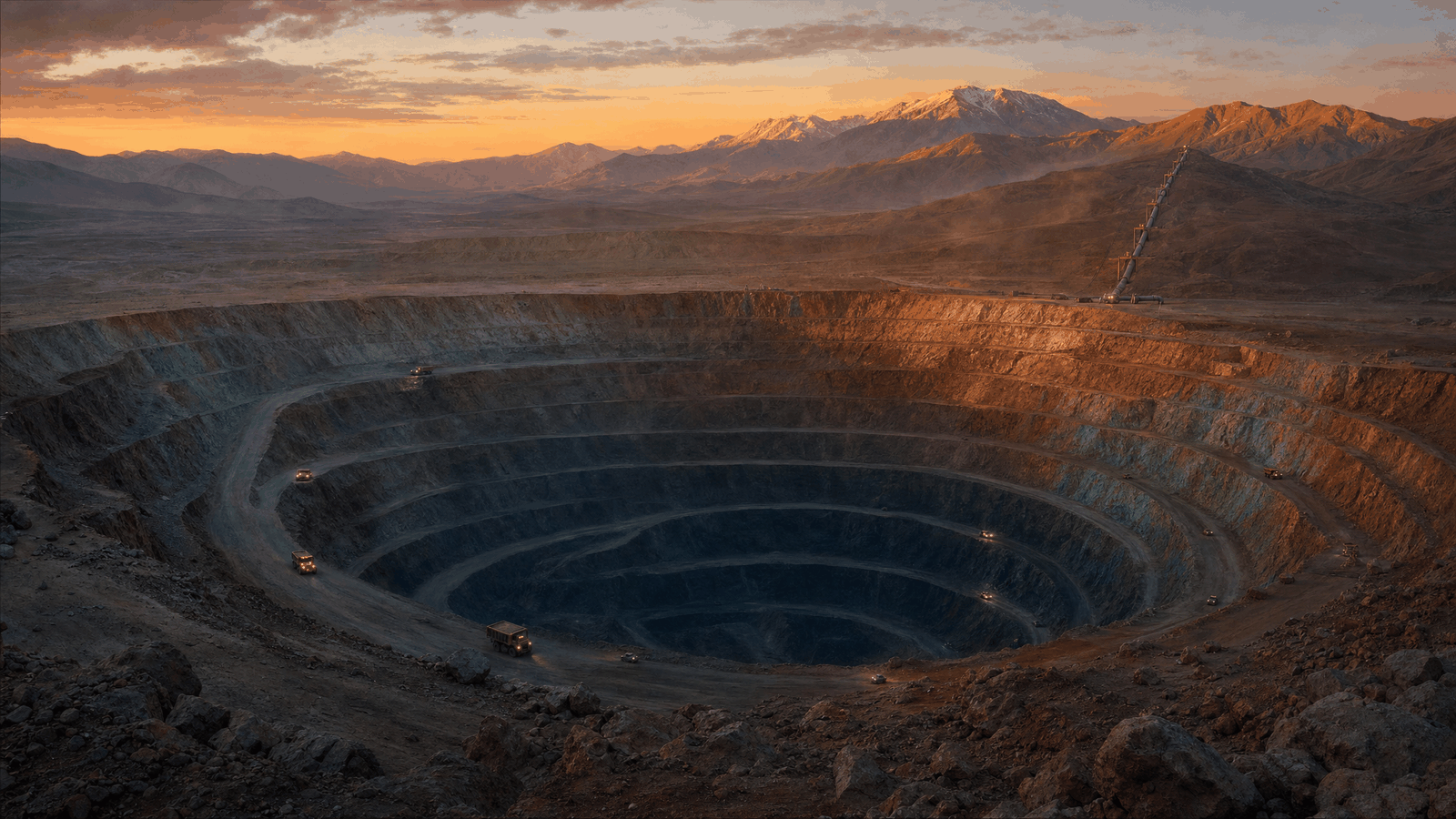
Four hundred and sixty-seven mountains yield copper; three thousand six hundred and nine yield iron. From these the land is divided and grain is sown; from these spears and halberds come forth, and knife-money arises.
—— Guanzi, “Earth’s Numbers” (Warring States period; my own translation)
More than two thousand years ago someone counted the copper mountains under heaven, found one for every eight iron mountains, and tied them to weapons and coinage. After this episode I think Friedland is telling the same story: copper is scarce, war needs it, and money needs it too.
What This Episode Is About
On the September 12, 2026 episode of Bloomberg Odd Lots, hosts Joe Weisenthal and Tracy Alloway talked with Robert Friedland, founder of Ivanhoe Mines. He has spent more than forty years in mining and has found large copper deposits in Mongolia and the Congo. The week they recorded, copper touched about $14,875 a ton, and Tracy cited a BNEF note saying global copper output this year may post its first decline since 2017. Price at the top, production heading down: the whole episode tries to explain that contradiction.

His origin story deserves a mention first. In the 1980s he and Steve Jobs were partners. They borrowed from Bank of America against Jobs’s Apple shares and bought timberland, planning to “live in a teepee and get rich” as rich hippies, because Douglas firs left alone grow about 6% a year. The Oregon land they bought held an old gold mine shut in 1942 by a Roosevelt executive order that forced miners to dig copper and zinc for the war. For three years the penny was made of zinc, because copper was reserved for the war. That gold mine was his door into the industry.
Key Points
1. Eighteen years to mine ten thousand years’ worth. Friedland says humanity has mined about 700 million tons of copper since Mohenjo-daro. To recover it you would have to tear down everything in the United States (about 300 million tons) plus roughly 200 million each from Europe and Asia, and go back to the days of the woolly mammoth. By his estimate, just holding global growth at 3%, without electric cars and without data centers, requires mining that same amount again in the next 18 years. People inside the industry, he says, don’t see that as possible.

2. The world’s largest copper mine is running out of grade. When Chile’s Escondida was found, its grade was close to 2%. Today it is 0.8%, and he expects 0.4% within two years. Halving the grade sets off a chain: the same copper needs twice the rock; deeper rock is harder; rock must be ground to talcum powder to free the metal, and 4% to 5% of all energy on Earth goes into that crushing and grinding. The mine sits at 12,000 feet in the Atacama, where it hasn’t rained in 30,000 years, and each cubic meter of rock needs two cubic meters of water. So the owners built a $4 billion desalination plant and pump water up from sea level, at a million dollars a day in electricity. He says they are modeling another $10 to $12 billion of investment, and production will still decline.

3. Sulfuric acid, an obscure input, sits in the middle. About a quarter of the world’s copper is recovered by leaching with sulfuric acid, and a large share of that acid comes as a byproduct of Middle East natural gas. With the Strait of Hormuz disrupted, he says acid went from $150 a ton to well over $1,000 in eight months, and Russia and China have banned exports. Acid also goes into fertilizer and semiconductors, so this line runs all the way to food prices. Friedland’s company built the largest copper smelter in Africa, which produces sulfuric acid as a byproduct, and he now sells it to fellow miners in the Congo.

4. The pump money couldn’t buy. This is the story I remember most. A Congo mine flooded after a seismic event and needed pumps moving 1,300 liters a second over a lift three Eiffel Towers high: nearly three meters in diameter and 80 to 90 feet long, lowered down the shaft like rockets. The Americans said they couldn’t build them. The Germans said no. The reason was samarium-cobalt magnets they couldn’t get. Only a Chinese maker could build them, in 30 days, and it did so because China was buying that mine’s copper. While flooded, the mine lost about $15 million a day in revenue. Money was beside the point, he said; the only question was who would sell him a pump.

5. Equipment lead times are longer than building a mine. When he built the first phase of Oyu Tolgoi in Mongolia (now roughly the fourth-largest copper mine in the world), the grinding mills were about forty feet across, and the ring gear took four and a half years to arrive. Today he puts it at eight to ten years, if ever. The gas turbines data centers want take six to eight years, and the fine print carries a force majeure clause: if a metal can’t be sourced, no delivery. His analogy: a 747 has four million parts, and with one missing it doesn’t take off.

6. A valuation model flattened the mining sector. He takes aim at net present value. The model was built for oil fields, which deplete fast without new investment, so discounting future cash flows makes sense there. A mine with a hundred years of reserves doesn’t deplete that way, and the same model discounts its distant value down to little. He says mining companies in aggregate are worth less than 1% of the S&P 500, an all-time low; for thirty years capital flowed to the internet, broadband and streaming, while China bought up the supply chain at low prices.

7. He argues both sides of tariffs, and names a variable nobody can measure. Copper fell about 3% on the recording day after a report that the White House hadn’t decided on refined copper tariffs. Friedland declined to take a position but laid out both sides: copper at $6 a pound plus a 30% tariff becomes $7.80, enough to pay union miners over $100 an hour; the cost is domestic inflation, with midterms approaching. He added that governments are hoarding copper as a proxy for money without reporting it, so no one outside can compute the real supply-demand balance.
Further Thoughts
Copper is at a record. Does that mean miners are cashing in?
That was my first reaction during the Escondida section. Rising copper prices should make the people digging it happiest, right?
Break it down and a miner’s profit is price × volume − cost. This episode moves all three. Price is up. Volume is down because grades are falling. Costs — power, water, acid, equipment — are rising, and part of that rise comes from the falling grade itself: twice the rock means twice the water pumped uphill. A mine spending $10 billion-plus just to slow its decline books that as capital spending, and shareholders don’t get it back.

So I started asking a different question: in this price run, which layer of the supply chain does the money flow to? The pump story answers part of it. The mine was losing $15 million a day. It was short of copper, and the party that decided when it could restart was the Chinese maker holding the samarium-cobalt magnets and the factory that could deliver pumps in 30 days.
If I wanted to check the answer, I’d look for three numbers: whether a company’s production guidance points up or down, whether its sustaining cost per ton is rising, and how much capital it spends for each added ton of capacity. The copper price is the column everyone sees; those three columns decide what shareholders end up with. The episode doesn’t say which company holds up on which column, and I don’t know either.
How should you hear a number like “eighteen years to mine ten thousand years’ worth”?
Friedland thinks big and talks in metaphors; Tracy laughed that he has a way with them. I enjoyed every minute, and I also kept in mind that he founded a mining company, and the bigger the copper-shortage story, the better for his industry. That doesn’t make him wrong. When I listen, I keep the numbers and the speaker’s position in separate boxes.
My habit is to break a big narrative into “what has to be true for this to hold.” The 18-year figure rests on at least three assumptions: 3% growth, constant copper use per unit of GDP, and recycling that can’t close the gap. Each can be questioned: could substitute materials cut copper intensity? Could recycling rates rise? The episode doesn’t go there, and at the end Tracy herself said she didn’t hear a lot of solutions.
Then separate noise from structure. Copper dropping 3% on a tariff report that day is noise. Escondida’s grade going from 2% to 0.4% is geology, and no headline changes it. I’d write down the structural items and revisit them: grade reports from the big mines, the year-over-year change in global output, sulfuric acid prices. If they move the way he says, the story still stands; if one reverses, I know which part to rethink.
Joe added an observation at the end that I agree with: every layer of the chain has its own backlog. To build more mines you wait for earth-moving equipment; for the equipment makers to expand, they wait for gallium or some other critical metal; one layer further up, the mines for those metals are waiting on their own equipment.
References
- Bloomberg Odd Lots, “Robert Friedland on the World’s Monumental Shortage of Copper,” 2026-09-12 (bloomberg.com/oddlots)
- BNEF’s estimate for this year’s global copper output (cited by Tracy on the show; possibly the first decline since 2017)
- Bob Dylan, “Subterranean Homesick Blues,” 1965. Friedland quoted its last line on the show: “The pump don’t work ‘cause the vandals took the handles.”
- Guanzi, “Earth’s Numbers”: the count of copper and iron mountains, and where weapons and coinage come from
- Resolution Copper (Arizona): Friedland’s example of a project that has sought a permit for 35 years
One Thing to Take Away
Where something gets stuck is decided by the longest lead time in the chain. However strong the demand, things move only as fast as the slowest link. Friedland could find the ore and raise the money; what stopped a whole mine was a ring gear with a four-and-a-half-year wait and a magnet no one could buy.
One thing I’ve tried: pick something you’re waiting on and keep wondering why it isn’t done yet — a renovation, a move, an application, a project at work. Break it into steps, and next to each write how long it takes and who you’re waiting on. Circle the box with the longest wait, and today make the one call or send the one email that gets that box moving.

This article is an educational discussion of investment method. It is not advice to buy or sell any individual security, offers no target prices, and does not analyze any current holding. Investing carries risk; make your own decisions or consult a qualified professional.