Cheeky Pint: The Airline CEO Putting Starlink on Every Plane
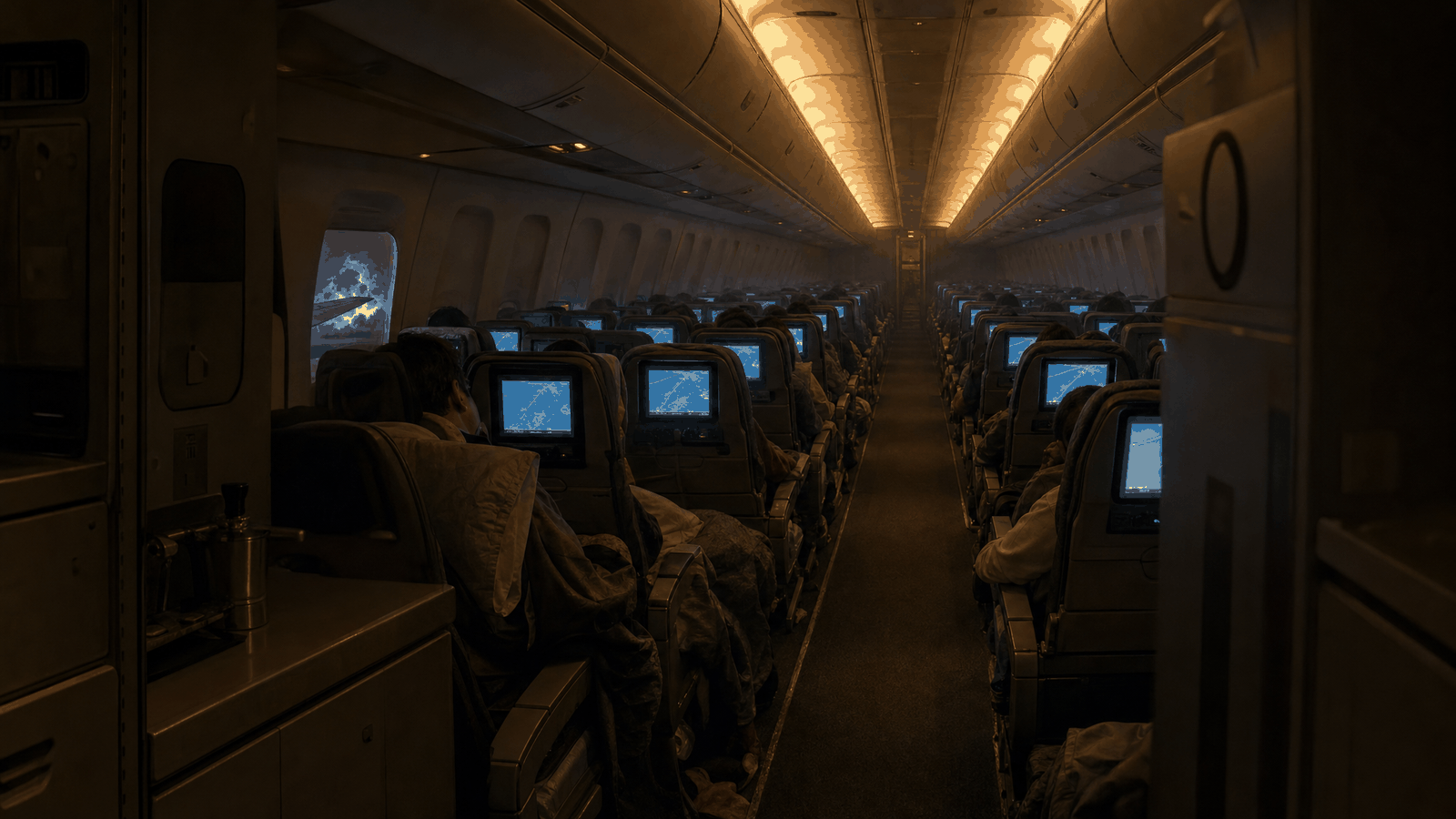
Notes on Cheeky Pint's 27 October 2026 conversation with United Airlines CEO Scott Kirby: at recording, 48% of United flights had Starlink with about three aircraft converted per day, he argues speed rather than free access is the proposition, and he says the lead lasts two to three years before the real ceiling — US air traffic control — binds everyone. Educational listening notes only, no investment advice, no price targets, and the judgements here may be wrong.
Contents
- The Saturday morning he took his laptop into the gym
- What he was really complaining about was a map
- The reason he can touch that map was buried in 2020
- That same year, he ordered two hundred widebodies
- That same logic now goes by the name Starlink
- He won’t let anyone use weather as a reason
- The one thing he cannot buy
- Everyone says it’s impossible — what gives me the right to take the other side?
- This thing I own keeps losing money — cut it or hold it?
- Sources worth checking
- One thing to take with you
Whoso would be a man must be a nonconformist.
—— Ralph Waldo Emerson, “Self-Reliance” (1841)
In the 27 October 2026 episode of Cheeky Pint, host John Collison sits down with United Airlines CEO Scott Kirby. At the time of recording, 48% of United’s flights had SpaceX’s low-earth-orbit network Starlink installed, with roughly three aircraft converted a day, and Kirby says the number crosses 50% within a week. He is blunt about the proposition: customers want speed, and free access is worth nothing to him — he has flown each of three competitors with free onboard Wi-Fi two or three times and describes the speed as slower than dial-up. He also says the lead is temporary, two or three years before everyone else has it, so the real wager is whether that window converts loyalty. And he names the ceiling nobody can buy their way past: the US air traffic control system.
The Saturday morning he took his laptop into the gym
Kirby says his view of AI flipped only in the past eight months. Summarising documents, summarising his day — he has no use for any of it, and says he can read his own calendar. What changed his mind was programming. He hired a tutor, took three one-hour sessions, then got up one Saturday morning, carried his laptop down to the home gym, and typed between sets while the thing ran. Two and a half hours later he had a web page: a few dropdown menus for sport, dates and bet type, and when you hit go it pulled odds from four sportsbooks, took your dollar amount, and placed the bet at whichever book had the best line.
He calls it his epiphany, and he phoned the team that same Saturday to say they were all in. What stays with me is the order of events: he built something himself first, then issued the instruction. Most people in a company discussing AI have nothing of their own on the table, so what they are discussing is somebody else’s conclusion.
What he was really complaining about was a map
He says he only worked out later that his frustration with the seatback entertainment screen was concentrated in the map. He wants the map up the whole flight, wants to zoom in and out, and the stupid thing keeps flipping back to a view of the globe — he knows roughly where he is on the globe without being shown. The system already knows his name and his birthday when he logs in, yet it cannot remember that he only wants the map. So United took the map software off Panasonic, the whole software stack with it. Owning it opened other things up: the moment you cross two million miles, a counter appears in the corner of the screen, counts down, then celebrates, and the flight attendants know exactly where over the country you crossed the line. He says the idea came from the book Unreasonable Hospitality — create memories for people — and it was unbuildable while the software belonged to somebody else.
The reason he can touch that map was buried in 2020
In 2020 every airline was cutting, and United chose that moment to start a several-hundred-million-dollar project: off the mainframes, onto the cloud, and the databases rebuilt so the data could actually be reached. He says the most valuable line in the episode, to my ear: there was no ROI on it, no payback, which is why companies don’t do it. What it bought was speed — he says United now does things competitors cannot, because their stack is wrong.
The migration itself was its own bet. Turning off a core mainframe wired into everything and turning on the replacement, they simply did not schedule several hundred flights in that window, so if it went wrong no customers were in harm’s way. It went off without a hitch.
That same year, he ordered two hundred widebodies
During the pandemic every expert in the world said travel demand would be down 50% forever, and every long-haul airline on earth except United permanently retired part of its widebody fleet. Kirby judged the premise wrong: COVID would be deep and long, and then it would end, and travel demand would come back. So United placed the largest aircraft order in history — 200 widebodies plus several hundred narrowbodies, at a list price he puts around $400 million per widebody, against a large discount.
The board thought the risk was enormous. His answer: because everyone else is shrinking, we don’t have to be right, we just have to be not totally wrong. He says people in Silicon Valley do this all the time — find something where your view differs from everyone’s, then go big; the upside is huge and the downside is small, so go looking for that shape.

He then takes apart two standing errors in human nature. One is extrapolating the present into the future, assuming whatever is happening today continues. The other is trusting surveys: travel experts asked people whether they would ever fly internationally again, and people answered no while everyone around them was dying. He says that was their honest answer at the time, and of course they went back to travelling once it was over. His own rule is clean: use surveys to ask how people felt about what you already did, never to ask what you should do next. As for experts, he says they live inside two standard deviations and force-fit everything into shapes they have already seen, so when the tails arrive they are wrong across the board — and in finance the value is all in the tails. Back in the nineties, doing his master’s, he was already arguing about value at risk: the model assumes everything is normally distributed, and so things that should not happen in the history of the universe happen every five years.

That same logic now goes by the name Starlink
Starlink went onto the small aircraft first because every aircraft type needs its own certification from the Federal Aviation Administration, and the Boeing 787s are still stuck at that stage. Delta’s decision not to take it was a mistake, he says, while also explaining why it looked rational: the industry’s habitual pace for modifying a fleet type is eight years, and against an eight-year ruler, being a year late is nothing.

Once the first aircraft was flying, the anecdotes started coming back: I’m switching to the regional flight because it has Starlink. One of the hosts offers a finer version — he was booking a flight that week and scheduling around a ball game, and if he could have been certain of Starlink he would have booked straight through the game. The gap between “maybe” and “definitely” is wide. So United shipped a Starlink flight tracker that same day, and plans to show the probability of Starlink on your specific flight in the app: on one aircraft type it is 25% today, but 36% if you are booking for Christmas, because they know how many they plan to have done by then.

He won’t let anyone use weather as a reason
One day the sky over Chicago was sunny, and a line of thunderstorms sat across the departure routes, which were closed. The standard “delayed due to weather” text lands with a customer standing in the sunshine, convinced you are lying. That day they split the customers with a one-hour delay in two: half got the usual text, half got a picture of the radar map showing the line of thunderstorms they would have to fly through and the routes closed as unsafe. He says the NPS — net promoter score, a satisfaction measure running from minus a hundred to plus a hundred — differed by 120 points between the two groups. The group with the picture weren’t merely not angry, they wrote back to say thank you, and he says that scored higher than an on-time flight. People can take bad news. What they cannot take is not knowing what is happening.

A host suggests this is expectation management, and Kirby pushes the term away on the spot: he wants communication. Framing weather as “weather happens sometimes, you should expect it” is an excuse; he told the operations team at a previous employer that anyone who said the word “weather” in his presence would be fired.
Then he goes to Denver. Winter storms there are the easy case; the hard case is summer pop-up thunderstorms, because a lightning strike within three miles of the airport closes the ramp for half an hour and nobody is allowed outside. But storms usually travel west to east, so a strike three miles east of the airport need not close anything. The FAA cannot know in advance where the storm will sit, so it takes the worst case and pulls down traffic into the airport ahead of time. He says they have started running AI simulations using different arrival and departure routes, and that 50% to 75% of Denver’s summer weather-driven delays could come off. That step still needs the FAA’s cooperation.
The one thing he cannot buy
Asked what limits the business most, he says air traffic control, and that air traffic control is 90% of the issue. He speaks up for the current FAA first — the best in his career, making more progress than ever — and then points at the structure: these capital projects run five to ten years, while the budget is written annually. The year starts, appropriations get delayed by a shutdown, approval may land two months into the fiscal year, then three months to ramp up, four months of work, and the last three months shutting the project down because authorisation stops at twelve.

The second problem is geography. Controllers don’t need to be at airports — they mostly sit in basements looking at screens, and could be consolidated anywhere in the country. Instead there is a facility in every congressional district, because the conversation on Capitol Hill is how many jobs you will put in my district. Four hundred and fifty facilities means four hundred and fifty chances for something to go wrong. He also points at the money: airlines pay 100% of the FAA’s fees and private jets pay close to nothing, and that is a powerful lobby. He says he is not advocating privatising air traffic control, because politically it is toxic.
The consequence has already started. The FAA has capped the number of flights in New York, it happened in Chicago this summer, and he expects it in more places. There is more room in the sky, and the amount that can be managed is the limit.
Everyone says it’s impossible — what gives me the right to take the other side?
This is where I get stuck: they are the experts, they are the majority, and who am I to bet against them. Kirby’s answer contains no claim to being smarter — the bet was affordable because of the shape of the odds, which has nothing to do with how sure he was. Everyone else was shrinking, so he didn’t have to be right, only not totally wrong.
That makes a usable check before you act: before taking the other side of a consensus, write out what happens if you turn out to be only half right. If the answer is that you are still standing and can still adjust, the size of the bet is right. If the answer is that being half right already ruins you, then however good the argument is, that isn’t the size to bet.
I borrowed his survey rule too. I used to ask friends whether I should write about some topic, everyone said sure, sounds good, and then nobody read it. Now I ask people who read the last one which sentence they remember. The answers are harder to hear, and they are useful.
This thing I own keeps losing money — cut it or hold it?
Kirby says plenty of newly appointed airline CEOs call him, and he opens with the same line every time: the route network is the foundation, and if it is broken, nothing else you do well matters. Then, he says, open the route P&L and you will find a pile of money-losing flying, and when you ask about it, people will tell you it is strategic. His test is brutally memorable: if you hear the words “strategic flying”, you don’t need to know which hub or which route — cancel it.
His own record: ten years ago United had 23 transatlantic destinations, next summer it will have 53, and only two didn’t work. Bergen, Norway was one of them — he likes Norway, he thought it should have worked, it didn’t, the loss was small, and they stopped. That, he says, is the advantage of their assets being fungible: they can try things and they can stop.

Then set Spirit beside that. He says New York airports now cost $52 per passenger, and Spirit’s average fare before it liquidated was $58. Out of 58 you pay 52 before fuel, before aircraft, before employees, before maintenance, and the arithmetic doesn’t close. The low-cost premise was always to fly to low-cost airports, and the US low-cost carriers abandoned it one by one, flying into New York, Chicago and San Francisco.
So on “cut it or hold it”, I start by sorting which kind of loss it is: the kind that is still an experiment, affordable, and stoppable, versus the kind where the arithmetic itself doesn’t close. The first can be held a while. The second never improves with holding.

Sources worth checking
- Cheeky Pint, episode published 27 October 2026, host John Collison in conversation with United Airlines CEO Scott Kirby
- United’s own Starlink fleet progress page and flight lookup, for checking the installed percentage and aircraft types
- FAA published air traffic control modernisation documents and annual appropriations records, against which his description of the budget cycle can be checked
- Unreasonable Hospitality, which he names as the source of the small seatback-screen touches
One thing to take with you
Same one-hour delay, and the group that got the radar map wrote back to thank the airline. The difference is whether what you hand over is a reason or evidence: a reason can only soothe, while evidence lets the other person see it for themselves. People can take bad news; what they can’t take is having no idea what is going on.
Something I’ve tried: pick one thing this week where you’re going to make someone wait — a draft running late, an answer that isn’t settled, you arriving half an hour behind. Instead of writing “sorry, I might be a bit late”, attach a piece of evidence: a screenshot of exactly where you’re stuck, a map of where you are, your reasoning for the hour you’ll deliver. The first time I did it I felt awkward, like I was constructing a longer excuse, and what came back was “thanks for telling me”.
This article is an educational discussion of investment method. It is not advice to buy or sell any individual security, offers no target prices, and does not analyze any current holding. Investing carries risk; make your own decisions or consult a qualified professional.
Comments
Loading comments…