Caibaogou Ep.571: A Six-Month Payback, and a Machine You Wait Thirty Months For
Listening notes on Caibaogou episode 571 (22 October 2026): at the SpaceX earnings call the AI segment posted US$7.56bn in quarterly revenue, up 830% year on year, overtaking Starlink's US$5.25bn for the first time; the same week at the TPCA show in Taipei, some PCB machines carried 30-month lead times. Educational notes only — no investment advice, no price targets, and the judgements here may be wrong.
Contents
- Two weeks earlier: a flying car buried someone else’s launch event
- Before the call: the market was busy pricing a default
- The day of the call: the biggest revenue line changed hands
- Six months to payback, so the money keeps going in
- The same week in Taipei: relationships are for queue-jumping
- Circuit boards are moving indoors
- What to watch next: the day lead times get shorter
- A dollar in, ten dollars of revenue out
- Further reading
- One thing to take away
I have heard it said: the merchant lays in furs in summer and fine linen in winter; in drought he lays in boats, in flood he lays in carts — so as to be ready when the thing runs short.
—— Guoyu, “Discourses of Yue I” (pre-Qin; words of the minister Zhong; translation mine)
In Caibaogou episode 571, published 22 October 2026, hosts Weiyu and Sky cover two things that happened in the same week. First, the SpaceX earnings call: the AI segment booked US$7.56bn of quarterly revenue, up 830% year on year, overtaking Starlink’s US$5.25bn (up 69%) for the first time, with that revenue coming from renting out its own data centres to model companies such as Google and Anthropic. The episode notes Musk saying the payback period on compute investment next year runs around six months, against the twelve months Google had previously described. Second, the TPCA show in Taipei, which Sky walked that day: every booth running flat out, and some circuit-board machines quoting 30-month lead times. The two sit at opposite ends of one supply chain, and whether either delivers depends on whether all that money can actually buy chips and equipment — which is the part Sky doubts most.

Two weeks earlier: a flying car buried someone else’s launch event
The hosts open with the flying car. The interesting part is a detail: someone photographed the underside of the demo vehicle and it was hollow. The shape says car; the structure inside bears little resemblance to whatever gets built. The reading in the episode is that Musk maxes out whatever can be demonstrated and strips out everything else. Pre-orders flooded Taiwanese social feeds all day at around NT$1.5m, in three tiers, with the cheapest unable to fly and the flying version available by invitation. Weiyu jokes he would not want one that cannot fly, then imagines a crowd testing its jumping on mountain roads and staircases.
Sky files the whole thing under capability demo. It will not carry Tesla. The weight of this episode sits in the next half hour.
Before the call: the market was busy pricing a default
This is the piece of background I most wanted to keep. Ahead of the SpaceX call, people had spent weeks discussing its financing costs, taking credit default swap quotes and backing out an annual probability of bankruptcy. A research report around the same time described one cloud operator’s position as dangerous, which the market read as the whole AI complex being dangerous, and AI names traded heavily for a stretch.
Sky has no patience for that back-solved probability. His point, roughly: bankruptcy is one or zero. If it does not happen, nothing happened; if it happens, it happened. The probability tells you nothing. I paused there, because I used to get nervous at those numbers myself. What he means landed later: that figure describes how frightened the market is, and says nothing about whether the cash is coming in.
The day of the call: the biggest revenue line changed hands
The numbers landed and the mood turned. Starlink: US$5.25bn, up 69%. The AI segment: US$7.56bn, up 830%, straight into first place in a single quarter.

Sky stresses where that money comes from. It is rent on data centres, not chip sales, and the tenants are Google and Anthropic — companies building data centres of their own. So what this print proves is narrower and more useful than “AI is fine”: the large players buying machines to rent out compute are earning a return that holds up. Push one layer downstream and you also have the answer to why Taiwan’s AI server supply chain is making money. Someone is converting cash into machines and collecting the rent.
Six months to payback, so the money keeps going in
The payback figure in the episode is six months. Google had said twelve; this call put next year’s compute investment at roughly six, and the per-watt pricing above the upper end of the range the market had discussed a quarter earlier.
Weiyu’s reaction is one I share: a business that pays back in six months is worth borrowing for, unless rates get high enough to break you. The capex follows that logic. The first three quarters of last year totalled US$8.1bn; the third quarter of this year alone was US$16.4bn, with 84% of it going into AI data centres, and fourth-quarter guidance of US$35bn to US$40bn. On the revenue side, third-quarter revenue was US$14.6bn — under US$60bn annualised — against Musk’s figure of US$500bn to US$1tn for next year, which means growth of eight to seventeen times.

Sky hits the brake here. Next year’s plan calls for something in the teens of gigawatts, and if you add up what the whole market has locked in for next year, that too only comes to the teens of gigawatts. SpaceX says it will take whatever chips it can buy from anyone, which puts one company at three to four tenths of global supply. “It wants to buy a lot” and “someone is willing to sell it that much” are two different statements, with TSMC’s capacity sitting between them. On its own silicon, the episode mentions a test chip next year and volume production in the third quarter of 2028. Sky notes that nobody inspects a test chip, so anything can be claimed about it; what moves him is supply-chain checks showing the company has paid for equipment, paid early, and bought a lot. Jumping that delivery queue costs money as well as goodwill.

The same week in Taipei: relationships are for queue-jumping
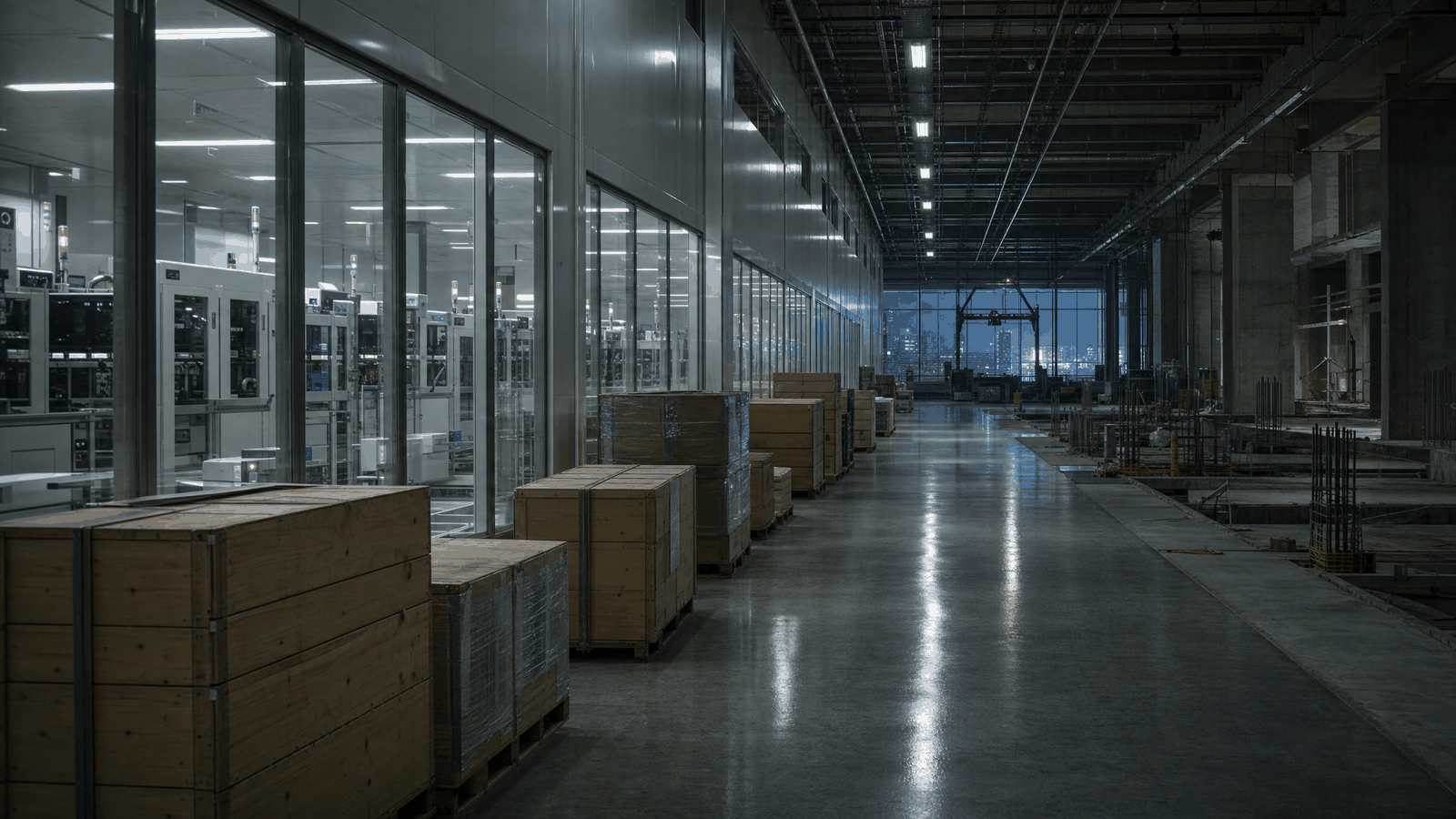
Back to TPCA. A circuit-board chairman giving the opening keynote said AI demand is growing faster than the PCB supply chain can expand, and that key materials will fall 20% to 40% short.
Sky’s description after one lap of the floor: nobody is less than full, and staying unfull now takes some doing. The shortage runs from laminate all the way to equipment, with lead times commonly past two years and some at three. One line stuck with me — a customer relationship is now a queue-jumping instrument. Orders were placed long ago, so the meeting is about getting yours shipped first. The equipment numbers say the same thing: lead times have stretched on 80% of PCB equipment, doubled on 20%, and some tools now take 30 months. That is two and a half years, for circuit-board equipment rather than an advanced lithography tool.
The consequence is that high-margin orders get pushed to the front of the queue, second- and third-tier plants pick up work they could never win before, and their equipment suppliers come along with them. Sky says his own thinking now leans toward that spillover: plants you thought were ordinary are doing better than they have in years.
Circuit boards are moving indoors
This is the observation I found most interesting. Circuit boards have always been made in open air. This year’s floor had lines living inside enclosures, boxed up like a bento. Once substrate line widths shrink past a point, airborne particles eat the yield, so cleanliness has to improve — nowhere near front-end semiconductor levels, and clearly headed that way.

Alongside it, Sky senses that some mid-stage semiconductor customers are now managing the circuit-board layer directly: cleanliness, handling, how process yield gets raised. For the equipment makers, higher specifications carry higher prices, so this round of buying lifts the whole industry a step rather than only adding capacity. The one thing he will commit to is that cleanliness requirements across these equipment stages are going up.
What to watch next: the day lead times get shorter
If you already own something on this chain, the uncomfortable question right now is probably whether buying more after all the good news makes you the last one in.
The reading this episode offers beats any price target: watch the lead time. Thirty months is the thermometer of the shortage. The day a channel check comes back at 25 months, the share price reaction will be violent, and past episodes turned over within a month or two. The reverse holds as well — a long lead time buys you no safety. Sky says it plainly: 30 months is not a half-year insurance policy. It tells you the current state and nothing about what the next check will find.
So what you follow here is not headlines but repeated readings of the same number. You bought a shortage, so you keep measuring the shortage.

A dollar in, ten dollars of revenue out
The other sore spot is harder to admit: a company’s numbers look too good and you cannot tell whether to be pleased or frightened.
Sky raises an observation I expect to keep: return on assets never used to look like this. A dollar invested producing a dollar of revenue was a reasonable sentence; a dollar producing ten dollars of revenue reads like printing money. He calls it strange. The problem arrives right behind it — the share price already stands on that expectation, so how do you beat it?
The noise listed later in the episode is the other half of the answer. A flood here, a design problem needing a respin there, and even a chip designer’s schedule getting disclosed through TSMC’s earnings call. Sky’s position is that this is the normal state of affairs, because volume production asks you to hold yield steady, scale up, and stay stable over long runs — TSMC slips sometimes too. A production line carries many odd variables, and the real reason for a miss is sometimes nothing grander than a cheaper part. When expectations get priced at their most optimistic, a small event is enough to knock them back.
Further reading
- Caibaogou episode 571 (22 October 2026), hosted by Weiyu and Sky; the episode splits into the SpaceX call and the TPCA show walk-through
- TPCA Show official agenda and keynote session listings, where the speaker and the material shortfall claim can be checked
- SpaceX and Starlink’s official service and business pages
- TSMC’s quarterly earnings materials on capital spending and advanced packaging capacity, the starting point for any estimate of the supply ceiling
- Taiwan Printed Circuit Association (TPCA) public industry statistics and show releases
One thing to take away
The thermometer of a shortage is the lead time, so anyone who buys a shortage has to keep taking its temperature. The gap between 30 months and 25 months in this episode matters more than any company’s margin estimate, because it is the reason you bought moving underneath you.
Here is something I have tried. Pick one thing you are currently betting on — it need not involve investing; waiting on a promotion, waiting for a relationship to warm up, waiting for a child to want to study all count. Write down one measurable reading of its current state (how many projects came your way in the last three months, how many times this month someone started a conversation with you), then come back and fill in the same box every month. The first time I did it, I found that the thing I thought I was waiting on had been reading lower for three months straight, and I had been watching something else entirely.
This article is an educational discussion of investment method. It is not advice to buy or sell any individual security, offers no target prices, and does not analyze any current holding. Investing carries risk; make your own decisions or consult a qualified professional.
Comments
Loading comments…