Enrichment Is Step Three: Catalyst on the Geopolitics of Nuclear Fuel
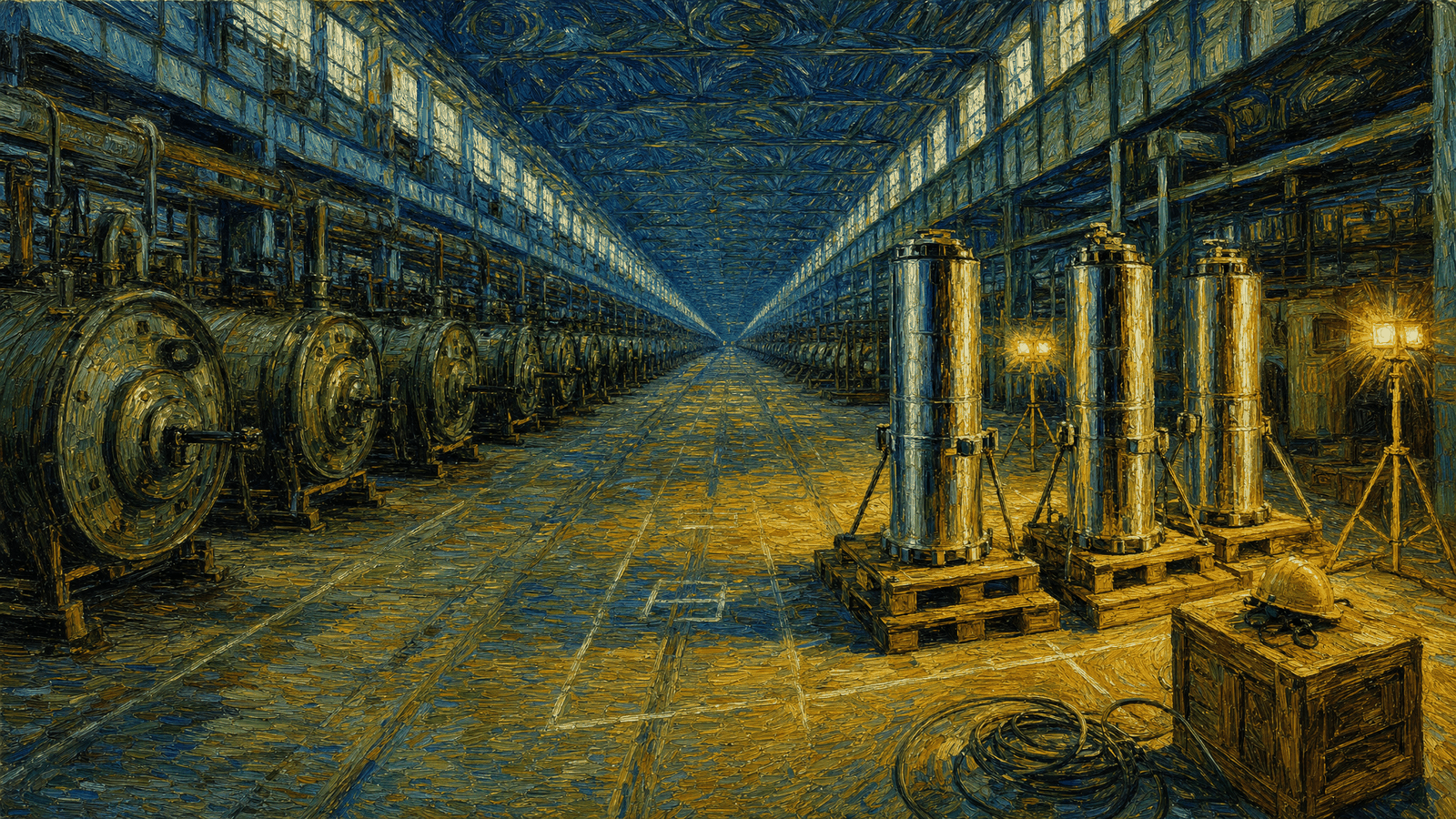
Notes on the November 5, 2026 episode of Catalyst with Shayle Kann, featuring General Matter CEO Scott Nolan on why the five-step nuclear fuel chain breaks at enrichment. Educational commentary; no investment advice and no stock recommendations.
Contents
Relying on others abroad while failing to measure your own strength at home — that is how a state is whittled away.
—— Han Feizi, “Ten Faults” (Warring States period; my own translation)
On the November 5, 2026 episode of Catalyst with Shayle Kann, host Shayle Kann talked with Scott Nolan, founder and CEO of General Matter, about the geopolitics of nuclear fuel. Nolan’s numbers: roughly 75% of the enrichment services the US consumes come from European producers and 20–25% from Russia, while the US-owned share of the global enrichment market has fallen from about 86% at its 1980s peak to under 0.1% today. Commercial domestic capacity for HALEU — the higher-assay fuel that advanced reactors run on — is essentially zero. Whether the episode’s thesis holds rests on two things: the legal deadline of January 1, 2028, and whether advanced reactors arrive on schedule.
The strongest version of the case: a five-step chain that breaks at step three
Nolan lays the chain out: mine the uranium, convert it to a gas, enrich it, convert it back to a solid, fabricate fuel. The US does all five steps. Only the middle one lacks commercial-scale domestic capacity.

Mining leans on Kazakhstan and Canada. Conversion is stranger still — one plant operates in the entire country, in Metropolis, Illinois, owned by Honeywell and long marketed under the ConverDyn name. It ran for fifty-plus years, got mothballed when the market soured in the 2010s, and has been ramping back toward nameplate capacity. One detail I liked: that plant sits five miles from General Matter’s own site.
The history of enrichment is the hardest-hitting stretch of the episode. In the 1980s the US led the world. Then the Berlin Wall came down, the Megatons to Megawatts treaty imported Russian warheads to be down-blended into reactor fuel, and depleted uranium went back to Russia for enrichment. Russia built out gas centrifuges; so did Europe. The US was still running first-generation gaseous diffusion. Over the next twenty years America shut its own enrichment down plant by plant — first privatizing it, then discovering that generation-one technology could not turn a profit against generation two. Hence 86% to under 0.1%. The only enrichment plant operating on US soil today sits in New Mexico and is run by Urenco, a European firm; it covers about 20% of US demand.

Congress banned Russian uranium imports in 2024, with a carve-out: the Secretary of Energy may waive the ban when a utility has no alternative source. That waiver process expires January 1, 2028. Utilities have been importing under waivers while diversifying, and the Russian share has slipped from 25% to 20%. Nolan calls it the 2028 cliff.
HALEU is cleaner to describe: zero. Nolan says that was his starting point. Back in 2022, looking at advanced reactor companies at Founders Fund, he asked each of them what the hardest part of building the company would be. Every answer was buying fuel. He asked why they could not get a US company to make it, and was told nobody in the US produces it. Large gigawatt-scale reactors have big cores and run on 3–5% enriched uranium. Factory-built reactors have smaller cores, so to reach criticality with a workable refueling cycle most developers have pushed to 19.75% — deliberately buffered under the 20% line that triggers weapons-grade classification. Physically, making HALEU means running the same separation process another round. What changes is criticality safety and licensing: vessels holding uranium have to be smaller so accidental criticality stays impossible.

The business model is worth noting too. Utilities buy the uranium and hold title to it; the enricher charges for a service, priced in separative work units, which Nolan describes as degree of entropy reduction times mass. So the LEU business is insulated from the uranium price.
Their site is Paducah, at the western tip of Kentucky — the last place the US did commercial enrichment, shut down in 2013, a former Manhattan Project site with power, trained workers, and a community that remembers the plant running. Nolan says they looked at over ten states and something like a thousand parcels; Paducah wanted them most. They leased roughly 100 acres at the south end of the DOE site, targeting completion before the end of the decade, with HALEU capacity sized to serve US demand into the middle of next decade and possibly to 2040.
The other side: three places the argument gives way
Shayle Kann raised the first one himself. The error bars on HALEU demand in 2030, 2031, 2032 are wide. Nobody knows how fast advanced reactors scale. Nolan’s answer was that he is bullish and expects them to surprise everyone — a reason to take the bet, not a demand schedule. The plant being built is sized to supply through 2040, and the first commercial fleet does not exist yet. If small modular reactors slip three years, the depreciation still has to be paid by someone.
The second: the dependency being named and the dependency being run are different. Russia is 20–25%. Europe is 75%. Nobody calls the 75% a bottleneck, because Europe is an ally. That gives the domestic-sourcing argument a political component — it addresses a slice of supply that sanctions could sever, rather than overall external reliance. If European export policy or capacity allocation ever became the problem, this framing has no answer prepared.

The third one matters most. America left enrichment for cost reasons, not policy reasons. Generation one lost to generation two. Today Urenco’s centrifuges and those of its European peers are long since depreciated, which keeps unit cost low. A new plant competes with fresh machines, fresh licensing, and a fresh team. A political premium helps with contracts while it lasts; once it fades, the comparison returns to dollars per SWU. The episode gives no numbers on that.
There is also a smaller inconsistency. Nolan criticizes the industry for leaving conversion unaddressed, yet when asked whether limited conversion capacity will constrain him, the answer is that they are not too worried, there is spare capacity and inventory, and it will be solved in five to ten years. That has the same shape as the chicken-and-egg logic he uses to explain why nobody built HALEU capacity. The difference is that this time he is the one waiting for somebody else to move.
Where I land, and the condition that decides it
My read: the LEU half stands up, and the HALEU half is a venture bet. Both are packaged inside one company, which makes them sound like one risk.
The arithmetic separates them. LEU replacement demand has three knowable quantities: a known volume (refueling the operating fleet), a known share to displace (20–25%), and a date written into law (January 1, 2028). HALEU has exactly one certainty — that it is zero today. Its demand waits on somebody else finishing a reactor.
That connects to a situation readers run into constantly: policy news lands, and the thing you were watching does not move, or moves for a day and gives it back. What I learned to ask first is whether the demand this news creates has a buyer today, or waits on another supply chain being built. The Russian uranium ban is the first kind — it reassigns procurement that already happens. HALEU is the second — it waits for small reactors to get from demonstration to commercial refueling. Same episode, same speaker, same plant, and the two timelines are years apart.

A related confusion: somebody calls a market a trillion-dollar opportunity, and you want to test it. This episode hands you three questions. Who is the customer? HALEU today sells to reactor vendors buying fuel for demonstration units; when fleets actually run, the buyer becomes the developer or the utility, at volumes orders of magnitude larger. Who holds the inventory? In LEU, the utility holds title to the uranium and the enricher only charges a toll — which is how you can tell the buyer has the stronger hand. What is the billing unit? A business priced per SWU is selling capacity utilization, not a commodity price.
So the condition I would watch: does the first wave of small reactors reach commercial refueling before Paducah’s capacity has to start amortizing? If it does, this bet converts from vision into contracts. If it does not, the HALEU half of that plant is capital waiting for customers, while the LEU half still has to beat fully depreciated European centrifuges on unit cost. Asked what he would fix with a magic wand, Nolan picked US mining permitting, noting something like 13,000 abandoned uranium mines in the US — small orebodies, and permitting a small mine is nowhere near proportionally easier than permitting a large one. That line stayed with me: fix step three and the bottleneck moves upstream rather than disappearing.
Sources worth your time
- Catalyst with Shayle Kann, November 5, 2026, on the global geopolitics of nuclear fuel, with General Matter founder and CEO Scott Nolan; the preceding episode covered the back end of the same chain, nuclear waste
- The 2024 Congressional ban on Russian uranium imports, its Secretary of Energy waiver mechanism, and the January 1, 2028 expiration
- The Nuclear Energy Institute survey of utilities on supply chain bottlenecks, which the episode cites as converging on conversion as the next one to solve
- Recent Department of Energy awards issued separately for HALEU enrichment, LEU capacity, and HALEU deconversion — a map of where the government thinks the chain is thinnest
- Two comparison points already operating or announced: Urenco’s New Mexico enrichment plant, and incumbent Centrus and its HALEU scale-up plans
One thing to take with you
How dangerous a dependency is comes down to how long replacing it takes. Availability, price, and a stable relationship describe today’s state. Risk is set by how much time passes between the day it breaks and the day a substitute is running. That is the whole lesson of American enrichment — the material never stopped arriving, nothing was ever short, but building an enrichment plant takes years, so even a waiver ending one year early leaves a gap nobody can fill.
Here is something I tried that takes ten minutes. Write down three things in your life that have exactly one source. The person who can pick up your kid on short notice. The electrician who knows your building’s wiring. The process at work only one colleague can run. The single drive holding every photo you own. Then write one number beside each: if it breaks today, how many days until a workable substitute is in place. Not “that would be hard” — a number of days. Some numbers will come out comfortingly small. Some will startle you, and it tends to be the ones you thought were safest, because they felt stable and so nobody ever went looking for a second source.

This article is an educational discussion of investment method. It is not advice to buy or sell any individual security, offers no target prices, and does not analyze any current holding. Investing carries risk; make your own decisions or consult a qualified professional.
Comments
Loading comments…