Can a Power Plant Roll Off an Assembly Line? Notes on MacroVoices 554
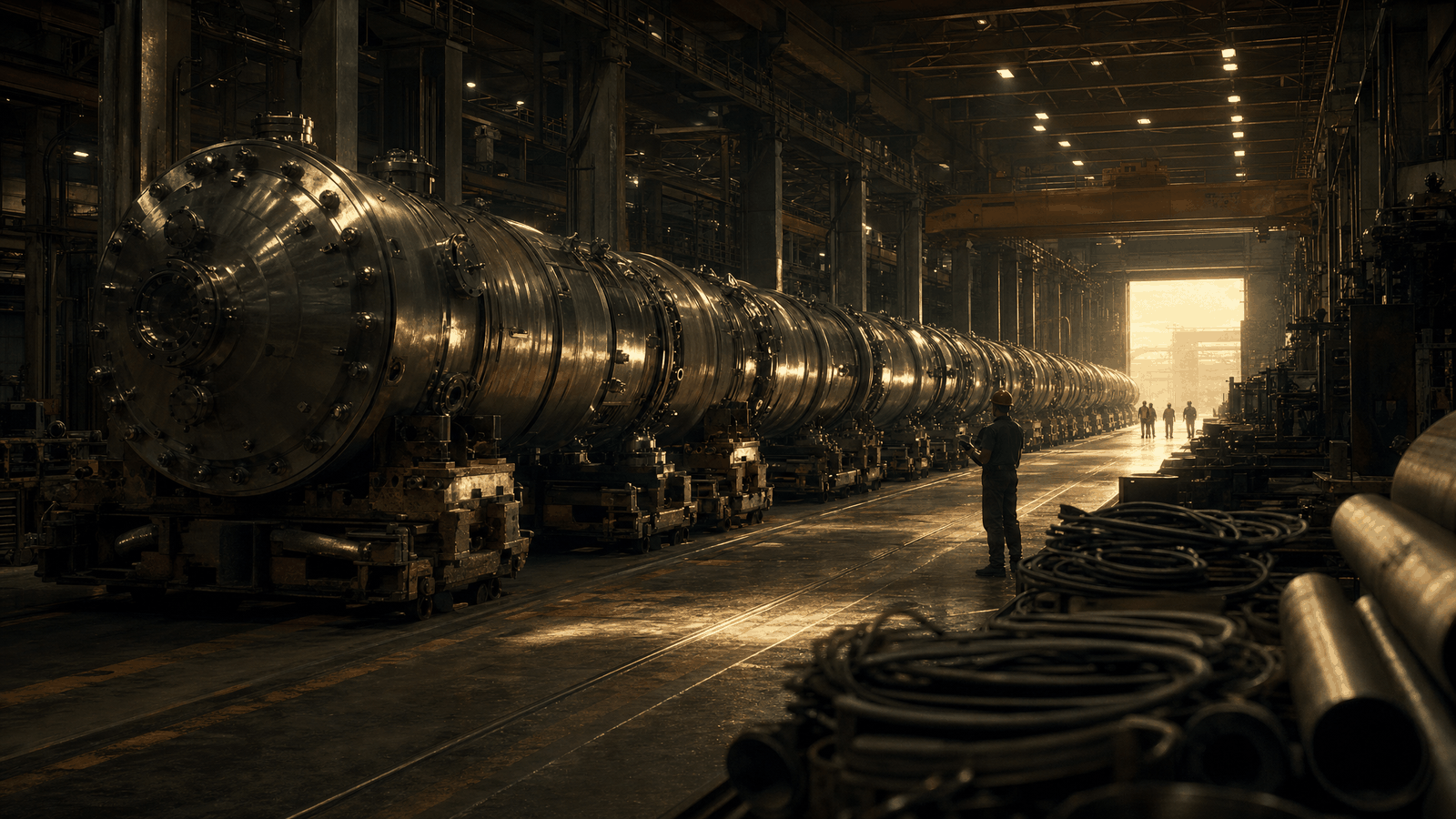
Notes on MacroVoices episode 554 (October 15, 2026), where Aalo Atomics CTO Yasir Arafat lays out a cost curve for mass-manufactured reactors, the fuel bottleneck, and the policy shift. Personal listening notes for education only; not investment advice and not a prediction about any company or share price.
Contents
- March 2026: the factory comes before the plant
- The previous seventy-five years: the dead end of one perfect reactor
- Now: what the Texas line looks like
- The next few years: a cost curve and 230 suppliers
- The 2030s wall: fuel
- The policy line running alongside: Carter’s shuttered plant, Britain’s buried 141 tonnes
- Another timeline: China
- ”I’ve heard stories like this before — how do I tell which one is moving?”
- ”The host owns a stake — can I still listen?”
- Resources worth a look
- 帶得走的一件事
To print two or three copies this way is no easier; to print hundreds or thousands, it is marvellously quick.
—— Shen Kuo, Dream Pool Essays, “Crafts” (Northern Song, c. 1088; my translation)
On October 15, 2026, in episode 554 of MacroVoices, Aalo Atomics co-founder and CTO Yasir Arafat said the factory they are building in Texas is aimed at 100 reactors a year of 10 MW each; the first unit lands in the mid-teens of cents per kilowatt-hour, the tenth comes in under 10 cents, and at roughly 50 units a year the output competes with coal and gas on price. He expects that within the first few years of the first factory running, far sooner than the fifteen years host Eric Townsend had assumed. Two conditions carry the claim: the 230-plus component suppliers have to scale alongside the factory, and the fuel has to stay on the 5–8% low-enriched uranium you can buy today. The host disclosed upfront that he is a private equity investor in the company and that it is the largest such position he has ever held — keep that beside everything he asks.
March 2026: the factory comes before the plant
The company first appeared on the show in episode 522, March 5, 2026, when CEO Matt Lozak described what they intend to mass-produce: whole power plants, not just reactors. Episode 554 pushes the timeline out, past the data-center beachhead, to what the US advanced nuclear industry would have to do to get below coal and gas.
Yasir’s own analogy is Amazon: Bezos started with books and became the everything store. Data centers are the books. He picked that beachhead for urgency — in seven decades no market has wanted this much power this fast. Citing Bank of America, he puts the 2026–2030 need at 125 GW against roughly 25 GW the grid and everyone else can assemble, leaving a 100 GW hole. One gigawatt is about a million homes.
The previous seventy-five years: the dead end of one perfect reactor
The host put the obvious objection first. The industry is seventy-five years old and fewer than 450 power reactors run worldwide — about six units a year of established demand. How does that justify an assembly line for something that historically takes a decade and tens of billions per project?
Yasir’s answer: “It is crazy until somebody proves that it is not.” Then came the line I remember longest. This country spent seventy years trying to make nuclear cheap by building one more perfect reactor, and each one got bigger, until nobody could predict the schedule or the cost. Vogtle, the first plant built after a thirty-five-year gap, took twice as long and more than twice the budget.
So they changed the question. Cheapness comes from building the same decent reactor a thousand times and improving it each generation. When they chose a design, they did not ask what looks best on paper; they asked for the most power you can fit on the back of a truck. The answer was sodium-cooled: high enough density, near-term to market.
Now: what the Texas line looks like
The facility goes from about 40,000 square feet to a million. The shipping unit is not a reactor but what they call a pod — five reactors feeding one steam header with three 25 MW turbines, 50 MW per pod. Twenty pods a year is 100 reactors, one gigawatt.
The configuration looks odd by traditional nuclear standards, and it looks odd because they asked customers first. What data centers said, over and over, was reliability. With one of five reactors down for refueling or maintenance, the other four carry nameplate; two of three turbines carry the full 50 MW. The redundancy is built into the hardware, and what it buys is near-full availability behind the meter.
One market signal surprised even them. Customers call not to order five or ten reactors but to reserve twenty percent of factory output. If three more do the same and eighty percent is taken, Yasir said, that is the signal to build the second factory — capacity sold becomes the trigger, keeping supply and demand stepping together.
The next few years: a cost curve and 230 suppliers
The host did his own arithmetic: one gigawatt a year covers one percent of the 100 GW hole others have already identified, and replacing what the world now gets from fossil fuels would mean running that factory for nine thousand years. So the real question is whether nuclear can get under coal and gas on cost and match a new gas plant on delivery time.
Yasir’s path is specific. The first-of-a-kind lands in the mid-teens of cents per kilowatt-hour, and today’s customers are buying speed at prices above that. By the tenth reactor, under ten cents. At around fifty a year, parity with coal and gas — and not in factory three or four, but in the first couple of years of production from factory one.
What he said next matters more to me than the curve. Getting there is where the harder problems start. Musk said designing the Tesla was the easy part and manufacturing was hard; Yasir thinks manufacturing is ten times harder. Twenty reactors a year is no issue with today’s supply chain. Climbing to 50, 100, 200, 300 is when things start breaking. Many of their manufacturing engineers came from Tesla for exactly this stretch.
And the hardest problem he names sits outside the fence: 230-plus vendors supplying steel, pipe, sensors, pumps, electronics, with the count still growing. How do you convince them to scale with you, to put their own capital into their own lines? He ranks that first among everything ahead.
The 2030s wall: fuel
Here the host landed what I think is the most valuable push-back of the episode. You can mass-produce reactors; nobody can mass-produce uranium mines, and a mine takes a decade from discovery to production. Centrifuge enrichment plants cost and take about as long as oil refineries. Every uranium specialist he has interviewed agrees a structural deficit arrives in the 2030s — on today’s fleet alone.
Yasir split it into now and later. Most advanced-reactor peers need high-assay low-enriched uranium, 8% to 20%, while 5% is what the market sells today and the industry has only lately pushed toward 8%; HALEU capacity is years from commercial scale. Aalo deliberately designed for 5–8% low-enriched uranium using commercially available uranium dioxide, so scaling the factory does not wait on a supply chain that does not exist.
His resource numbers run against intuition. Of identified uranium in known mines, roughly thirty percent has been tapped; the remaining two-thirds supports about 117 more years on today’s once-through cycle. And once-through burns five percent of the fuel — the other ninety-five is recoverable. Add recycling and fast-spectrum reactors, which start from higher enrichment but extract sixty to a hundred times more energy from the same mined material, and 117 years becomes about twelve thousand. His comparison: oil and gas run civilization for roughly fifty more years.
Hence the line the show used as its cold open: whether we transition to nuclear is settled; when is the question.
The policy line running alongside: Carter’s shuttered plant, Britain’s buried 141 tonnes
The host supplied this part, and supplied it well. The United States built an elaborate reprocessing facility in the mid-1970s for about a billion dollars of the money of the day, finished it, and then President Carter ordered it shut as it was ready to run. Britain reprocessed spent fuel into 141 tonnes of reactor-grade plutonium — burnable as fuel — and then decided to spend some four billion pounds disposing of it geologically. The technology works. Policy is what sits in limbo.
Yasir says the winds have turned. Nuclear has bipartisan support for different reasons — carbon-free on one side, energy security and manufacturing jobs on the other — but presidents rarely said so plainly. This administration does, and Energy Secretary Chris Wright is pushing to put fuel recycling back on the table. Yasir pointed to NLIC, a nuclear life-cycle innovation campus program: mining, conversion, enrichment, fabrication, reactor building, recycling used fuel into fast-reactor fuel and burning it, all hosted in one community to attract public and private capital. Five or six states made the short list; two will be chosen.
On waste he had a line I enjoyed: The Simpsons did more damage to nuclear than any anti-nuclear group. About 250,000 tonnes of used fuel sits in storage worldwide, all solid, inside engineered casks, with no person or plant ever harmed by it from commercial operation; stacked together it fits on one football field, one storey tall. His contrast is carbon capture — oil and gas now works to pull CO₂ back out of the open air and lock it into solid form, while nuclear’s waste has been concentrated solid from the start.
Another timeline: China
The host said the competitor he fears is not another reactor company. China has more light-water reactors planned or under construction than the entire US fleet, has a high-temperature gas-cooled reactor in service, and has signalled a fleet of container ships powered by thorium molten-salt reactors.
Yasir did not dispute the threat. China is formidable and has out-competed the US in many industries. But look closely, he said: every advanced reactor China has stood up traces to a technology the US built first, often as a prototype at a national laboratory — Idaho alone built 52 reactors. His example is the pebble-bed gas-cooled design: China got a plant running before the US, and you hear little about it since, because keeping it online has met a lot of first-of-a-kind trouble. Money and headcount do not make you good at first-of-a-kind; the way the US stays ahead is by inventing the next thing before the last one is copied.
Both men are describing two faces of the same situation, and the way to settle it is the capacity factor of those Chinese advanced units a few years from now, not today’s talk.
”I’ve heard stories like this before — how do I tell which one is moving?”
This is my own biggest problem with energy content. An episode leaves you lit up, three years later nothing has happened, and none of what was said can be checked.
What I do is sort the speaker’s sentences into two piles. One pile is directional narrative — demand explodes once nuclear gets cheap, we will stay ahead — sentences that hold for any company in any year, which makes them useless as progress indicators. The other pile carries numbers and dates: under ten cents by the tenth unit, parity at fifty a year, within a few years of factory one starting, second factory when eighty percent of output is reserved. That pile can be scored, and can be falsified.
More useful still is finding the variable he does not control. In this episode that variable is fuel and those 230 suppliers. The factory is theirs; the suppliers’ capital decisions are not. So over the next few quarters I will watch whether fabricators and enrichers actually break ground on expansion and how long the offtake contracts run. Whether the bottleneck layer loosens decides whether the whole schedule above is real.
”The host owns a stake — can I still listen?”
You can, and the disclosure here was straight: he said at the open that he is a private equity investor in the company and that it is his largest ever such position, and he said it again at the close.
My way of handling it is to split the content. Facts and mechanisms — Vogtle’s schedule and budget, 125 GW against 25 GW, the difference between 5–8% and 8–20% enrichment, Britain’s 141 tonnes — are checkable and do not bend with his interest. Judgments and timing — when costs fall, who wins, whether demand explodes overnight — I discount, because the person asking has money on the answer, and every “are you crazy” question in this episode gave the guest room to tell the story more fully.
The interesting part is that his bias ran toward optimism and he said so himself: he expected fifteen years, Yasir said a few, and his reaction was that he had already done the arithmetic and agreed. Someone who has already run the numbers and likes the answer asks softer objections. I wrote down the source of that 125 GW figure so I can check it myself later.
Resources worth a look
- MacroVoices episode 554 (October 15, 2026) and episode 522 (March 5, 2026); macrovoices.com has per-episode pages and interview links
- The World Nuclear Association (world-nuclear.org) annual uranium resource and fuel cycle reports, for checking the “thirty percent tapped” and “117 years once-through” magnitudes
- US Department of Energy (energy.gov) material on HALEU capacity and the nuclear life-cycle innovation campus program
- The NRC advanced reactor licensing dashboard (nrc.gov) — where a design sits in review tells you more than a press release
帶得走的一件事
The idea I keep from this episode: doing something well once and doing the same thing well a thousand times are two different capabilities, and the second one is what brings the price down. Nuclear spent seventy years practising the first — one more perfect, larger reactor — while the thousand-times capability lives in supply chains and repetition, and you train it by making the same object over and over, improving a little each generation. That is why Yasir puts his hardest problem on those 230 suppliers rather than on the reactor.
Here is something I have tried, and I would like to invite you to try it: pick one thing you have done three or more times this month and started from scratch each time — reconciling accounts, writing a weekly report, packing a child’s lunch, warming up before a workout. Don’t optimize it. Do one thing only: the fourth time, write down which step stalls you and whether it stalls because it is different every time. Then fix that one step in place and write it down again on the fifth pass. After two rounds you can see the shape of your own cost curve, and which square on your line is the real bottleneck.
This article is an educational discussion of investment method. It is not advice to buy or sell any individual security, offers no target prices, and does not analyze any current holding. Investing carries risk; make your own decisions or consult a qualified professional.
Comments
Loading comments…