Europe Is Betting the Winter on 80 BCM — Notes on Columbia Energy Exchange's Global Gas Episode
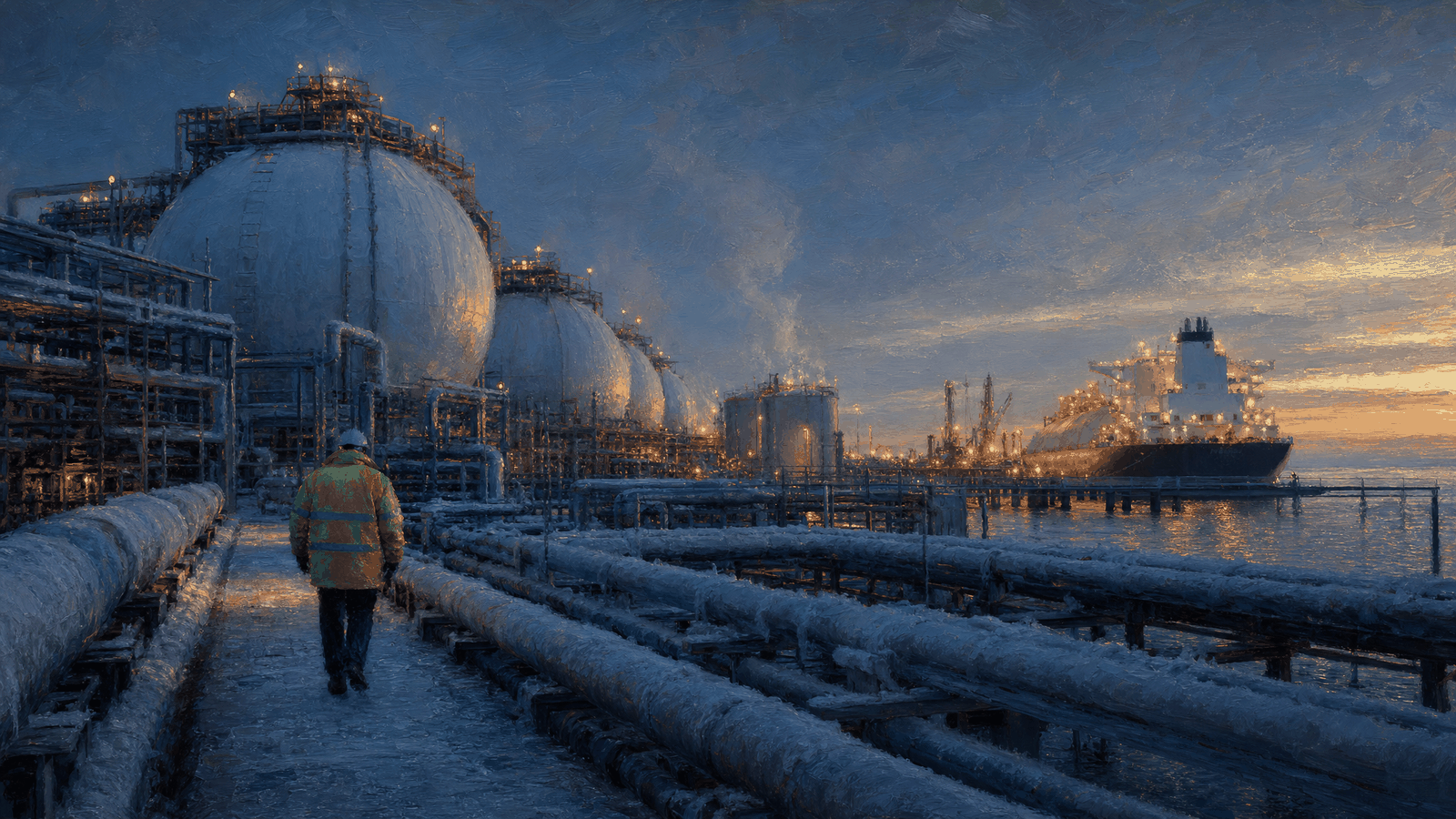
On 29 September 2026, Columbia Energy Exchange gathered three CGEP scholars to discuss Europe's gas position heading into winter: 80 BCM in storage, a record withdrawal of 74 BCM, and seven months of a closed Strait of Hormuz. An educational listening note on supply-demand structure and how to read it. Not investment advice; no individual securities discussed.
Contents
- 2022: Europe got through it, and mistook that for capability
- From spring 2026: seven months of a closed strait
- This summer: low water, hard-working air conditioners
- Right now: 80 against 74
- 1 January: those five BCM of Russian LNG
- 2029 to 2031: the question becomes who buys it
- The numbers in the news are all true, so why can’t I read them
- How a growth story gets whittled down
- Further reading
- The one thing to take away
In the seventh month the Fire Star sinks westward; in the ninth, clothes are handed out.
—— Book of Songs, “Odes of Bin: The Seventh Month” (pre-Qin; author’s translation)
On the 29 September 2026 episode of Columbia Energy Exchange, host Jason Bordoff brought together three research scholars from Columbia’s Center on Global Energy Policy: Anne-Sophie Corbeau in Paris, Ira Joseph in New York, and Tatiana Mitrova in Cyprus. Ira Joseph supplied the two numbers that define the whole story: Europe expects to enter this winter with roughly 80 BCM of gas in storage, and the most Europe has ever withdrawn in a single winter is 74 BCM, set in 2018. Six units of margin — and it only holds if Europe stays mild and Asia stays mild at the same time. By then the Strait of Hormuz had been closed for seven months, roughly 80% of Qatari LNG exports were gone, European gas was in the mid-70s of euros per megawatt hour, and Asian cargoes were fetching $25 to $26 per MMBtu. What follows is my own read after an hour with them.
2022: Europe got through it, and mistook that for capability
The line that stayed with me came from Tatiana Mitrova. European policymakers, she said, settled into a relaxed feeling — we survived 2022, so we can survive anything. She called it a mistake.
The two winters after 2022 were mild, and Europe rode that luck through. High prices took out a slice of industrial demand along the way. Anne-Sophie Corbeau was blunt about that slice: the decline in industrial gas demand is structural, it is not coming back, and with higher gas prices for longer it is coming back even less. So Europe now holds two facts at once — demand below 2021 levels, storage below normal — and has been treating the first as an antidote to the second.
From spring 2026: seven months of a closed strait
Then Hormuz. Ira Joseph put a rough figure on it: about 80% of Qatari LNG exports lost. Global LNG supply peaked in January 2026 and has run lower since. The United States, Canada, Nigeria and Australia added volumes, so year-on-year the picture holds up, but it does not fill the hole. On the day they recorded, Qatar declared force majeure on several more countries for November.
One image is worth keeping. Pakistan’s supply came entirely from Qatar; when the strait closed, their LNG went to zero overnight. Anne-Sophie noted that even when cargoes became available again at $25 per MMBtu, that price hurts a country like Pakistan. Europe can pull cargoes in with money; Pakistan and Bangladesh cannot. That is what “flexible LNG” means in practice — when supply is short, you pay more than whoever wants it on the other side of the planet.

This summer: low water, hard-working air conditioners
Anne-Sophie listed the things stacking up. Hydro levels are low across Europe. A hot summer pushed air conditioning demand up, and even France, with its nuclear fleet, burned more coal and gas for power. Germany and the Netherlands are furthest behind on storage. Over the past two winters, she pointed out, Europe drew down between 55 and 60 percentage points of storage. Households will not stop heating because a minister asks them to, and gas is the fuel of last resort in the power sector — when the wind drops, the sun sets, the reservoirs run low, or a reactor trips, gas covers it.
Ira gave the other end of the range: the least Europe has ever withdrawn in a winter is 37 BCM. So this winter could use 37, or it could blow through 74. A range that wide makes any single-point forecast useless.

Right now: 80 against 74
Stacking the three of them together, the question stops being “will Europe run short” and becomes a list of conditions that all have to hold: mild weather, no Asian bidding war, no damage to infrastructure. Anne-Sophie recalled the 2018 “Beast from the East,” which arrived at the end of February — cold at the moment storage is lowest, when withdrawal rates fall and heating demand is hardest to meet. Her other worry this winter is cyberattack and sabotage. She was on holiday in Germany during the Leipzig attack, and a drone carrying explosives had threatened Romania’s Neptun Deep field, the one meant to replace Russian pipeline gas.
Tatiana added the most useful piece of method in the hour: under this kind of uncertainty, the decision-making itself has to change. You do not know whether the winter will be cold, whether Hormuz reopens, where geopolitics lands. So stop betting on a point. Work in probabilities, build buffers, create optionality.
1 January: those five BCM of Russian LNG
The EU is due to take Russian LNG imports to zero on 1 January. Tatiana pointed out that this decision was made before the Hormuz crisis, when the assumption was a wave of new US LNG in 2026 and an oversupplied Europe, which made dropping Russian gas risk-free. The assumption changed; the decision stands.
She sized it: roughly four million tonnes, about 5 BCM, across the first quarter. That replaces nothing of the Hormuz shortfall, though at the margin, once every other buffer is exhausted, it helps. And even if Europe lifted the ban temporarily, Putin might not allow the gas to flow. In 2022 it was the Russian side that changed contractual terms and demanded payment in roubles. He could say it is too late, or ask for concessions on Ukraine. As Tatiana put it, even if Europe kneels praying for five BCM, there is no guarantee it helps.
What bothers her more is the time the debate consumes. Parts of the German and French political spectrum are pushing to restart Nord Stream, a destroyed pipeline that cannot be repaired in weeks and carries legal and contractual problems that would take decades to unwind. The weeks that remain are going into a phantom argument.
2029 to 2031: the question becomes who buys it
With margins like these, supply is piling in. Ira called it striking while the iron is hot. He cited Total’s supply-demand forecast, published the day before: LNG supply up 50% between 2026 and 2029, and 75% by 2031. That is a great deal of LNG for the world to absorb in five years.

Demand is loosening at the same time. China is on track to be the world’s third largest gas producer this year, with demand down year-on-year for a second straight year, and Chinese companies are reselling their US LNG contracts elsewhere rather than landing them at home. India runs its gas-fired power fleet at about 15% because it cannot afford the fuel. Southeast Asia was the fill-in box in every forecast, yet what Anne-Sophie heard in Bangkok was the prime minister talking about solar, biomass and a new licensing round — with similar messages out of Pakistan and Bangladesh. Ira flagged one thing that gets misread: more than half the volume contracted in recent years sits with Shell, Total, BP, Vitol and Glencore, who have to resell it. Those signatures measure the risk a middleman will carry, and not end-user demand.

The numbers in the news are all true, so why can’t I read them
I hit this frustration with energy coverage often: every story has data, every story is reasonable, and together they point nowhere. This episode handed me a fix — sort each claim by which time horizon it belongs to. Tatiana said it plainly: people keep mixing up different time horizons. Restarting Nord Stream, new LNG final investment decisions — those matter beyond 2030 and do nothing for this winter.

My question now is one line: can this news change physical supply in the next three months? If it cannot, it is answering a different question and should not be used to explain today’s price. That works far outside gas. New capacity announced on an earnings call, a long-range policy target — most of it is the second kind.
How a growth story gets whittled down
The LNG story has been “Asian demand will come.” Ira described the forecast grammar as noun, verb, LNG demand growth in Asia — first China and India, then Southeast Asia, always a box to fill the gap. That box is now in question too.
What is whittling it down is three slow things happening together: coal came back (Vietnam softened an ambitious gas-to-power plan and added coal plants), solar got cheap enough that Pakistani households and businesses install it themselves, and batteries let renewables cover more hours. Ira’s own framing was careful and accurate: LNG demand will grow, but power generation has alternatives, while industrial use is where it is hard to replace.
Listening to that, I thought about a habit I use on any growth theme — separate “the total will grow” from “the part I care about will grow.” Global LNG demand growing is true. Which link in the chain captures it, and who gets paid there, is a separate question. This episode’s answer: much of the growth will miss the power sector, while supply expands 50% in five years. Put those together and Ira’s conclusion is that prices come down until US exporters stop making money and start shutting in export capacity.
Further reading
- Columbia Energy Exchange, episode of 29 September 2026, hosted by Jason Bordoff with Anne-Sophie Corbeau, Ira Joseph and Tatiana Mitrova, produced by the Center on Global Energy Policy at Columbia University (energypolicy.columbia.edu)
- Anne-Sophie Corbeau’s post-GasTech piece “Short-Term Gain, Long-Term Pain,” and her Energy Connect op-ed “The Cyclical Unhappiness of the Energy World”
- Total’s LNG supply-demand forecast released the day before the recording (supply +50% 2026–2029, +75% by 2031)
- EU storage filling data and the official texts behind the 1 January ban on Russian LNG imports
The one thing to take away
This episode nails one idea: when facing something you cannot calculate, the move is to add options, not to sharpen the forecast. Tatiana located Europe’s failure precisely — instead of building buffers and fallbacks while there was still time, they waited for an answer to “will this winter be cold.” Negotiate in December and the same gas costs more, and in some cases no molecules are physically available at any price.
Here is something I have tried that has nothing to do with investing. Find the thing in your life that is stuck behind an answer you do not have yet — a job application waiting on a reply, a test result pending, a relationship waiting on someone else to speak. Take twenty minutes and write down three things you can do before the answer arrives that stay useful whichever way it lands. Not plan A and plan B — things both branches need: finish updating the résumé, condense the medical history onto one page, write out what you actually want from the arrangement. You will find that half of what felt like waiting was movable.

This article is an educational discussion of investment method. It is not advice to buy or sell any individual security, offers no target prices, and does not analyze any current holding. Investing carries risk; make your own decisions or consult a qualified professional.