China Built 700 Waste-to-Energy Plants in Six Years: A Business Priced by Policy
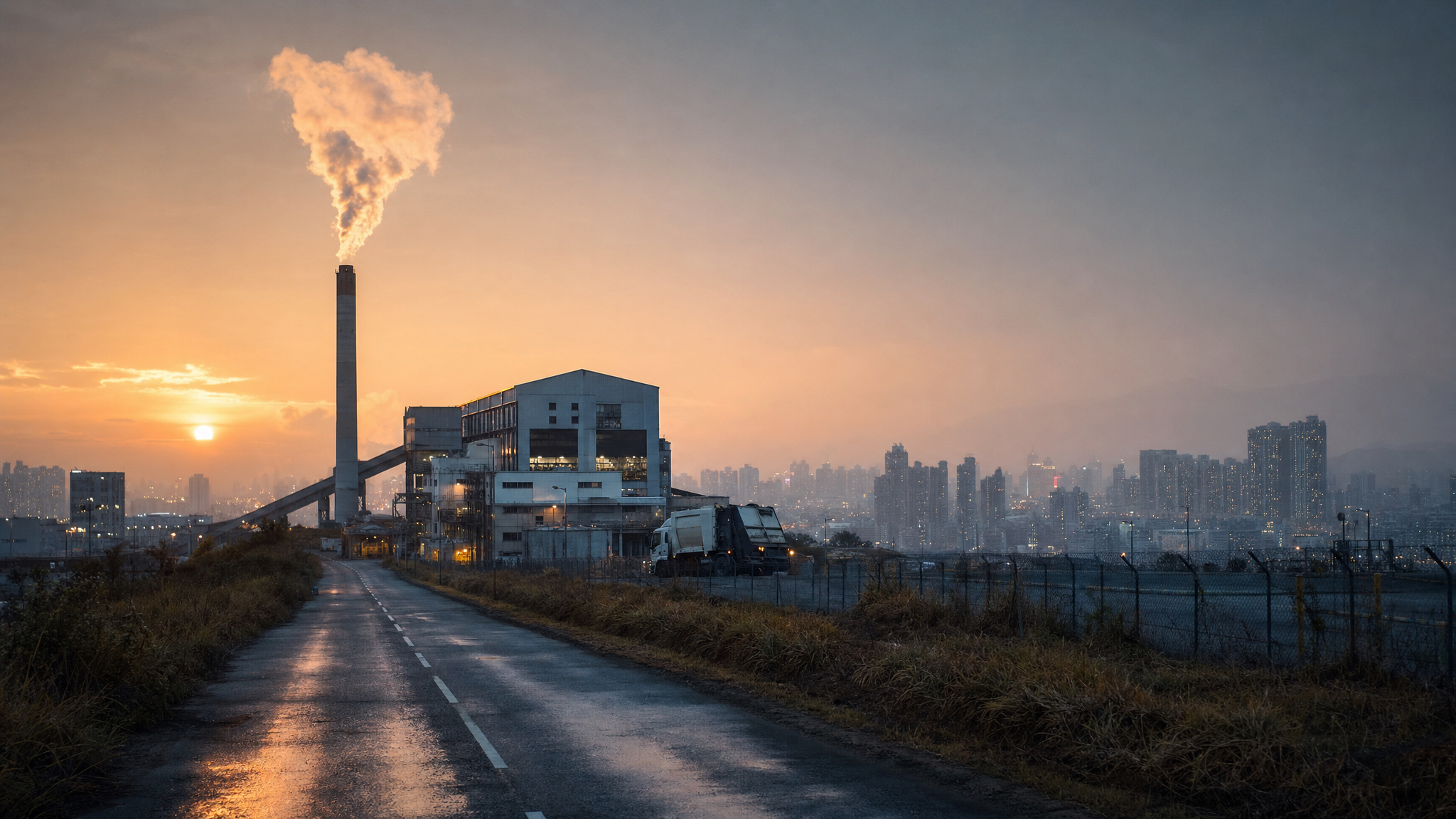
Notes from Asianometry's episode on China's incinerator boom — how to read a business whose revenue is set by subsidy, why utilization rates matter more than installed capacity, and how local opposition becomes a real line item on the schedule. Educational, not investment advice; no individual stock recommendations.
Contents
Whatever suffices to supply the people’s needs, stop there. Any added expense that adds nothing to the people’s benefit, the sage kings did not undertake.
— Mozi, “On Frugality in Expenditure,” Part II (Warring States period; my translation)
Mozi’s test is plain enough: did the money spent actually turn into something good for people? Twenty-three centuries later that question has become surprisingly hard to answer. When a city produces tens of thousands of extra tons of garbage a day, which option counts as “benefit to the people” — burying it, burning it, or finding a way for it not to exist?
What the Episode Is About
Asianometry’s 20 August 2026 episode covers how mainland China built 700 waste-to-energy plants in six years.
It opens with a 2019 story: the enormous Jiangcungou landfill outside Xi’an had filled up roughly twenty-five years ahead of schedule. That year China had about 400 incineration plants handling around half its municipal solid waste. Six years later the count is over 1,137 and more than 80% of municipal waste is burned. As the host puts it, human history has never seen a more furious span of incinerator building.
But the interesting part isn’t the size of the number. It’s the mechanism. How does a piece of infrastructure nobody wants to live near — one whose capital cost runs five to ten times the alternative, and which generates power less efficiently than a coal plant — get built at that pace by twenty-odd competing listed companies? The answer isn’t a technology breakthrough. It’s a price schedule written into policy, plus a lesson learned the hard way after a street confrontation.
The Main Points
1. The primary purpose of burning waste isn’t power. It’s volume. Incineration leaves ash at roughly 25–30% of the original volume, which for land-constrained Asian megacities is the whole point. The side benefits are real too: odors gone, organics gone, no accumulating landfill gas. That last risk isn’t hypothetical — the December 2015 collapse of stockpiled construction waste in Shenzhen killed at least 73 people.
2. Waste-to-energy loses on thermodynamics, and the reason is specific. A typical moving-grate plant runs around 30% efficiency or lower against roughly 40% for an advanced coal plant. The gap sits in steam temperature: about 400°C versus 600°C. And the temperature is capped because chlorine in plastics makes the flue gas corrosive. Put plainly: the moment plastic goes into the feedstock, the plant’s efficiency ceiling is set.

3. China’s waste growth has no historical precedent. In 1981 the country collected about 26 million tons of municipal solid waste; that same year the United States, with a quarter of the population, generated six times as much. Then came 8–10% annual growth, overtaking the US as the world’s largest generator by 2004 and reaching 178 million tons by 2014. Composition changed too — from mostly kitchen organics to a mix heavy in plastic, paper and metal containers. Organics are 60–80% water, and water absorbs heat, which is one concrete reason incineration went nowhere in the early years.
4. What actually opened the floodgates was the April 2012 tariff. The policy deemed every ton of waste to yield 280 kWh, purchased at RMB 0.65 per kWh; anything above that gets the local coal benchmark of roughly 0.25–0.45. That works out to about RMB 182 per ton in subsidy alone. Add the city’s waste disposal fee (competitively bid, typically RMB 60–160) and a ton of garbage brings in roughly RMB 250–350 against a cost including depreciation of around 200. The subsidy is more than half of total revenue. Without it, the business doesn’t work.

5. Getting one built is a separate problem, and the 2014 Hangzhou confrontation was the turning point. The plan was a 3,000 ton-per-day plant in Yuhang district — over a third of the city’s daily waste. The siting was defensibly technocratic: a former stone quarry, reachable without residential roads. But the process was closed. Twenty thousand residents petitioned. When survey equipment arrived on site, rumors spread, and by May tens of thousands were clashing with police. Academics have a name for this script: decide, announce, defend — usually followed by abandon.
6. Hangzhou didn’t abandon it. They rebooted, and that’s the most valuable part of the episode. The inexperienced state-owned startup operator was replaced with the larger, more experienced Everbright. A full environmental impact assessment was redone with public participation and documents posted online. Staff interviewed over 25,000 residents and collected 500 comments. Locals were hired as supervisors. Five thousand residents were bused to other facilities to see the automatic monitoring equipment for themselves. A financial commitment to district tourism and infrastructure was attached. Construction restarted in April 2015; the plant entered service in November 2017. That sequence became the playbook.
7. Then came the overcapacity. By 2020 China hit its target with 462 plants and 580,000 tons of daily capacity, so the center raised it to 800,000 with a rural focus — while simultaneously ending the RMB 0.65 subsidy for anything started after January 2021 and sunsetting it for existing plants after 82,500 operating hours. By end-2024 there were 1,137 plants. The E20 Research Institute puts average utilization for 2023–2025 at roughly 60%, with some plants above 80% and others as low as 24%; about 16% of projects run below half. National daily incineration capacity is around 1.2 million tons against 700,000 tons of daily waste collection. Which produces a genuinely surreal image: counties digging up their own old landfills to feed the furnaces.

Going Further
”The policy support is there — why is this a hard business?”
The instinct on seeing a national target, a subsidy and a central government deadline is that the sector is about to take off. This episode offers a colder reading: the subsidy isn’t an accelerant. The subsidy is the revenue.
Read the price schedule again. RMB 182 per ton of subsidy inside RMB 250–350 of total revenue means more than half the income statement isn’t paid by a customer — it’s set by a document. Policy money has two properties: it arrives fast (one 2012 circular pulled in a wave of capital) and it leaves on a published schedule (new projects after 2021 get nothing; existing ones stop at 82,500 hours).
The distinction that matters: customer money grows when you do the job better. Policy money only shrinks as the calendar advances. That’s precisely why the structure was later changed — to force these companies off generation revenue, which can’t compete with solar and wind, and toward city disposal fees, heat sales, metal recovered from slag, even selling power directly to data centers.
So for any sector with a state mandate behind it, one concrete question: how much of the revenue is priced by policy versus by the market, and when does the policy line expire? Both answers are usually in public documents. Note also that fixed costs here are high and operating leverage severe — a 10% revenue drop can take 30% of the profit. Subsidy expiry isn’t a few points of margin compression. It’s a rewrite of the business’s constitution.
”If capacity looks that good, how is anyone losing money?”
The episode hands you a devastating comparison: 1.2 million tons of daily incineration capacity against 700,000 tons of daily waste collection.
Capacity is something you build. Demand is set by a physical ceiling. How much garbage a city produces depends on population, income and consumption habits; it does not increase because you built another plant. Once construction outruns waste growth, the surplus becomes pure fixed cost. That “16% of projects below 50% utilization” translates to: doors open, equipment depreciating, loans servicing, staff paid, furnace idle half the time.
The detail about digging up old landfills is the sharpest thing in the episode. It reads as resource recovery; it functions as capacity hunting backwards for feedstock. When an industry starts mining its own past to feed its present, the growth story is over.
This generalizes. Anything where the construction cycle creates its own demand — data centers, grid transformers, shipyards, panel fabs — has the same shape. Watch utilization, and watch its distribution, not installed capacity or order backlog. An average of 60% sounds unremarkable, but when the same dataset contains plants at 80% and plants at 24%, that isn’t a mediocre industry. That’s an industry that has already sorted its members into survivors and casualties. Averages are at their most deceptive when they compress two different fates into one number.

There’s a further layer worth noticing: 60% of total capacity sits in five provinces — Zhejiang, Jiangsu, Guangdong, Shandong and Fujian. The later pivot toward central, western and rural China happens because the high-waste regions are already saturated. But places with less waste have worse plant economics by construction. That pushes the utilization problem into the future rather than solving it.
”If everyone opposes these things, do they ever actually get built?”
On technical and financial grounds, Hangzhou’s plant and Seoul’s Mapo project look alike: both necessary, both reasonably sited, both fully engineered. One got built. The other was formally cancelled in March 2026 when Seoul declined to appeal to the Supreme Court, costing the city 1,000 tons per day of capacity — in a city that has already banned sending solid waste to landfill without incineration. That 1,000 tons doesn’t vanish with the project. It just becomes someone else’s problem.
The difference is whether public objection enters at the design stage or after the announcement.
You cannot eliminate NIMBY sentiment — as the episode notes, not even the Communist Party can. What you can do is channel it earlier, while the site, the design and the compensation package are still changeable. Once you have announced and defended, the government must spend resources protecting a choice it already made, at which point any concession reads as guilt and any firmness reads as arrogance. Of the four words in “decide, announce, defend, abandon,” the fatal one is the third.

Everything Hangzhou did on restart — publishing documents, interviewing 25,000 people, hiring residents as monitors, busing people to see working plants — isn’t communications technique. It’s treating trust as an engineering item with a budget and a place on the schedule. And replacing the inexperienced operator was an honest admission that inexperience was itself a source of distrust.
For investment reading: on any large physical project, social license is a real schedule variable, not a PR expense. It appears in no column of the model, but it decides whether the denominator is three years or never. The check is mechanical: before the announcement, was any document public, was any meeting open to residents? If the answer is no, discount the dates on the timeline.
One human aside. Describing how a moving grate works, the host is suddenly reminded of the incinerator in Toy Story 3, goes and checks, and reports that it appears to be a simple open pit — presumably for dramatic reasons, since a real moving grate wouldn’t have been as tense. Then: “but now I am concerned for Andy’s neighborhood.” A channel about thermodynamics telling you, in one line, how filthy open burning is.
Worth Reading
- Asianometry, “China Built 700 Waste-to-Energy Plants in 6 Years,” 20 August 2026. The source. Worth watching in full.
- World Bank, Decision Maker’s Guides for Solid Waste Management Technologies (2018) and What a Waste 2.0. The per-daily-ton capital cost ranges cited in the episode — $66,000–120,000 for incineration, $5,000–20,000 for landfill — come from here, and remain a good public benchmark for comparing disposal routes.
- Wang Jiuliang, Beijing Besieged by Waste (2011). An independent documentary made by riding a motorbike around Beijing and mapping over 450 illegal dumps. The episode credits this kind of undeniable footage with forcing the policy shift — a useful reminder that what changes policy is often not the report but the form of the evidence.
- E20 Research Institute data on utilization rates for China’s waste-to-energy projects. In infrastructure, utilization is almost always more honest than installed capacity.
- On the dioxin and furan health controversy, note the episode’s posture: for a great many of the questions, the answer is “we don’t know.” When both sides of a debate sound certain, both have usually outrun the evidence.
One Thing to Take With You
The line from this episode that stuck with me hardest is “the subsidy isn’t an accelerant, the subsidy is the revenue.” It’s the reason I started pulling apart, one by one, the money in my own life that I’m not the one paying — the employer’s top-up, the hours a family member absorbs, the reach a platform still gives away for free. They arrive so naturally I had never entered them as a cost.
The method is simple and costs nothing. Tonight, open last month’s statement or calendar, point at one thing you do on a fixed basis, and fill in two numbers next to it: what share of it someone else is paying (money, time, or patience all count), and how many fewer times a month you’d do it if that share went to zero tomorrow. The first number came to me fast; the second took ten minutes, because it had never occurred to me that the thing could be done less.
Keep the sheet. The day next month’s statement arrives, take it out and check whether those fewer times actually happened.
This article is an educational discussion of investment method. It is not advice to buy or sell any individual security, offers no target prices, and does not analyze any current holding. Investing carries risk; make your own decisions or consult a qualified professional.
Comments
Loading comments…