The Format War That Almost Happened: How DVD Got Settled in 1995 by a Company That Sold No Players
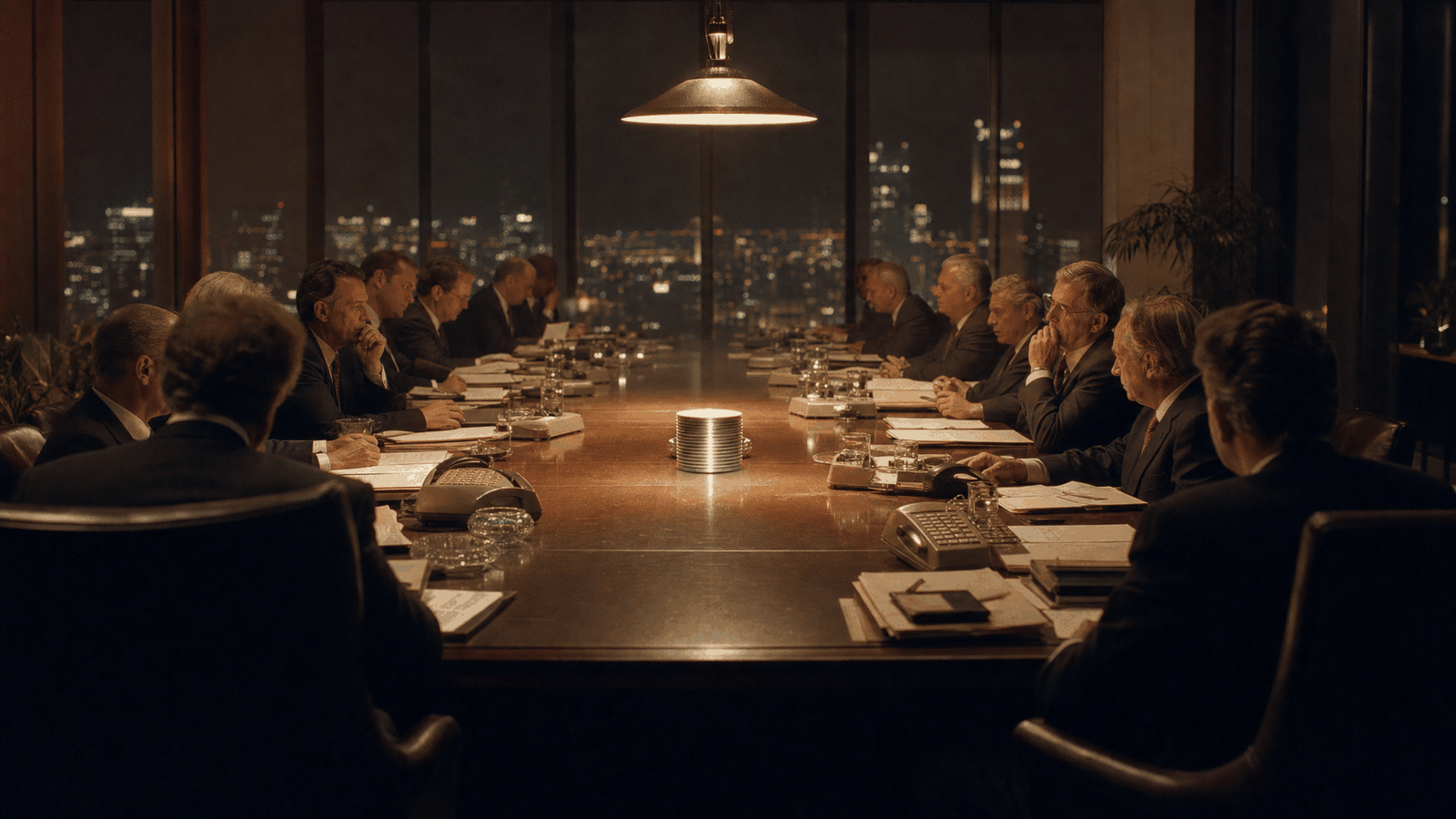
Listening notes on Asianometry's September 27, 2026 video, The Dramatic Birth of the DVD Boom: MMCD's 3.7GB per side against SD's 5GB, the roughly 3 cents per disc in CD patent royalties, and how IBM pushed both camps to one table in August 1995. Educational and for thinking practice only — no investment advice, no individual stock views or price targets.
Contents
If two tigers fight, neither of them comes out alive. I act as I do because I put the urgent needs of the state before a private grudge.
— Sima Qian, Records of the Grand Historian, “Biographies of Lian Po and Lin Xiangru” (Han dynasty; my translation)
Asianometry’s video of September 27, 2026, The Dramatic Birth of the DVD Boom, covers the 1995 standoff that nearly became VHS versus Betamax all over again. Philips and Sony’s MMCD held 3.7GB per side; the SD camp led by Toshiba and Matsushita held 5GB per side, and the two traded insults in the press for most of a year. In August 1995, IBM told both sides that if they did not compromise within a few weeks, IBM would publicly back SD — and on August 24 they announced they were meeting to merge the two into the 4.7GB-per-side DVD. The episode’s material comes mainly from Los Angeles Times reporting at the time plus later retrospectives, so where the participants disagree I say so below.
Good technology wins on its own
My old model of format wars came from Betamax: short recording time, conservative licensing by Sony, so VHS won. On that model, a format war is a product contest — both sides ship hardware, customers vote, and it resolves in two or three years. So when I opened this episode, I expected to read sales curves for two kinds of disc.
What the episode opens with instead is “it could have been a disaster.” In late August or early September 1994, representatives of seven of the world’s largest content makers met and issued a requirements list: one side of the disc had to hold a 135-minute feature, picture quality had to beat LaserDisc (the high-end disc format of the day), it needed surround sound, multiple languages and subtitle tracks, and it needed copy protection. Richard Cohen, president of MGM/United Artists’ home entertainment arm, told the Los Angeles Times plainly that if large numbers of consumers looked at it and said this beats tape and beats LaserDisc, then for people who control libraries it becomes a chance to sell the films all over again.
For scale, the episode uses the CD: about $2.35 to manufacture, about $16 at retail, and 400 million discs made worldwide in 1988. What the record labels made from CD, the studios wanted to make a second time on digital video.
With the requirements on the table, both camps proposed. MMCD held 3.7GB per side, clearing the 135-minute bar by a hair. SD packed the pits on the disc surface smaller and tighter — 0.4 microns across and 0.74 apart, against MMCD’s 0.45 and 0.84 — for 5GB per side, on a substrate thin enough (0.6mm) that two could be bonded back to back for 8 to 9GB, at the cost of flipping the disc halfway through the movie. SD also kept a dual-layer option in reserve: the top layer is semi-transparent, so a laser focused on it can read it and also shoot through it to read the layer underneath, up to 10GB on one side. At this point the narrator cannot help himself and asks whether that doesn’t sound crazy. That was my reaction the first time I understood dual-layer discs too.

Pit spacing on the table, royalties under it
Behind that requirements list stood one man: Warren Lieberfarb, president of Warner Home Video. What worried him had nothing to do with picture quality — the more channels digital satellite and cable carried, the less anyone left the house to visit a rental store. The US rental market was worth $5.5 billion in 1988, home viewing supplied more than half of studio revenue, and by the end of the 1980s growth in VCRs and rental shops had flattened. His conclusion was to offer audio and video better than cable at $10 to $12. After seeing Philips demonstrate CD Video he ran the numbers on LaserDisc and found that at high volume the per-unit manufacturing cost could be half that of a VHS cassette, and from then on getting movies onto a disc substrate became his mission.
He also switched sides. He started with Philips, where early work on the MPEG-1 codec gave iffy results; after Toshiba and C. Itoh bought 12.5% of Time Warner for a billion dollars in 1991, he went to look at Toshiba’s compression, liked it far better, and took Warner over there in 1992.
So what were the two camps arguing about? The number I think matters most in the whole episode: CD patent holders collected an estimated 3 cents per disc, and 1.4 billion CDs were made in 1993, which works out to roughly $42 million a year in royalties. The SD camp did not want that stream extended into digital video, so they took their case to the US Justice Department, which was already investigating Philips and Sony over anti-competitive patenting practices.

Above the table it read like trench warfare by press quote. Sony president Nobuyuki Idei, June 1995: “Do you want to turn over your CD? We have no intention to compromise on that.” Toshiba senior manager Koji Hase shot back: “He always says that about turning over the disc. It’s so craftily done. But it’s not true. Ours has more room on one side than theirs. How can we support a lesser format?” Sony chairman Norio Ohga said a split in the standard was unavoidable “because we are in a world of democracy.”
In late April 1995, Apple, Compaq, HP, IBM and Microsoft jointly urged the two sides to make peace. Both refused. What moved things was August: the technical group of seven computer makers put out a release saying both formats met the requirements for next-generation data storage, that the only thing missing was a single format, and that they would back neither until the two consolidated. When that failed, IBM’s optical disc expert Alan Bell brought in chairman and CEO Lou Gerstner and went to Sony and Philips directly — compromise within a few weeks, or IBM comes out publicly for SD. On August 24, both sides announced they were meeting to hammer out a combined standard.
Here is what they hammered out: SD’s bonded substrates and error correction, plus MMCD’s data modulation scheme — the rule that maps ones and zeros onto the sequence of pits and lands, something like a spelling system. Swapping in that scheme cut capacity from 5GB to 4.7GB per side. SD grumbled; IBM said it didn’t care about 0.3 gigabytes. The name was negotiated too: Sony and Philips wanted CD in it, the SD camp refused, and they ended up picking a nickname that had been floating around for a year, Digital Video Disc — and since it had to store data as well, the V became Versatile. The DVD Consortium formed in December 1995 and is today’s DVD Forum.

And after unification? Copy protection took a long time to settle, and Paramount, Dreamworks and Fox held their movies back. Toshiba’s SD-3000 went on sale in Japan in November 1996; the US launch came in March 1997 with more than 20 companies shipping players at $600 to $1,000 and about 30 titles available. Then the count for the whole of 1997 in the US came in at 340,000 players against an expected 1.2 million. DVD-ROM went nowhere either, partly on cost and partly because Sony and Philips had shipped the cheap and popular CD-RW standard. What actually built volume was Netflix’s DVD-by-mail service launching in April 1998, the $200 players out of China in 1999, and the PlayStation 2 in 2000 — ten million sold by March 2001. In 2001, US consumer spending on DVD and on VHS hit parity at $5 billion each.
There is a side story in the episode I enjoyed. In the West, VCD was panned as expensive and unnecessary: players cost more than VCRs, could not record television, and the compressed image at roughly 240p looked about as good as VHS. In Chinese-speaking Asia it caught fire. In 1992 someone saw MPEG-1 at an international TV technology exhibition in the US, partnered with the chip company C-Cube, and built the world’s first VCD player in Hefei under the name Wanyan (萬燕). At 5,000 RMB — about $867 — the first run sold out anyway, because VHS had never established itself in mainland China and this was the only game in home video. The device design had not been patented, so it was copied, competitors outspent it on advertising, and Wanyan was sold to the Meiling Refrigerator Company in 1996. In 1997, China bought 10 to 15 million VCD players.
Now I go looking for the buyer nobody can afford to lose
So when I see two giants squaring off, the first thing I do now is find the buyer neither of them can afford to lose, then ask whether that buyer can make life impossible for both at once. The content makers wrote the requirements list, but they were split across the camps — Sony had bought Columbia in 1989, Warner stood with SD — so they could not move each other. The computer makers sat differently: partial to neither, and wanted by both as a channel. That is why “we back neither until you consolidate” carried weight.

You may share the habit I had of reading a decision as a starting gun. The DVD comparison is hard to ignore: the standard was unified in August 1995, and by the end of 1997 sales were three-tenths of what was forecast. Unification cleared one roadblock; getting the car moving still took studios willing to release titles, hardware down to a few hundred dollars, and someone figuring out how to get the disc to your house. So when I read that a standard has been settled or a format war is over, I ask one more question: is the roadblock what the buyer was short of, or was it something else? Where I’ve lost money is reading “obstacle removed” as “demand present.”

That 0.3GB also stayed with me. The SD camp was technically right, the compromise cost them 6% of per-side capacity, and the party paying the bills said it didn’t care.
Let me be clear about what I don’t know. I can’t tell how much weight to put on IBM’s move: the public record is the version reporters wrote, the two sides may already have been talking privately, and that phone call could have been the straw that broke the deadlock or just the straw that happened to get written down. Also, DVD’s run lasted about a decade before Blu-ray and streaming took over, so the prize both sides fought that hard over was smaller than they thought.
Worth a look
- Asianometry, The Dramatic Birth of the DVD Boom, September 27, 2026
- Los Angeles Times coverage of the MMCD versus SD standoff, 1994–1995 (the source of the quotes used in the episode)
- Stewart Wolpin’s 2007 retrospective on the DVD naming and negotiations (the narrator recommends it on camera)
- The DVD Forum’s record of how the standard evolved
One thing worth taking with you
One idea: when two sides are deadlocked, the concession usually comes from a third person — the one they both have to sell to. So look at that person’s posture first, and read the two camps’ insults later.
One exercise: pick something you’re deadlocked on right now — a method you’re arguing over with a colleague, an arrangement you’re arguing over at home. Write a third name on a piece of paper: who receives this when it’s done, who uses it, who pays for it. Then write two lines, one for what that person cares most about and one for what they don’t care about. What I’ve tried myself is reading those two lines out to the other side without mentioning my own position first.
This article is an educational discussion of investment method. It is not advice to buy or sell any individual security, offers no target prices, and does not analyze any current holding. Investing carries risk; make your own decisions or consult a qualified professional.