Forty Days of Rain, Two Years of Expensive Hard Drives: Supply Chain Lessons from Thailand's 2011 Flood
Notes on Asianometry's 2026-09-06 episode about how Thailand's 2011 floods took out 40% of global hard drive capacity — and what it teaches about concentration, second-order dependency, and sticky prices. Educational, not investment advice.
Contents
The bed is soaked, no dry corner left; the rain comes down like hemp threads, and will not stop.
— Du Fu, “My Thatched Roof Torn Apart by Autumn Winds” (Tang dynasty, 761; translated by the author)
What the Episode Covers
Asianometry posted an episode on 6 September 2026 looking back at Thailand’s 2011 floods. Over 1.4 meters of rain fell during that rainy season — 143% of Thailand’s average — with five tropical cyclones and storm systems passing through. Sixty-five provinces were declared disaster zones. 13.6 million people were affected, 815 died, and economic damage reached $46 billion.
Then the water reached the industrial estates. Roughly 40% of the world’s hard drive capacity sat in Thailand, with four of the top six makers operating plants there. For the next two years, everyone buying a hard drive anywhere was paying for that rain.
What stayed with me wasn’t the disaster itself. It was the parts of the chain that never got wet and went down anyway.
The Main Points
1. The concentration was heavier than I’d assumed. In 1983, 72% of world HDD production sat in the United States, with Japan second at about 12%. Labor costs and price competition pushed assembly work to Southeast Asia — first Singapore (English-speaking workforce, tax incentives, available factory space, plus customers like DEC and Apple already on the ground), then, once Singapore got expensive and crowded, on to Malaysia, mainland China, and Thailand. By 2011, 50–60% of Seagate’s capacity and 60% of Western Digital’s sat in Thailand.

2. The industrial estates were built on rice paddies, inside a flood plain. The Chao Phraya basin covers a third of Thailand’s area; much of the lower basin sits one to two meters above sea level, and parts of Bangkok are below it thanks to land subsidence. The estates went north of Bangkok — proximity to the capital was the draw, and a flood plain was the price. Nobody was naive about it: the estates ringed themselves with dykes up to two meters, secondary seawalls, pumping and drainage systems. The line in the episode that stuck with me was that the presence of all that infrastructure may itself have bred a false confidence that when the rains came, things would be fine.

3. Blaming the dam operators aimed at the wrong target. Critics later argued the dams should have released water sooner, alleging farmer favoritism and rice-related corruption. But a 2023 study modeled 17 release scenarios and found that even with perfect foreknowledge of the coming rains, the two dams’ operators could have cut the flooded area by at most 3.68%. A 2020 study of gauge stations along the Chao Phraya found that in one basin lowland, under 30% of the floodwater came from the river — 73.7% was local rainfall. The water people wanted released wasn’t the water that did the damage.
4. Seagate’s plant stayed dry and stopped production anyway. Its facilities up in Korat remained operational — but seven of its top ten component suppliers were underwater. Nidec, the Japanese maker of the spindle motors that hard drives run on, had two plants flooded and shut. Seagate responded by aggressively qualifying new suppliers, reworking product designs to cut complexity, and renegotiating payment terms to keep suppliers alive. The episode’s verdict: in the grand scheme of things, Seagate got lucky.

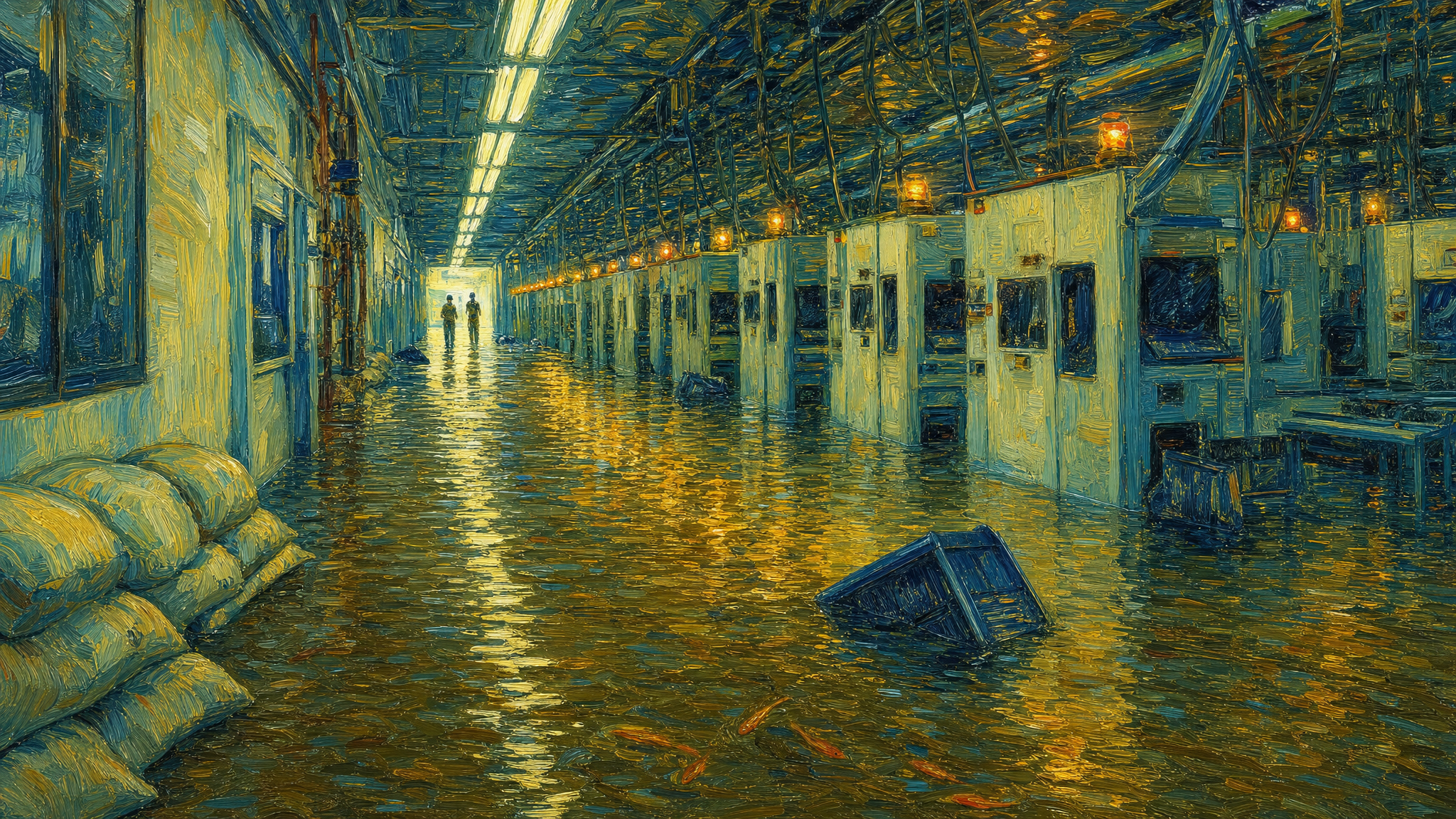
5. Western Digital lost the one piece nobody else could make for them. Water rose at the Bang Pa-in estate on 15 October; the company shut down and evacuated. The facilities ended up under 1.8 meters of water, with fish swimming across the ground floor like an aquarium. The critical loss was the slider fab. A slider is the aerodynamic ceramic piece attached to the read/write head that keeps it from touching the platter — no sliders, no hard drives. WD assembled 40% of its drives in Malaysia and could source some sliders from a third party in the Philippines, but losing in-house slider capacity put up to 75% of pre-flood production at risk. A week after the breach, 500 engineers and senior managers went in to salvage what they could, while the other 38,000 workers stayed home at 75% pay. Thai Navy divers were sent in; the equipment was too heavy to lift whole, so it was disassembled underwater and brought up in pieces. 670 pieces of slider equipment were eventually recovered, about 80% of it reusable.

6. The timing could not have been worse. A round of price cuts and excess capacity in 2010 had crushed gross margins and triggered consolidation — WD announced its acquisition of Hitachi in March 2011, Seagate its acquisition of Samsung a month later. The floods hit a market where supply and demand had just come back into balance, with no excess inventory to work off. Tom Coughlin estimated Q4 2011 demand at around 180 million units against actual production of 110–120 million — during the holiday shopping season, no less. Terry Gou said publicly that the floods would hurt more than the March 2011 Japanese earthquake. In Taiwan the flood barely made the news, but a 1TB drive at the Guanghua market jumped from NT$1,750 to over NT$3,000. In December, Intel announced it would miss its Q4 revenue forecast by a billion dollars, citing the hard drive shortage by name.

7. Supply came back. Prices didn’t. WD got a partial restart of its assembly plant in 46 days; the CEO and president attended the 30 November reopening to see the first finished drive come off the line, a week ahead of schedule. The slider fab didn’t restart until January 2012. Later research tracking supply quotes found HDD availability fell 40% overall right after the floods — 60% for WD items, 24% for non-WD — and returned to pre-flood levels after about nine months. Prices lagged badly: NewEgg retail prices didn’t reach pre-flood levels until April 2013, and BackBlaze’s retrospective found their cost per gigabyte of $0.044 in September 2011 wasn’t seen again until September 2013. The episode offers several candidate explanations: multi-year long-term agreements signed early on, the cost of duplicative factories built for resilience, demand migrating to flash-equipped tablets (HDD shipments peaked in 2010 and never returned to that volume), perpendicular magnetic recording hitting its areal density ceiling with HAMR and MAMR still years out, and the two acquisitions that same year leaving three major makers. On that last one the episode offers two words and lets you pick: the market was “stabilized,” or it was “cartelized.”
Going Further
”None of this shows up in the financials — so what am I supposed to read?”
That was my first reaction. No Seagate quarterly report has a line item for “my seventh supplier sits on a flood plain.” You can read customer concentration and inventory turns all day and never locate those two Nidec motor plants.
But the episode hands you a workable substitute question. Of Seagate’s three responses, the slowest was “aggressively qualifying new suppliers” — note aggressively, which is an admission that the normal pace wouldn’t do. So the question isn’t “is this company’s supply base diversified?” It’s “how long does it take to replace the top supplier?” That duration is the length of the pain you’d have to sit through.

Why were sliders so lethal? Precision ceramic, in-house line, one third party in the Philippines able to top you up. Replacement time measured in years, so the aftershock ran in years too. Flip it around: a component you can second-source in two weeks makes headlines when it breaks, not wounds.
When I look at a company’s upstream now, I go hunting for the part where nobody can name a second supplier. If I can’t find one, that usually means I haven’t read enough — not that it isn’t there.
”The bad news is over, so why won’t the price come down?”
Supply normalized in nine months; prices took two years. If you’d watched supply recover in mid-2012 and concluded prices would fall, you’d have been wrong twice — once on timing, once on direction.

I’d sort the episode’s candidate explanations into two piles, using one test: does this go away on its own once the water recedes?
Long-term agreements expire. Depreciation on duplicate factories finishes amortizing. Those go away. Two things don’t: tablets and flash took a permanent slice of PC drive demand, and the two acquisitions took the major players from five to three. That’s a structural shift on the demand side and one on the supply side. The water receding leaves both untouched.
So “when do prices come back” isn’t a question about the flood’s timetable — it’s a question about structure’s. The episode makes the mirror point too: Seagate and WD earned unusually fat profits and margins in 2012 on high drive prices, but that was always read as temporary, and things reverted to historical norms after 2013. Within one set of financials, some numbers revert and some don’t, and the test is where the money came from. High because of a shortage? It ends when the shortage ends. High because there are fewer players? You wait for the next entrant.

“Nobody could have predicted this, so what’s analysis for?”
I thought so too, until that 3.68% figure changed my mind.
What the 2023 study effectively did was grant the dam operators a god’s-eye view: given perfect knowledge of the coming rain, how much could you have saved? 3.68%. The number doesn’t tell you the dams were well run. It tells you the system’s fragility wasn’t located at the link everyone was yelling about. Public attention went to release timing; 73.7% of the water fell locally and had nothing to do with releases.
I find that useful for reading companies. The controversy everyone argues about after an earnings report is often the “release timing” — it looks like a decision error, you can assign blame, it makes a headline. The variable that actually determined the outcome may be the local rainfall nobody is discussing.
Predicting the timing of the flood: not possible. Seeing that 40% of capacity sits on a flood plain with seven critical suppliers living next door: possible. Every fragility in this story — the concentration, the single slider fab, the zero-slack supply-demand balance, the holiday-season timing — was visible before it rained. What you can’t forecast is the fuse, not the explosive.
Worth a Look
- Asianometry, “The Flood that Wrecked the Hard Disk Drive Industry,” 6 September 2026. The channel also has an earlier episode on how the HDD industry migrated to Thailand, and one on the 2010s recording trilemma and the areal density ceiling — both are useful background.
- BackBlaze’s retrospective on their blog, which charts cost per gigabyte from September 2011 through September 2013. It’s one of the few first-hand sources that renders price stickiness as a long time series.
- The 2023 study of 17 water release scenarios for the Bhumibol and Sirikit dams, and the 2020 study of gauge station data along the Chao Phraya — the basis for the episode’s revision of the blame narrative.
- Tom Coughlin’s Q4 2011 supply-demand gap estimate, and Intel’s December 2011 forecast update.
The One Thing to Take Away
Seagate’s factory never flooded. Seagate stopped production anyway. That line stayed with me: your risk doesn’t live inside you, it lives inside whoever you depend on — and its size equals how long replacing them would take.
Here’s something I’ve tried, if you want to try it too. Take a sheet of paper and write down three things you currently depend on. The colleague who’s the only one who knows how something works. The car that would wreck your week if it died. The email account every other account hangs off. The one person you call when you’re stuck. Three is enough.
Then write one number next to each: if they vanished tomorrow, how long until I found a replacement?
Precision isn’t the point. Two weeks, three months, or “I have no idea” all count as answers. When you’re done, the one that makes your stomach drop is usually not the one you think about most often. Everybody has a slider fab somewhere in their life. We just call it something else.
This article is an educational discussion of investment method. It is not advice to buy or sell any individual security, offers no target prices, and does not analyze any current holding. Investing carries risk; make your own decisions or consult a qualified professional.
Comments
Loading comments…