Odd Lots: New York's Trash Problem Runs Through an 1811 Street Grid and a Truck Nobody Built
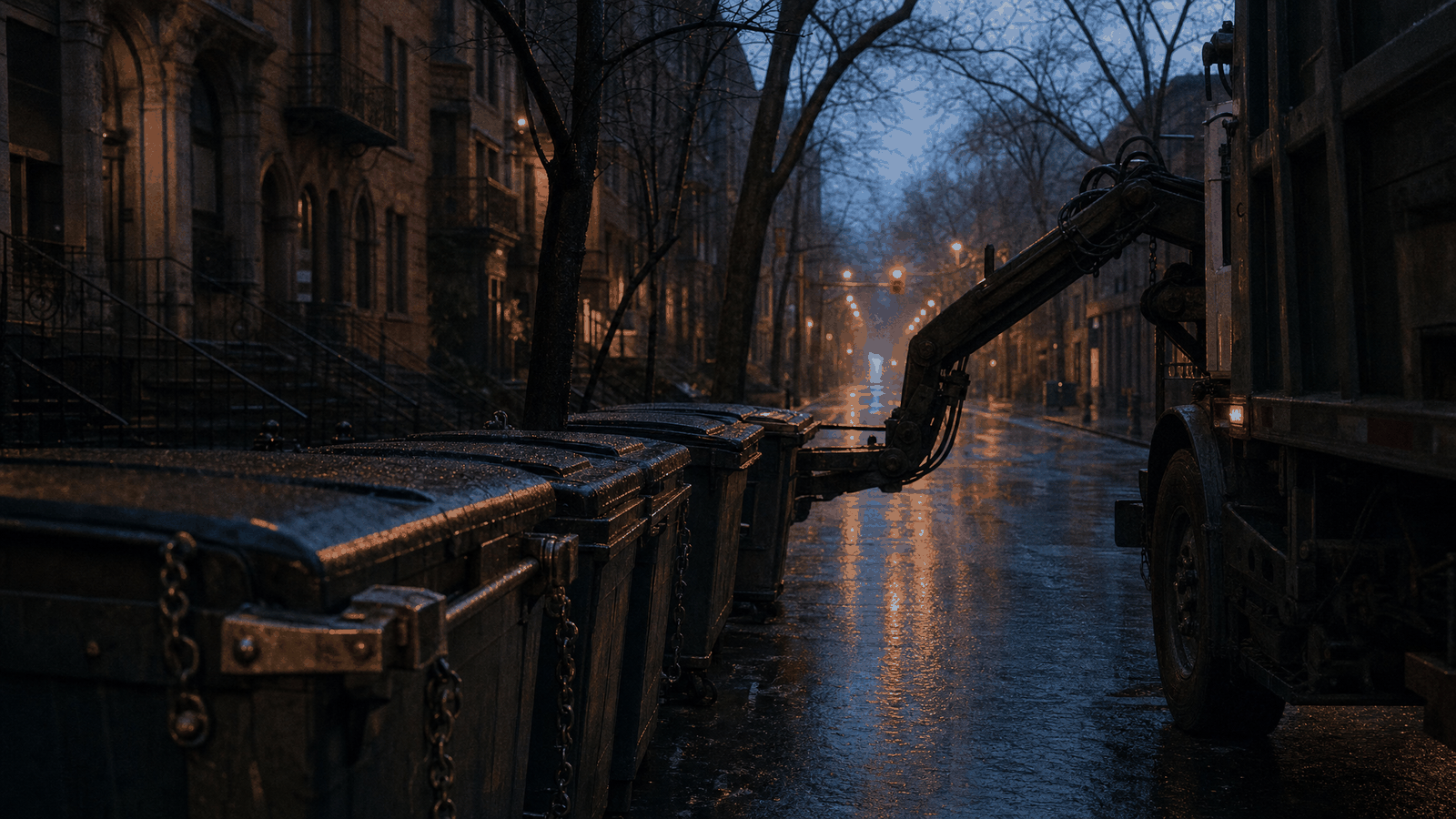
Notes on the Odd Lots episode published 9 November 2026, where Tracy Alloway and Joe Weisenthal talk with Joshua Goodman, Deputy Commissioner at New York City's Department of Sanitation, about how the city gets its garbage out: 24 million pounds of refuse, recycling and compost a day, a 70,000-block volumetric analysis, a side-loading collection truck prototyped in ten months, and a parking impact estimate revised from 150,000 spaces down to roughly 30,000. Containerization started in West Harlem in June 2025, with a commitment to cover all 59 community districts by the end of 2031 — on annual budget cycles, so the commitment is not an appropriation. Educational listening notes only, no investment advice, no price targets, and the judgements here may be wrong.
Contents
One must imagine Sisyphus happy.
—— “The Myth of Sisyphus,” Albert Camus, 1942 (my own rendering)
In the Odd Lots episode published on 9 November 2026, Tracy Alloway and Joe Weisenthal host Joshua Goodman, Deputy Commissioner at New York City’s Department of Sanitation, on how the city gets its garbage out. Goodman says the department collects, processes and exports 24 million pounds of refuse, recycling and compostable material every single day, and that putting trash into containers on the street — something European and Asian cities have done for decades — has never been done by any city in North America. New York began in one community district in West Harlem in June 2025, reached Brooklyn Community District 2 in autumn 2026, and the mayor has committed to funding a full rollout across all 59 districts by the end of 2031. He is also clear about the limit of that commitment: the city runs annual budget cycles, the money is not sitting in an account, and the commitment is the strongest version available today.
Treating the mess as nobody caring, and Barcelona as a copy-paste
My old view was simple to the point of arrogance. Those black bags on New York sidewalks read to me as a symptom of slack governance: the city has the most expensive real estate and the densest population on earth, and it still has residents leave food waste on the pavement overnight. My explanation was that nobody wanted to deal with it seriously, and everyone got used to it. European cities had been putting trash into on-street containers for decades in Barcelona and Amsterdam, so what New York needed was a copy.
Two shallower judgements sat underneath that. One was that I treated recycling as theatre for residents — sort it all, then watch it go into the same hole. I had seen that line online too many times and took it on board. The other was that collecting trash carried no ideology: Mayor LaGuardia’s line that there is no Republican or Democratic way to pick up the garbage sounded self-evident, since either it gets picked up or it doesn’t.
Goodman takes that quote apart. He calls it patently untrue, and says that the moment you dissect it you see that an enormous public-space logistics programme is going to be coloured by ideology; the quote frames the thing as a binary and undersells the planning behind it. His own framing is a set of questions: is the person you are designing for someone who spends their public time in a car, or walking? Is a rat a curiosity to them, or a daily reality? Who you put first changes the answer. He says a person who walks down a dirty street on the way to work thinks, first thing, that nobody cares about me, and he isn’t going to blame them for it.
No alleys in 1811, plastic bags in 1968, and then no truck in North America
The first thing that moved me was learning that New York’s black bags have a traceable origin.
Goodman points to two events. The first is the 1811 street plan. In New York, he says, the only non-renewable resource is public space — there is a finite amount of room — and the 1811 grid was laid out without alleyways. Chicago has comparable density and alleys behind most buildings to store trash. He adds a detail I enjoyed: when a movie set in New York has someone jumping out of a dark alley, it was shot in Chicago or on an LA soundstage, because New York doesn’t have them. With no storage space behind the buildings, the trash goes to the sidewalk.

The second event is the 1968 sanitation strike, the city’s last major sanitation labour action. The volume during the strike went far past what the metal cans on the street could hold, and when it was resolved Mayor Lindsay set up groups to study the after-effects. One of them was called the Committee on the Black Bag. It studied plastic trash bags, which were new at the time, and the plastics industry was pushing them as rodent-resistant. Goodman says you can easily find newspaper coverage from that period of people proudly announcing that moving from metal cans to black bags would cut rats and free up public space. It became clear quickly that this was wrong, and it took the city roughly five decades to get serious about a new solution. That stretch was the most useful part of the episode for me: the most visible feature of a city’s streetscape can be the residue of one crisis response plus one industry’s marketing, carried for half a century.

The second thing that changed my mind is that they found a missing layer of data. Sanitation is a data-driven agency with close to a century of records on the weight of the trash, because weight had long been their primary efficiency metric. Containerization asks about volume instead: whether a container holds a block’s daily output is a question about volume. There was no ready conversion between the two, so they ran a 70,000-block volumetric analysis — going out and measuring piles of trash, converting a century of weights into volumes, and measuring the streetscape itself while they were at it. You may know the length of a block, but the bin can’t sit in front of a curb cut or a hydrant, and because they chose a side-loading model they also had to account for tree canopy height, since the arm can’t swing up into a tree. On capacity they planned for one extra day above collection, because the day after Christmas runs several times normal.

Then comes the part I never expected to be a blocker: the truck. No city in North America does on-street containerization, so no automated side loader existed that was appropriate for New York residential use. He went to see one in operation at the Port of Philadelphia and found it so loud that the idea of it coming down your street was ludicrous. European trucks can’t simply be imported — different emission standards. Truck industry experts told him designing one from scratch would take about five years. They weren’t waiting five years, so the department got into the truck design business, something Goodman knew nothing about going in, and had a prototype in about ten months. It is assembled from parts: the European side-loading body, a Mack chassis identical to the one under many of their current collection trucks, and a firm that specialises in getting the two sets of electronics to talk to each other. About 20 are running now out of a fleet of roughly 2,300.

The last piece is the European model I assumed was copyable. New York declined the open shared containers common in Europe for two reasons. One is money: residential collection in the city is free, unlimited and has no means test — you put it out, they come and get it, and Goodman says it is basically them and the public library at this point. Businesses pay private carters for their collection, so a free open bin on the street invites a business to put its trash in. The other reason is belonging. They read Defensible Space, by the 1970s urban planner Oscar Newman, whose finding was that controlling for income, age and other demographics, public housing still had a higher crime rate than market-rate housing, and that part of the cause lay in the design of the space: significant parts of many developments felt like they belonged to nobody, because they belonged to everyone. Sanitation carried that over to cleanliness and asked how to make every part of the city belong to someone. So a building’s container is assigned to that building; it sits in front of your building because it is yours. The effect he wants is that no corner of the city lets a person litter, or watch someone else litter, and think it’s not their problem.

Two numbers belong side by side. The Future of Trash report in spring 2022 said on-street containerization could take up to 150,000 parking spaces, out of roughly 3 million citywide. Once they had gone further into analysis and implementation, the follow-up Back to the Future of Trash put full rollout at around 30,000, with room to go lower as more buildings opt into sharing. He also says the pushback they heard at the start was mostly conceptual — I bet people will be mad about parking — and that very few people are mad about parking.

Two failed experiments stayed in my notes. In 2018 the department ran a one-district pilot of the Tokyo and Mexico City approach and removed every litter basket, since people often say the baskets attract trash. People littered everywhere. The other is Barcelona’s own self-assessment: American urbanists will tell you Barcelona is the perfect answer, and the Barcelona people said they still have plenty of issues, one being that they converted their fleet too heavily to side loaders, then learned that residents still leave a loose bag beside the container once in a while and the couch still needs picking up, so they had to go back for a different truck. New York is keeping the traditional rear loader in the programme for that reason.

One stretch had nothing to do with trucks or data and stayed with me longest. Of the department’s 6,500 sanitation workers, out of about 10,000 staff, half of all line-of-duty injuries are sprains and strains from throwing bags, so mechanised collection is a material difference for their backs and knees. The injury he says has risen sharply is needle sticks, which they attribute to people buying GLP-1 drugs from online pharmacies — the needles come with an instruction booklet, but the package arrived from an internet pharmacy and nobody reads it, so people think this is trash and it goes away in the bag. What he wants people to remember is that a human being handles your garbage. I also liked his account of the mirrored collection truck the artist Mierle Laderman Ukeles designed for the department in the early 1980s, a piece called Social Mirror: I make the trash, and when I see the trash, that’s me. They bring it to parades now and people call it the selfie truck. Goodman says it isn’t the selfie truck.
What blocks a thing for fifty years can be one layer of data nobody measured
What I keep thinking about is the same misread in another setting. A company says it is transforming, writes it into the annual report three years running, and the product line doesn’t move, so we hand it a conclusion: management doesn’t want to. The correction this episode gave me is to look for two things first — which layer of data they are missing, and whether anyone manufactures the part they need. New York was missing both: the gap between weight and volume on one side, the truck nobody built on the other. The unwilling-management version can’t explain a 70,000-block volumetric study, and it can’t explain a ten-month prototype.
Applied to reading companies, the question I would add is whether what they currently measure lines up with what they say they are going to do. When a dashboard is full of one kind of number and the announced direction runs on another kind, that gap is where the timeline stretches.

The second thing I take with me is the size of that revision. From 150,000 parking spaces to about 30,000 is a factor of five, and both numbers came from the same agency. I wouldn’t call the first number dishonest — it was a feasibility-stage upper bound — but it tells me that a plan’s earliest published number and its number at implementation are two different objects, and public argument often spends years treating the first as the second. Next time I see an impact estimate for a new programme, I’ll ask which stage it came from.
A few things I haven’t worked out, written down so I don’t read this back too confidently. I agree with the point Tracy raises at the end: residential trash in New York isn’t pay-as-you-go, so heavy wasters are subsidised by people who throw out very little, and that is a political choice the episode doesn’t go on to litigate. The second is 2031. Goodman says the commitment is as good as it gets and the city council supports it, but the city runs annual budgets, several mayors and several budget cycles sit between here and there, and the remaining 57 districts take five years to cover. The third is behaviour. He says himself that he hopes to re-evaluate littering after full containerization, since piles of trash attract more trash, and only once the streets no longer have heaps of black bags will anyone know what kind of littering is left.
Worth a look
- The Odd Lots episode of 9 November 2026, the source for this piece, hosted by Tracy Alloway and Joe Weisenthal with Joshua Goodman, Deputy Commissioner at NYC’s Department of Sanitation
- Defensible Space by Oscar Newman (1972), which the episode credits for the logic behind assigning containers to buildings
- The Department of Sanitation’s Future of Trash (spring 2022) and the later Back to the Future of Trash, whose parking estimates differ by a factor of five
- The 1811 Commissioners’ Plan for New York’s street grid, which explains why the city has no alleys
- Social Mirror, the mirrored collection truck Mierle Laderman Ukeles made for the department
- The city’s compost giveaway at NYC.gov/getcompost, which distributed about 15 million pounds of finished compost this past season
The one thing to take with you
One idea: a place nobody owns is a place nobody looks after. That is what Newman found in public housing, and it is what New York is betting on by assigning each container to a single building and keeping it out of shared use. The mess tends to land in the few metres where belonging is vague.
Something I’ve tried: find one place at home or at work that nobody owns — the shared fridge, the landing on the stairwell, the task in the group chat that nobody has claimed — write it down, put a name next to it, your own will do, and look after it once this week.
This article is an educational discussion of investment method. It is not advice to buy or sell any individual security, offers no target prices, and does not analyze any current holding. Investing carries risk; make your own decisions or consult a qualified professional.
Comments
Loading comments…