Enough Fear to Fill the Trenches, Yet War Still Needs a Decision: Reading Westad's The Coming Storm
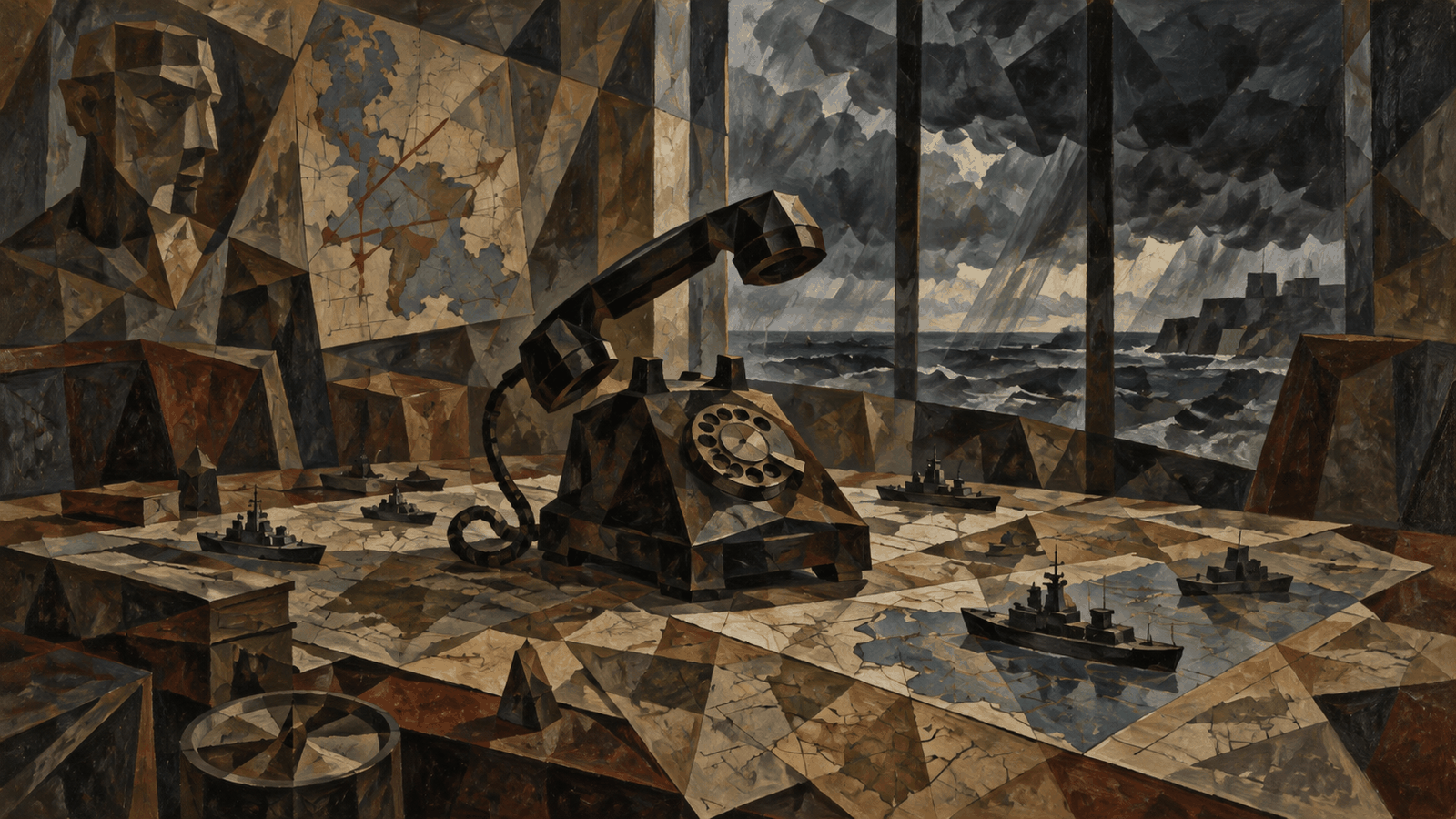
Yale historian Odd Arne Westad sets pre-1914 Europe beside today's multipolar world. The passage I keep coming back to: fear and resentment between Great Powers are never in short supply, and what actually pushed the world into war was a handful of concrete decisions made during a crisis. An educational reading note, not investment advice.
Contents
In safety, think of danger. If you think of it, you prepare; if you prepare, there is no disaster.
—— Zuo Zhuan, Duke Xiang year 11 (Spring and Autumn period); translation mine
Living next door to a flashpoint
If you live in Taiwan, every few weeks a headline tightens your chest: military drills, tariffs, a harsh line from some leader. The tension fades after a few days, life goes on, and then the next one arrives. After a while I realized I could no longer tell which ones deserved real worry and which were noise.
That’s why I picked up this book. It asks whether the Great Powers will fight another major war, and it talks about Taiwan directly, more than I expected.
The author and the book
Odd Arne Westad is the Elihu Professor of History and Global Affairs at Yale, a historian of modern international history who specializes in East Asia since the eighteenth century. His The Global Cold War won the Bancroft Prize, and Restless Empire: China and the World Since 1750 won the Asia Society book award.
The Coming Storm: Power, Conflict, and Warnings from History came out from Henry Holt in March 2026 (publisher page, Amazon, Apple Books). A Traditional Chinese edition was published by Linking in Taipei on June 11, 2026 (Books.com.tw).
It’s a short book: an introduction, three chapters, and a conclusion. Chapter one covers how the powers rose, chapter two their fears and resentments, chapter three how wars actually start, and the conclusion how to avoid one.
”Made in Germany,” 130 years ago
Westad’s central claim is that the system being born today resembles the pre-1914 world more than anything since. The Cold War was too bipolar, two blocs living separate lives. The interwar years were dominated by economic collapse and hateful ideologies. Pre-1914 Europe, by contrast, had several powers grinding against each other, an old hegemon slipping, new ones pushing up, globalization stalling, and tariffs and nationalism rising together.
One of his examples made me laugh, and then it stopped being funny. In 1896 the British critic Ernest Williams published a book called Made in Germany. The cloth in your own clothes, he told readers, was probably woven in Germany. Walk around the house and the mark greets you everywhere, until “you go to bed, and glare wrathfully at a text on the wall; it is illuminated with an English village church, and it was ‘Printed in Germany.’” His answer was tariffs, to protect British industry and jobs.
Swap the country names and you could read that on a cable news panel tonight. Westad puts the numbers side by side. Britain’s share of global manufacturing fell from about 23 percent in 1890 to 13.5 percent in 1913. China’s share in 2023 was 28 percent; Germany’s in 1913 was 15. “I am a Tariff Man,” says Donald Trump, and a century earlier Britain’s Joseph Chamberlain also walked away from free trade once the national edge had shrunk. The rising powers answered the same way both times, accusing the old hegemon of getting rich on free trade and then pulling up the ladder.

He describes the rising power as “a very unhealthy mixture” of hubris and fear. Pre-war Germany’s industrial output grew two and a half times between 1870 and 1914, yet its leaders felt encircled by Britain and worried that growth was about to peak, which made a gamble look tempting while strength lasted. He sees the same mixture in today’s China, where a slowing economy and a population that started shrinking in 2023 might make “now” look like the best moment.
Fear enough to fill the trenches
By this point I assumed he was about to say war is coming. Then, at the start of chapter three, he pulls back. This is the passage I’d call the heart of the book:
In the early twentieth century, just like today, there were enough fears and resentments among Great Powers to fill all the trenches on the Western Front or all the nuclear silos ever built. But such attitudes, by themselves, rarely produce Great Power war. Wars need causes, real or imaginary.
He then walks through the summer of 1914. On June 28, nineteen-year-old Gavrilo Princip shot the Austro-Hungarian heir in Sarajevo. On July 23, Vienna sent Serbia an ultimatum with a 48-hour deadline, written so it could not be accepted in full. Serbia accepted most of it; Austria-Hungary declared war anyway on the 28th. Russia mobilized on the 30th, and Germany declared war on Russia on August 1. The British cabinet argued to the last minute without signaling clearly whether it would fight, and only declared war on August 4, after German troops entered Belgium.
His conclusion: however menacing the backdrop, what led to the cataclysm was “Austria’s attack, Russia’s mobilization, Britain’s hesitance, and—in the final instance—Germany’s willingness to risk war and, in the end, declare it.” Fear is the dry wood. Decisions are the match.

Taiwan in the book
Westad spends real time on Taiwan. His image: Taiwan is “a bit like Alsace, Bosnia, and Belgium rolled into one.” Alsace, because Beijing treats it as lost territory bound up with national identity. Bosnia, because one local crisis could drag several powers in. Belgium, because whether a great power would come to its defense shapes whether an attacker dares to move.
He cites a few figures. About 65 percent of people on Taiwan now identify as Taiwanese, 30 percent as both Taiwanese and Chinese, and only about 5 percent exclusively as Chinese. The two economies were once tightly bound, yet today only 5 percent of Taiwan’s FDI and less than a third of its trade goes to the mainland. His point is that economic interdependence did not hold back political decline, and Britain and Germany were each other’s biggest European trading partners before 1914 too.

The most dangerous frame of mind in Beijing, he suggests, is the fear that “time for unification may be running out.” A decade or so ago China’s leaders believed time was on their side. With the economy slowing and younger people on Taiwan feeling more Taiwanese, that anxiety could invite risk-taking.
His remedy is credible deterrence:
If German leaders in July 1914 had been convinced that Britain would join in against them, it is much less likely that they would have declared war on Russia and France. Today, if CCP bosses believe that the United States will help defend Taiwan, it makes it less likely that they will attack the island.
He admits Washington is in a bind. Forty years of “strategic ambiguity” only work if Beijing believes America is likely to act, and trading ambiguity for certainty is sure to raise tensions.

The real danger is thinking it can’t happen
One number stopped me: less than half of one percent of the world’s population has experienced a Great Power war. The nineteenth-century statesmen who kept Europe’s peace grew up in the shadow of the Napoleonic wars. They were afraid. My generation doesn’t carry that fear.
Meanwhile popular hostility runs higher than before 1914. Two in five Americans told pollsters a war with China within five years is likely, and Westad says that level of mutual suspicion exceeds what existed before World War I. A belief that big wars can’t happen, sitting right next to a belief that the other side is out to get you: that pairing is what unsettled me most in this section.

He adds one more layer. In 1914, railway mobilization timetables convinced generals that whoever moved first would win, squeezing diplomacy into a few days. AI, drone swarms, and hypersonic weapons will squeeze decision time even further.
What I took from it
This part is my own; the book says nothing about markets.
When a cross-strait or tariff headline hit, I used to tense up and go check my account. Since reading this I’ve added one step: which pile does this belong in? One pile is background: fear, resentment, harsh words, polls. The book says there was enough of that a century ago to fill the trenches, and on its own it rarely became war. The other pile is someone making a concrete decision they can’t take back, like an ultimatum with a short fuse, a mobilization order, or refusing to take the other side’s call.
That last example comes from the book. Westad notes that the leader hotlines left over from the Cold War now count for very little, and the Chinese side has several times simply not picked up calls from the Pentagon. He also reminds us that the Kaiser, the Tsar, and King George V were cousins; closeness didn’t prevent war, “but an answered phone call may buy extra time.” To me that’s a signal ordinary people can actually see. Background shows up every day. The decision is the match.
One thing to take with you
The line I kept: fear is everywhere; what’s worth watching is who makes a decision they can’t take back.
Here’s something I tried, if you want to try it too. Next time a headline makes your chest tighten, whether it’s cross-strait news, tariffs, or a rumor of layoffs at your company, hold off on forwarding it. Take a sheet of paper, draw two columns labeled “background” and “decision,” and write down the facts from the story in each. Doing that much counts. A week later, look at the sheet again. Whether the right-hand column is empty or not tells you whether that story was worth the tension you felt that day.

This article is an educational discussion of investment method. It is not advice to buy or sell any individual security, offers no target prices, and does not analyze any current holding. Investing carries risk; make your own decisions or consult a qualified professional.