Columbia Energy Exchange: You Only Find Out What Was Walking on Its Own After the Handrail Comes Off
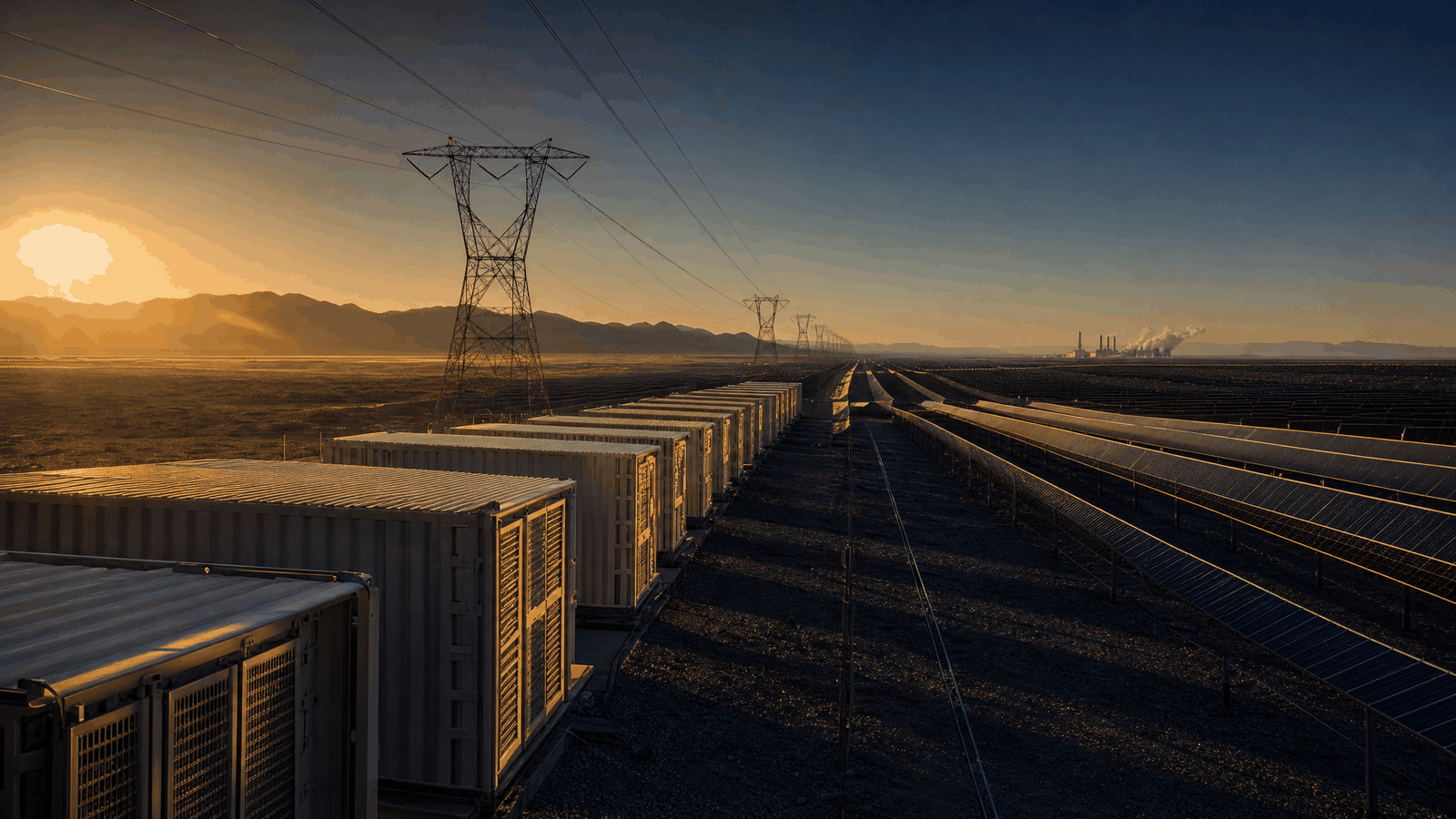
Notes on the Columbia Energy Exchange episode of 17 November 2026, where Jason Bordoff talks to BloombergNEF's Ethan Zindler and Columbia visiting fellow Lily Bermel. Zindler puts BNEF's build-out through 2036 at about 530 GW of solar, about 100 GW of wind and about 400 GW of battery storage; after most clean energy tax credits were cut, BNEF's initial 20-25% haircut has narrowed to roughly 6-7% below its pre-bill forecast. Educational listening notes only - no investment advice, no price targets, and the judgements here may be wrong.
Contents
The green hills cannot hold it back; eastward, after all, it flows.
—— Xin Qiji, “Pusa Man: Written on the Wall at Zaokou, Jiangxi” (Southern Song, c. 1176; my own translation)
In the Columbia Energy Exchange episode of 17 November 2026, host Jason Bordoff talks to two guests: Ethan Zindler, who leads country and policy research at BloombergNEF (BNEF, Bloomberg’s energy transition research arm), and Lily Bermel, a visiting fellow at Columbia’s Center on Global Energy Policy. Zindler’s numbers: BNEF sees about 530 GW of solar built in the US through 2036, about 100 GW of wind, and what he calls perhaps the most important piece, about 400 GW of battery storage. And after the One Big Beautiful Bill Act cut most clean energy tax credits, the 20-25% haircut BNEF called right after passage has narrowed to roughly 6-7% below its pre-bill forecast. Bermel’s framing is that the administration is creating near-term headwinds which cannot repeal the structural tailwinds — what holds the build-out up is demand growth the economy has not seen in decades. Two caveats: those two figures run off different baselines and do not belong on one scale, and both speakers assume the pace of data centre build-out is not interrupted by state policy.
The credits are gone — why didn’t clean energy fall over?
Because demand arrived at the same time, and wind, solar and batteries are the fastest things to build right now. Bermel released a report this summer called Glass Half Full. It takes the Biden-era policy environment as the baseline — the Inflation Reduction Act credits plus the EPA power plant rules — then applies today’s environment, with the rules rolled back and some credits removed, and asks how much clean capacity still gets added over the coming decade. Her answer is about three quarters. Her reasoning sits in market structure rather than in the model: wind, batteries and solar are mainstream, mature, highly penetrated technologies, and the demand pull is strong enough that they were about 90% of what got added to the grid last year.
Zindler’s number starts from a different baseline. BNEF compares against its own pre-bill forecast: a 20-25% haircut at passage, several upward revisions since, and now a gap of only 6-7%. He says he does not quite understand the controversy, because the reason for the revisions is simple — top-line electricity demand is providing ballast for everybody. His image for it is a big tide lifting a lot of boats, renewables and gas both in the water. Bermel puts it more bluntly: it is always worth clarifying which glass we are talking about. Hers is relative to Biden-era expectations; his is clean power as a share of the total. Three quarters and 6-7% come off two different rulers, one against a 2021 baseline and one against BNEF’s own pre-bill forecast, and merging them gives you a wrong conclusion.

How can record clean energy and a gas boom happen at once?
Because the denominator is growing. US power demand was basically flat for two decades, in a swap-and-replace market where coal retired and gas plus renewables filled in. Now top-line demand is growing on its own, so both sides are building.
Zindler’s sense of scale: the US has roughly 1,400 GW of installed capacity today. This year is a record build year, next year another, with around 90 GW of wind, solar and storage. Then a dip to something near 75 GW a year, and in the 2030s a recovery to 100-110 GW a year — the era in which, in his view, the market has moved past tax credits and stands on its own. He heads off the limits of the unit himself: storage is not generation, and renewables run at lower capacity factors than gas, coal or nuclear, so you cannot scale new capacity into proportionally new generation.

Data centres are the main driver of this round. He puts their current share of US power demand at “I’m going to guess about 5%” — an estimate on the spot, not a looked-up figure — tripling or more from here, with about two thirds of that growth met by gas-fired generation. Bordoff pushed the frame out to the whole country, asking whether that also means more than half of all US demand growth comes from gas; Zindler’s answer was a single yes, with no further numbers.

There is a reverse risk hiding on the gas side. Adding data centre gas demand to LNG demand, he gets to a US gas market that could in theory start to tighten over the next couple of years — and for data centres without enough pipeline capacity, the price of gas could go up.
Who were those credits actually paying?
Bermel’s judgement: the majority goes to the large developers and companies who would have built anyway, which makes it essentially free money to them, and a lot of lawyers and accountants are very happy about it.
Her path there: build-out held up after the credits came off, which says the credits were not creating deployment that would not otherwise occur. She adds the observation from the field I most wanted to write down — companies are starting not to plan around credits, because “you can only tell your EPC contractor to hurry up so much.” Nobody is putting forward a project that depends on a credit to pencil out. Credits can help a project pencil when gas prices and relative economics move, but so far they have not radically changed these projects’ economics or improved their odds of survival. She calls them closer to a discount for the companies that manage to survive the permitting gauntlet.
The schedule is worth noting, because it sets when the difference becomes visible. The wind and solar credits have effectively expired, leaving only safe-harboured projects — those under construction or able to demonstrate meaningful progress, and there is a considerable volume of those coming online over the next couple of years. The storage credit runs to about 2032 before phasing down. Solar and storage credits are 30% of capital expenditure: spend a hundred million dollars on a battery and you get a thirty million dollar credit. Wind is production-based — you earn as you generate.
So the policy has bent the shape of what gets built. Solar equipment is cheap now and the 30% on the battery is still available, so the fashion is a reasonably sized solar system with a giant battery attached, and the credit claimed on the battery. What a credit changes includes not only whether something is built but what shape it takes — and that one is still shaping the market into the 2030s.

The electric vehicle passage is the most counterintuitive in the episode. The $7,500 per customer credit for new EV purchases disappeared at the start of the fourth quarter of 2025, and monthly sales fell from somewhere around 180,000-190,000 to about 100,000. That same cut fed the other side: a set of battery makers had been building plants for a big EV market, got halfway through, and after the law passed faced a choice — finish the plants for vehicle batteries, or for stationary storage? They chose storage. The reason is that the battery credits still on the books into the next decade come with a condition: the batteries cannot be Chinese-made, so building domestic battery availability mattered, and that is part of what lifted BNEF’s forecast. Zindler’s summary is that the EV sector’s loss has been the clean power sector’s gain, with a zero-sum flavour to it.

If money isn’t the constraint, where is it stuck?
The finding from her own paper that struck Bermel hardest: the binding constraint on building clean energy has moved from cost to supply-side barriers. There is a literal ceiling on how much clean energy can be added each year and how fast.

That ceiling is most concrete in the permitting reform discussion. They recorded before the Senate’s motion to proceed, so both talk about what the bill could do: the transmission provisions could make it easier to build across state lines and let the US finally build high-voltage direct current transmission at scale, something China has sped ahead with. The cost is that environmental groups worry gas pipeline permitting gets easier in the same package, and Zindler says he understands both sets of concerns.
Bermel is clear about where behind-the-meter gas (generation built next to the data centre, outside the public grid) comes from: hyperscalers put an enormous premium on speed to build, and connecting directly to the grid is too slow and too cumbersome, so they build their own. By that logic permitting reform is the tool that pulls those loads back onto the grid. She also lists where she thinks money would do more: clean firm power like geothermal, advanced nuclear and carbon capture; grid equipment and supply chain, from transformers and inverters to poles and wires; and training the workforce.
Tariffs are the other thing adding cost right now. Zindler says the US often pays twice as much for a solar module as other markets, which is to say we are artificially inflating the cost of solar, while the domestic manufacturing industry it supports is still very small. Bermel adds that tariffs raise prices on more than modules — grid components are in there too — which makes removing them a ready-made way to cut costs.
Then the historical observation he prefaced with “whoever wants to come at me, fine”: BNEF has watched subsidies removed in other markets, most often feed-in tariffs, and the market afterwards tends to find a way to reduce its costs dramatically, most visibly in solar, repeatedly, in different places. His condition is no massive tariffs on imported goods. He leaves one question open: whether the horse has long since left the gate on conventional polysilicon modules, and whether the wiser move now is to enjoy the very low equipment prices available on the global market and deploy as fast as possible.
So what can I actually do with this?
The first sore spot is one I have hit myself: a policy headline lands, and do I now have to reprice everything I hold? My old reflex was to treat policy as the endgame and cut a whole industry’s growth rate the moment a credit was repealed. The episode offers a different first question — where the money comes from: who is paying for the demand, and how many percentage points of unit economics the subsidy represents. BNEF moved its haircut from 25% to 6% by changing a demand assumption, with the policy judgement left alone.
The second sore spot is “the news says record levels, should I be happy?” This episode gives a handy reading: share of additions, share of the total, and share of the growth are three different numbers. Clean energy at about 90% of last year’s additions, and gas meeting two thirds of new demand, are both true at once — and whoever writes the headline picks the one that suits them. I now ask whose denominator a percentage is using, which works well outside energy too.

The third sore spot is closest to the judgement I actually make in a portfolio: how do I tell whether a company stands on its own or on policy? Bermel’s line about the EPC contractor is a checkable signal — when customers are competing for construction slots rather than for tax credits, the demand holds up. The other shift is that the bottleneck has moved: with the constraint sitting on the supply side, the place where money is made moves from whoever can drive generation costs down to whoever can unblock interconnection, transformers and skilled labour. That direction is my inference from the episode; neither speaker named a single company.
Three things I am unsure about. The two estimates run off different baselines, and any merged conclusion drawn from them will be wrong. The 5% data centre share is Zindler’s on-the-spot estimate, flagged by him as a guess. And the whole episode assumes the pace of data centre build-out holds, while Zindler says it will be shaped by post-election state policy — he is quite pessimistic about what comes out of Washington over the next two years and more interested in the states, noting that Texas now sits at the centre of the entire political discussion and that a Democrat was elected to the Texas Railroad Commission, which does not happen every day.
Worth a look
- The Columbia Energy Exchange episode of 17 November 2026, the source for this piece
- Lily Bermel’s summer report Glass Half Full, estimating clean capacity against a 2021 Biden-era policy baseline
- BloombergNEF’s forecasts on the US power market and data centre demand
- The Center on Global Energy Policy white paper on the permitting reform bill’s provisions and their implications
One thing to take away
Whether something is walking on its own is only measurable once the handrail comes off.
While the subsidy is there, “a lot is getting built” has two explanations: the technology is already cheap enough to stand up, or the subsidy is working. Those two look identical in the data and cannot be separated. They part company only after the support is removed, and this episode’s answer is that the first explanation dominates — three quarters of the capacity still gets added, the haircut is 6-7%, and developers have stopped planning around credits.

Something I have tried that works outside investing too. Pick one thing you believe you do under your own steam — exercise, writing, a few pages of a book a day, staying in touch with one friend — and take away the external push for a week: switch off the reminder, stop logging it, stop scheduling it with someone, and see whether it is still there. What survives is yours; what doesn’t is useful too, because it tells you that handrail cannot come off yet.
This article is an educational discussion of investment method. It is not advice to buy or sell any individual security, offers no target prices, and does not analyze any current holding. Investing carries risk; make your own decisions or consult a qualified professional.
Comments
Loading comments…