Notes on Catalyst's global auto shift: America's 100% tariff buys time, not safety
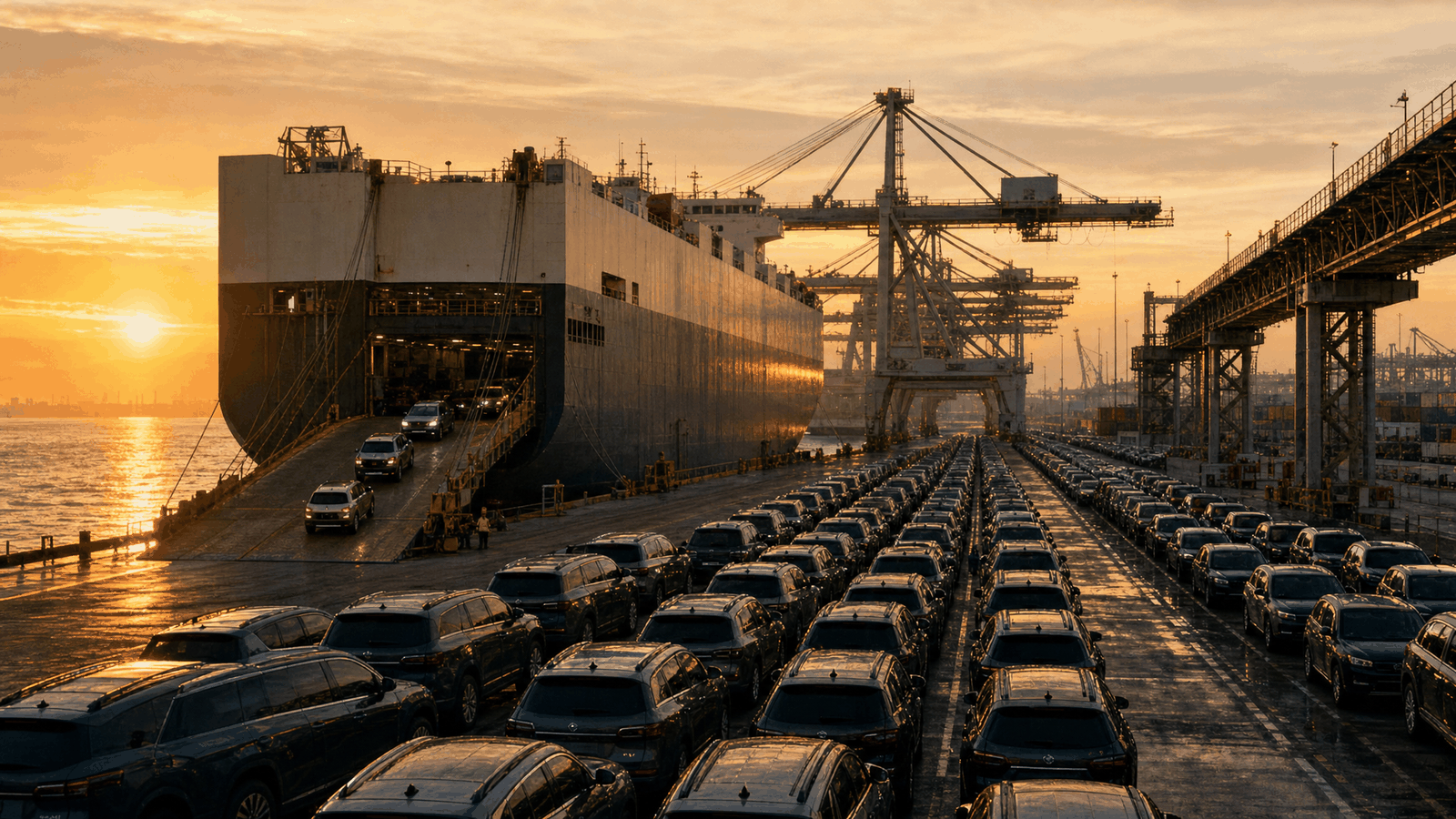
In the November 19, 2026 episode of Catalyst with Shayle Kann, host Shayle Kann talks with Dunne Insights founder Michael Dunne about Chinese car exports. Dunne's figures: China exported about 1 million cars in 2020 and is tracking around 12 million this year; domestic capacity is roughly 55 million units against 25 million of domestic demand, and about half of last year's exports were gasoline cars. The US is the one large market that keeps them out with a 100% tariff. Educational listening notes, no investment advice, no price targets, and my reading may be wrong.
Contents
This process of Creative Destruction is the essential fact about capitalism.
—— Capitalism, Socialism and Democracy, Joseph Schumpeter, 1942
In the November 19, 2026 episode of Catalyst with Shayle Kann, host Shayle Kann talks with Michael Dunne of Dunne Insights, who has tracked the car business from inside China for decades. Dunne’s numbers: China exported about 1 million cars in 2020 and is on track for roughly 12 million this year, more than Japan or Germany ever shipped at their peaks; domestic capacity runs around 55 million units against 25 million of domestic demand, which leaves fifteen to twenty million units idle and hunting for markets once exports are counted. The US is the only large market that keeps those cars out, with a 100% tariff, and the claim in this episode is that the wall buys time. The episode is titled around solar while the conversation is about cars from start to finish — a fitting slip, because Dunne’s throughline is that the playbook solar went through has come around to automobiles.
The tariff stopped the cars, so I assumed it stopped the story
I used to read Chinese EV news with two ideas in my head, and neither survives this episode.
The first was geographic comfort. There is no BYD in the showroom, a 100% tariff sits on Chinese vehicles, and rules keep Chinese hardware and software off American roads, so the whole thing read like foreign news. The second idea was more concrete: I assumed Chinese cars are cheap, so letting them in would answer America’s missing affordable car, and that the reason for keeping them out was protecting Detroit. Put together, those two ideas produce a lazy conclusion — whether Chinese cars get in is American politics, with little bearing on the companies I actually follow.
Dunne pries that open in his opening line. He describes the Chinese car industry as giant, brutal, ruthless, and like a meteor from outer space heading our way — a meteor that has not made landfall. Something that has not landed looks theoretical from inside the United States. From anywhere else, it has already hit.

Twelve times the exports, and several ways around the wall
Dunne has watched this playbook since the 1980s. On his first trip to China, the goal was to dominate the world in buttons — the kind on your shirt. The method was to concentrate enormous capacity at home, let the competition there turn brutal, then export everywhere. They won, and they still hold it. After buttons came steel, solar panels, drones, and now cars.
What makes this round large is that the idle capacity is shopping in other people’s markets. Dunne says every country he has visited in the past 24 months, in every time zone, now has Chinese cars arriving — with the United States as the single exception. Mexico, Europe, South Africa, Thailand, the Middle East, all at once. So the pain shows up outside America. Volkswagen has said it will cut 50,000 jobs by 2030 and is closing plants for the first time since the Second World War. Honda posted a loss last year, its first since the 1950s, because it is being beaten down in Thailand, Indonesia, Australia and the UK. Dunne names Nissan and Stellantis as the most vulnerable today, and expects them either to joint venture with the Chinese and eventually be absorbed, or to have their brands bought outright. What stayed with me was his timing: this is happening in Europe now, with no three-to-five-year cushion.

The composition of those exports is the other thing I had wrong. I assumed this wave was electric. Dunne says half of last year’s exports were gasoline cars, because the overcapacity covers every powertrain. Inside China, EVs went from 5% of the market in 2020 to half today, while the export mix carries both.

The pricing section is the hard part. China can build an electric car and sell it under $10,000 — a BYD Seagull starts around $8,500, with per-unit cost Dunne puts at roughly $7,000 — and building the same car there runs 30% to 40% cheaper than in Europe or the US. His conclusion is that there is one answer to where you should build an EV, and Tesla is the proof, with half of its global production sitting in China.

So why, even behind a 100% tariff, is there no flood? This is the most counterintuitive stretch of the episode, and it overturns what I had been hoping for. That $10,000 car in China would not pass US safety homologation. The same Seagull sells for about $20,000 in Mexico, where standards are lower, and Dunne puts a US-legal version around $25,000. At that price an American buyer is looking at a small car with short range and ordinary styling, and wants something bigger. More to the point is what the Chinese makers want: they are starved of profit at home. Dunne says the manufacturers he talks to show little interest in solving America’s affordability problem and a great deal of interest in attacking the large SUV and pickup segments. BYD’s mid-size Shark pickup aims straight at the Tacoma and the Ranger, and he knows full-size pickups and SUVs sit in other Chinese pipelines. They would come in with the highest-end vehicles they can build, chasing margins they cannot find anywhere else.
Which is why the wall has several ways around it. Mexico dropped import duties to zero mid-COVID and spent the next two years as the single largest destination for Chinese exports; Dunne was recently in Mexico City and saw dozens of brands, Chinese cars all over the streets, dealerships going up. Under American pressure Mexico raised the duty to 20% last September and to 50% this January, and the response from Chinese executives was to start looking at plants inside Mexico — assemble locally, sell locally. To the north, Canada held the line at 100% alongside the US and then opened a first duty-free quota of 49,000 electric vehicles; the first batch arriving is Teslas built in China, with Volvo, SAIC, BYD and Geely queuing behind it. And in San Diego, Dunne says it is not unusual to see BYDs and MGs cross the border for the day; among the people who commute across every day, some buy a Chinese car there, register it there, and make it their daily driver, which also shows up near El Paso and in Phoenix. The numbers are small, and his inference is that as Americans see those cars and decide they want one, the pressure runs toward letting them in.

Cybersecurity is America’s firmest argument, and Dunne puts it back into the power relationship. The UK, Australia, New Zealand, Brazil, Mexico and Canada shrug at software-defined Chinese cars. The US sees itself in a knock-down rivalry with China, so the same car is a risk here. His example is Iran, where traffic lights and their cameras were hacked by the Israelis, who then knew where everyone was, and he says the same tool could take the form of cars. The scenario he describes is a few cities told at once to run the red lights and ignore the stop signs, and the US having more to lose than other countries. As for how the wall ends, he bets on the TikTok outcome: a joint venture, American majority ownership, everyone shrugging that it is Chinese and also American. In his words, like gravity or water, the Chinese will find a way in.
Where I now put my eyes: the overseas lines of American carmakers
You may have had this puzzle too. A company holds its domestic share, nothing in the news looks broken, and the stock stays weak. The measure this episode handed me is to go look at its export markets. Volkswagen’s plant closures and Honda’s loss happened in Thailand, Indonesia, the UK and Australia — places that live in a segment footnote and make no headlines. A carmaker’s home numbers can hold for two or three years, while the overseas share it loses does not come back, because a buyer who has switched cars once has switched habits. The same question inverts into the supply chain: the valuable position belongs to whoever collects rent on that overcapacity — batteries, charging, vehicle software — layers the car passes through whatever badge it wears.
The second puzzle is whether the cheaper side wins. The Seagull sells at $8,500 against a cost near $7,000, and Dunne says margins are ultra thin by any standard anywhere, so they are selling like crazy without making much money. Thin margins fund scale; they do not fund a decade of research and warranty claims, so who survives this industry is still open. I also keep myself from fixing on today’s brands. Dunne counts more than 60 Chinese carmakers and over 100 brands, like a school of fish of every shape, size and colour swimming in different directions. Solar already turned its names over once — the biggest manufacturers of a decade ago are mostly gone. Consumer brand loyalty may make cars behave differently, but I will not assume today’s names are the names in five years.
Autonomy is where my reading moved most. Dunne frames it as a two-horse race between the US and China, with China’s edge in regulation: the regulators he talks to there see their mission as smoothing the path to commercial ramp and ask what you need to go faster, while American regulators ask how to make sure nothing goes wrong. So the US leads in invention and China leads in commercialization, and Chinese autonomous vehicle makers are already pushing into the Middle East, the UK and Germany. Tie that to the price structure and an interesting inference falls out: an American cannot buy a fully self-driving car he owns, because the sensor suite is expensive, while a Chinese car that starts far lower can carry advanced autonomy to private buyers. Dunne says the Chinese consumer reads a car differently from the Detroit car culture he grew up in — it is a projection of social status and a gadget, and since driving in Beijing or Shanghai traffic offers no fun, not having to drive is better. His bet is that autonomy spreads there faster than EVs did. On charging, his signal is that it is good enough that nobody thinks about it any more: the fast chargers sit inside the cities, so people charge on the commute, at the office, at the mall.

Three things I am unsure of. How long thin margins hold, since the episode offers no cash flow or debt structure for these companies beyond “not making much money.” Whether Mexican assembly clears US safety homologation and rules of origin, since Dunne mentions plants being scouted and not that gate. And how much of the security concern is real risk versus industrial protection — he grants that the US looks over-paranoid and rests his own judgment on having more to lose, which is not a threshold anyone can test.
Further reading
- Catalyst with Shayle Kann, November 19, 2026, with guest Michael Dunne, produced by Latitude Media.
- Dunne Insights and his Driving with Dunne podcast, which track the Chinese car industry over time.
- His book Car Wars, due in January, on exactly this subject.
- The turnover in the roster of solar panel manufacturers, as a comparison for whether the car brands change hands too.
The one thing to take away
One idea: a wall does not change where water flows, only when it arrives. Tariffs, bans and homologation can block one path, and none of them touch the pressure of overcapacity itself, which converts into assembly in Mexico, into a badge that reads Dodge, into a minority stake in a joint venture. When you size up a wall, count the pressure’s alternative routes; the height of the wall comes second.
Here is something I have tried, offered as an invitation. Pick one thing you currently file as blocked and therefore not going to happen — a competitor your company keeps out, a technology the regulator keeps out, a change you keep out yourself. Write three routes it could take around the block, and after each one write a sign you would be able to see: a job posting, a new licence, a supplier that changed its name. Then set the paper as a reminder three months out, and on that day go count how many routes have shown a sign.
This article is an educational discussion of investment method. It is not advice to buy or sell any individual security, offers no target prices, and does not analyze any current holding. Investing carries risk; make your own decisions or consult a qualified professional.
Comments
Loading comments…