No Gas Stations at Sea: Catalyst on Anduril's Maritime Energy Problem
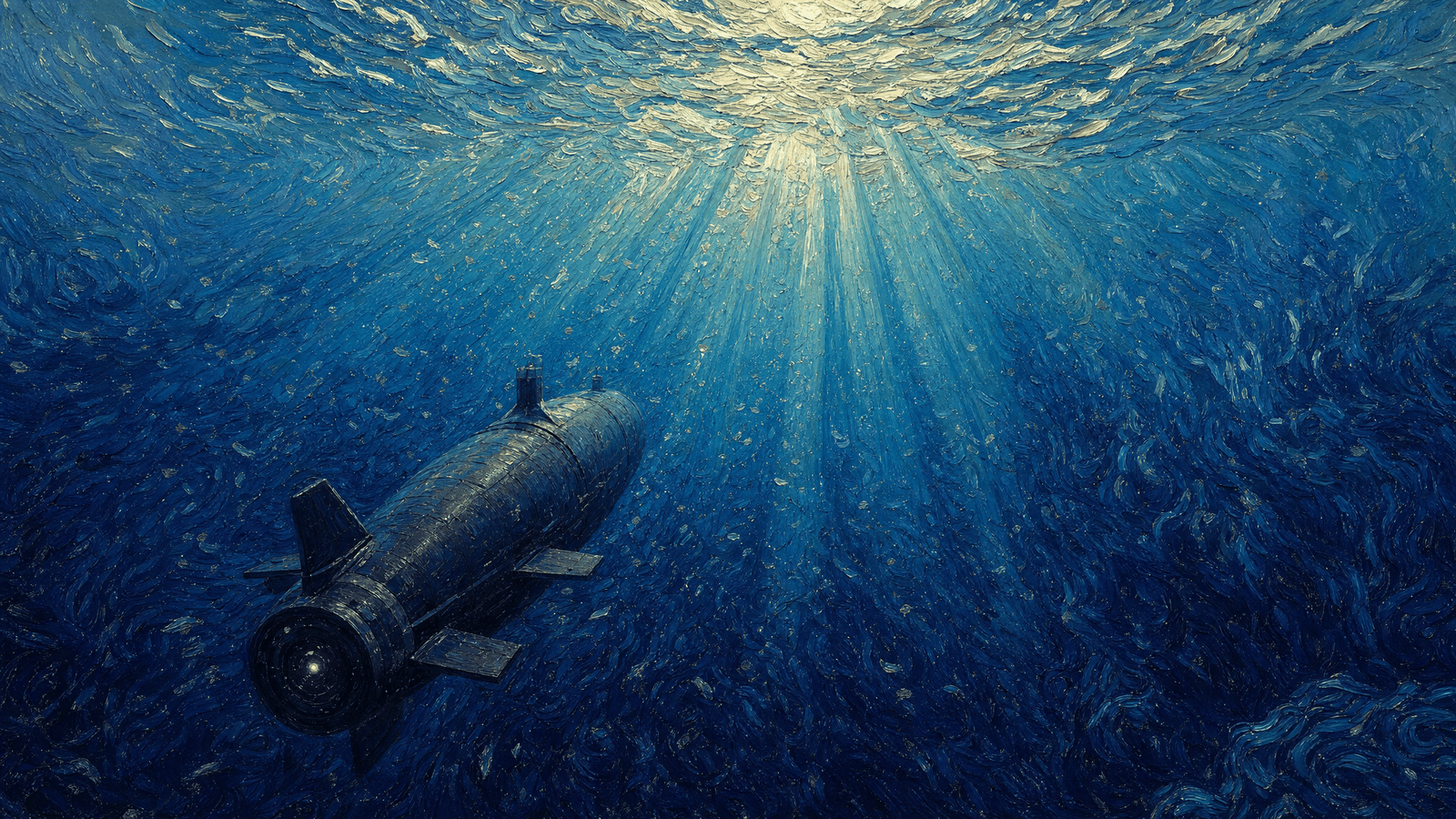
Notes on the 2026-09-24 episode of Catalyst with Shayle Kann, featuring Anduril's Andrew Nus on energy density, certification timelines, and nuclear-powered shipping. Personal commentary for educational purposes; not investment advice, no stock picks or price targets.
Contents
Water, water, every where, Nor any drop to drink. —— Samuel Taylor Coleridge, “The Rime of the Ancient Mariner” (1798)
On the September 24, 2026 episode of Catalyst with Shayle Kann, host Shayle Kann talked with Dr. Andrew Nus, head of growth and strategy for Anduril’s maritime division, about how the defense world thinks about energy. Nus gave the two numbers the whole conversation hangs on: water is roughly a thousand times denser than air, so moving an underwater vehicle one nautical mile costs about a thousand times the energy it would in air; and the entire battery market for undersea vehicles sits, by his estimate, in the low hundreds of megawatt-hours. He also said certifying a battery system for shipboard use takes one to two years, during which the commercial battery world moves on by two or three generations. These are his on-air estimates, scoped to uncrewed undersea and surface vehicles — they don’t transfer to ground or air platforms.

What the episode covers
Kann opens by explaining why he made it: after years of talking about dual-use technology, he’d never once had a conversation about how defense thinks about energy. The topic is enormous, so he picked maritime as the entry point — autonomy is arriving at sea, and once autonomy arrives, energy requirements change with it.
Anduril builds autonomous defense systems, and Nus’s division focuses on maritime robotics for both commercial and defense customers. He spends most of the episode on one theme: how hostile seawater is to machines. Salt corrodes everything, and the deeper you go, the harder the ocean tries to crush you. So you can’t drop an off-the-shelf lithium-ion cell into a submersible and expect it to survive at operating depth. It won’t last long down there.
What struck me is how little this conversation has to do with “defense is hot right now.” It’s about physical and procedural limits, and those limits are what actually decide who can build what.
Key takeaways
1. Propulsion eats the energy; compute is a rounding error. Kann draws the contrast with Waymo — a self-driving car is a computer on wheels, with one ratio between onboard compute and propulsion. Underwater, fighting a thousand times the density, that ratio flips hard toward propulsion. And there’s only one energy system on the vehicle, feeding propulsion, sensors and payload from the same budget.
2. There are no gas stations at sea. The moment a vehicle leaves the pier or launches from a ship, it carries everything it will use for the whole mission. Nus says that recharging infrastructure doesn’t exist because commercial demand hasn’t justified building it. That’s also why nuclear matters for submarines — it buys margin across all three phases: transit in, loiter on station, transit out.

3. Long endurance and useful power are separate things. My favorite passage is about buoyancy engines used in gliders: pump oil between two bladders, change the vehicle’s density, add small wings, and it soars quietly for enormous distances. The Navy and commercial operators have used them for years. The catch is there’s little power left aboard to run sensors. Endurance and available power are two different budgets, and that distinction travels well beyond this domain.

4. There are two ways to package a battery for depth. Put the cells inside a pressure vessel that fights the ocean and keeps them dry, or stack the cells and pot the whole module in epoxy so the pack itself tolerates the pressure. Both need capital-intensive equipment and testing. As Nus puts it, this isn’t something you wake up one Monday and start doing.

5. The certification clock is itself a cause of falling behind. Nus says he has set a lot of batteries on fire over the last fifteen years, all to get a piece of paper saying this battery in this vehicle is safe to operate from this ship. The cost isn’t only money and time — two or three years of certification means missing two or three cycles of commercial battery investment. That was the line I wrote down.

6. Nuclear commercial shipping sells speed and port access. The US Maritime Administration has put out public requests for information. Commercial ships today run around 10 to 12 knots, a speed optimized against fuel price, consumption and emissions. Nuclear could push that to 20 or 25 knots, letting operators charge a premium for five-day delivery instead of seven, and possibly opening ports where refueling infrastructure is thin. Nus guesses maybe 10 to 20 percent of the market, over several years — and he flags upfront that he isn’t a commercial shipping expert.
Going further
”This theme sounds huge — should I chase it?”
The episode hands you a clean antidote: the whole undersea vehicle battery market is, by Nus’s estimate, a few hundred megawatt-hours. In EV terms that barely registers. How big a story sounds and how big its addressable market is are unrelated quantities.

I’ve paid for that lesson, so now when a theme heats up I make myself find a “how much is it today” number before reading another paragraph about why it will matter. Nus is candid about this: Anduril gives its battery partners a demand signal hoping those hundreds of megawatt-hours become gigawatt-hours in a few years. The words are “hope” and “forecast.” Keeping a company’s internal expectation in a different bucket from its signed orders is the most usable thing in this episode.
”The technology exists — why can’t they use it?”
If you’ve ever wondered why a company still ships five-year-old specs, this episode offers one shape of answer: the bottleneck is process, not R&D. Certification takes one to two years while battery technology turns over annually, so you’re permanently chasing a bus that already left.
I find the sorting question portable: is this company’s bottleneck physics, supply chain, or a piece of paper? Physics needs a scientific breakthrough. Supply chain needs capital and years. Paper needs policy and standards bodies. Those three loosen on very different timescales, which changes whether waiting is reasonable. Nus mentions one shortcut worth watching — the EV market already complies with a strong body of battery regulation, and grandfathering some of that into defense applications would skip a round of testing.
”A headline says a technology is coming. How much should I believe?”
Nuclear shipping is the ready-made exercise. The facts in the episode: a regulator issued requests for information, investment is flowing, policy and regulatory obstacles are stacked up, the guest estimates 10 to 20 percent of the market over several years, and he volunteers that he’s read a couple of white papers rather than run a shipping line.
My habit with passages like this is to sort them into three boxes: who is asking, who has ordered, who has been paid. The evidence here sits in the first box. That doesn’t mean it won’t happen — it means you know where it stands when you see a headline announcing the nuclear shipping era.

Where to look next
- Catalyst with Shayle Kann, September 24, 2026, produced by Latitude Media, on podcast platforms and YouTube.
- For background, look up “buoyancy engine glider,” and MARAD’s public requests for information on nuclear-powered commercial shipping.
- Radioisotope power sources — the radiovoltaic devices mentioned at the end — have decades of documented use in space, with far more public material than the maritime side.
The one thing to take away
How far you can go is set by how much you carry. Every constraint in this episode returns to that: once you leave the pier there’s no resupply, so what you brought is what you have. Submarines, gliders and nuclear ships differ only in how each one answers that question.
Here’s something I’ve tried. Pick one thing you’re doing this week that you can’t pause and restart halfway — a hard conversation, an interview, a long drive, sitting with family through an appointment whose result you don’t know yet. Before you set out, write down three things you won’t be able to get once you’ve started. It might be the answers to the three questions they’ll probably ask. It might be the worst outcome you could live with today. It might be a bottle of water and a charged phone. Then go get them before you walk out the door.
When I do this I usually stall on the second item, and that’s when I notice I hadn’t decided where the trip was going. The stall is the useful part.
This article is an educational discussion of investment method. It is not advice to buy or sell any individual security, offers no target prices, and does not analyze any current holding. Investing carries risk; make your own decisions or consult a qualified professional.