An Ant-Hole in the Dam: How an Exception for Wheelchairs Became an Invisible Port
Bloomberg Odd Lots hosts the New York Times' Iran correspondent and Iran International's head of digital on their new book, Stolen Revolution. This isn't an episode about oil. It's about the hardest thing in any economy to price: what happens when passing a certain size means someone knocks on your door for a share.
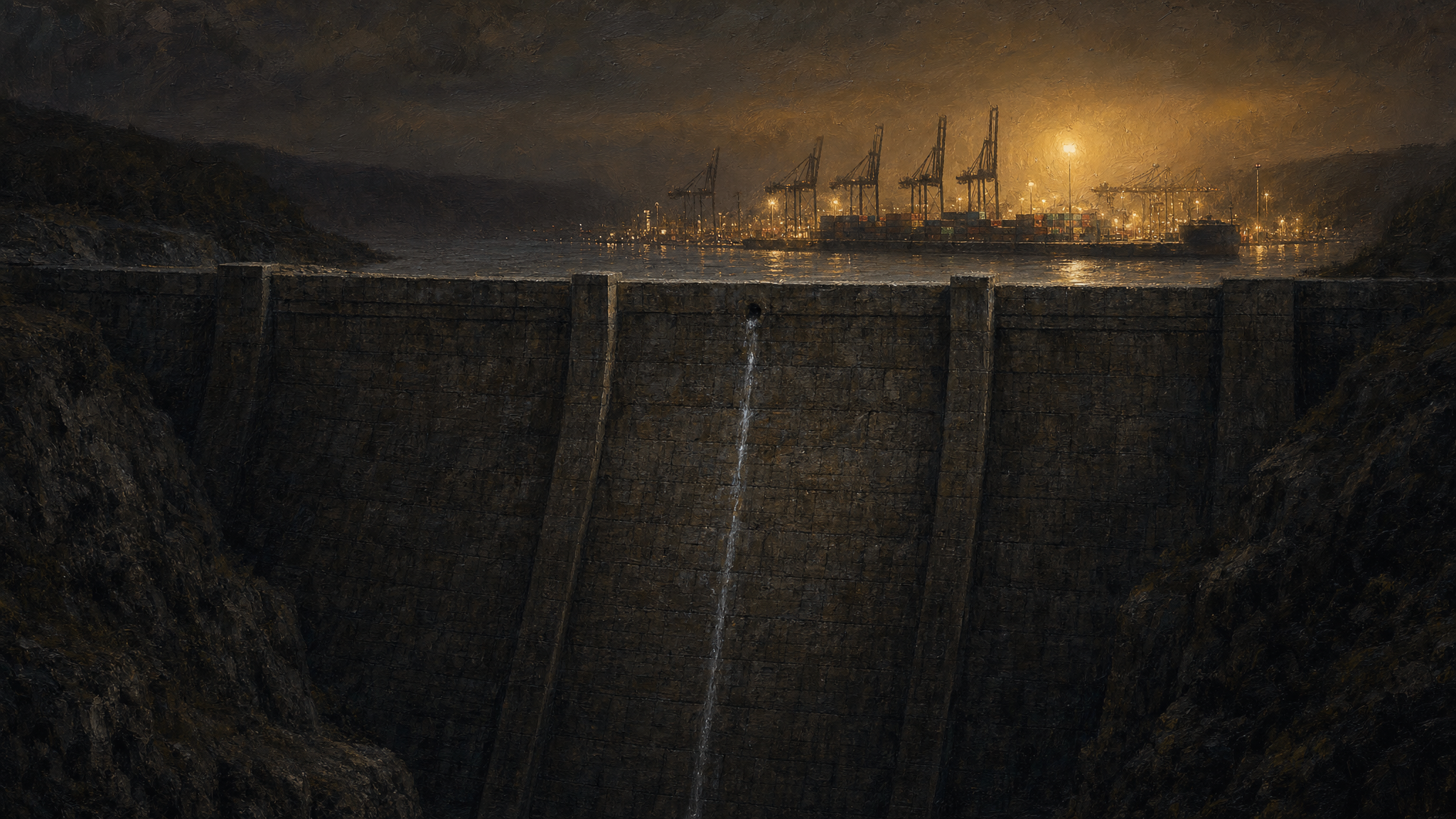
A dam a thousand fathoms long collapses through the hole made by ants;
a house a hundred feet tall burns from smoke through a crack in the chimney.
—— Han Feizi (3rd c. BC)
What this episode is about
The guests are two journalists who have covered Iran for years: Yeganeh Torbati (Iran correspondent, The New York Times) and Bozorgmehr Sharafedin (head of digital, Iran International). They spent five and a half years on their new book, Stolen Revolution: Betrayal and Hope in Modern Iran.
Joe opens honestly: when people discuss Iran’s economy they only ever discuss oil, and he knows almost nothing about what ordinary middle-class economic life there actually looks like. That’s the gap this episode fills.
I didn’t listen to it for Iran. I listened to it for institutional risk — and it’s the most concrete dissection of that I’ve come across.
Original episode: How the Iranian Economy Actually Works
The notes I took
First, what “mafia state” means here. In a normal society, citizens are equal and share equally in national wealth. In a mafia state, society is layered, and citizens are rewarded according to their loyalty to the system.
The logic extends into foreign policy. In that ranking, a proxy fighter in Lebanon or Yemen is more loyal than a critical professor at the University of Tehran, and therefore more deserving of the nation’s resources. Hence the domestic argument you hear inside Iran: the government says it can’t afford free milk in schools, but can afford payments to regional proxies.

The 1979 revolution promised the opposite. The revolutionary coalition began with the middle class and intellectuals — some Islamists, some communists, some secular liberals who simply felt the Shah was trampling on rights. The working class joined late. Khomeini deliberately borrowed the most effective leftist arguments (bourgeoisie versus proletariat, with an Islamic tinge) and promised to provide for the poor: free electricity, free buses, housing.
Over the last ten to fifteen years, the government has largely stopped even pretending that’s the goal. Since 2017, dissatisfaction has spread beyond the middle class to people who are genuinely poor and struggling.
The economy is more diversified than you’d guess. Besides oil, Iran has a car industry, steel plants built after the Iran-Iraq war that once led the region, and a very large agricultural sector. These industries aren’t especially efficient and attract almost no foreign investment — but they employ people, which matters enormously under sanctions.
The real shift was control moving from the formal state to a shadow state. These industries began under ministries answerable to parliament — the sort of government a Westerner would recognise. Control migrated to entities tied to the security forces: controlled by clerics, accountable to no other part of government.
Then came fake privatisation. After a sweeping wave of nationalisation (shipping, mining, banking), the state decided decades later to privatise. What didn’t happen was actual privatisation: people close to the centres of power acquired these assets at very low prices. Many factories never resumed production — the machinery was sold and the land redeveloped into apartments.
Private business runs into a ceiling. The single most important line in the episode:
If a business becomes successful and passes a certain threshold, you will see the security forces knocking on your door. They want their share.
The guest reaches for the mafia-movie image himself: you run a successful restaurant, and they come to collect.

Now the wheelchairs. Early in the revolution, a set of religious foundations (bonyads) was created by Khomeini’s order, with unimpeachable stated purposes: distribute wealth to the poor, care for the families of war martyrs and for wounded veterans.
One character the book follows ran such a foundation. He wanted to import German wheelchairs for wounded veterans; the industry minister objected on the grounds that imports would undermine domestic production. He also happened to be a member of parliament — so he went to parliament and passed a bill allowing the foundation to import anything it wanted, free of government supervision. His justification was preserving the foundation’s “revolutionary character,” unconstrained by bureaucracy and red tape.
Importing wheelchairs for wounded veterans is a laudable motive. But what that step actually established was the principle that these foundations sit above the law — a right private companies don’t have, and entities unconnected to the state don’t have.
Then the exception grew up. Decades later, that same man became speaker of parliament, and during the reform era discovered what became known as the invisible ports: dedicated jetties in southern Iran belonging to the Revolutionary Guards, through which anything could be imported with no government oversight, no audit and no tax.
The 2004 airport episode is the most cinematic passage. Iran was opening a new airport — planned since before the revolution, delayed by revolution and war, meant to rival Dubai and Istanbul.
On opening day, the Revolutionary Guards drove armoured Land Cruisers onto the runway to stop the first plane landing. The transport minister had to beg them to let it down. When the second aircraft approached, they scrambled a fighter jet to threaten it, and it diverted.
Why? The Guards had wanted the operating contract, hadn’t offered the best price, and the government had given it to a Turkish-Austrian firm. The airport stayed shut for months, effectively a no-fly zone, and reopened under state firms. Parliament wrote a report. Nobody was held accountable.
Why this structure is so hard to challenge. The guests note a feature that distinguishes it from, say, the late Soviet Union: these institutions ultimately answer to a single figure regarded as holy, whose authority derives from God. Both the military and the large foundations report only to him. And — how do you question God’s representative?
The vaccine episode is a textbook case of ideology and self-interest merging. During 2020–21, Iran was among the worst hit by Covid. The supreme leader barred the import of most Western vaccine doses; almost simultaneously the government launched a domestic vaccine programme — and the contract went to the conglomerate he controlled.
The guests are fair about it: his suspicion of American and British motives was probably genuine. But the same decision created a shortage, and his conglomerate was positioned to step in and profit from the government contract.
Sanctions institutionalised the opacity. Decades of sanctions made the system less transparent, and each faction carved out business while proving itself indispensable. One example is stark: unable to pay the police and military, the government gave them oil instead. The estimate offered: roughly half of Iran’s oil exports are now handled by the Revolutionary Guards.
The startup chapter is the saddest one. Iran was the second country in the Middle East to get internet access, after Israel, with a young population. In the 2010s the Rouhani government enabled 3G and 4G, mobile data spread, and the app ecosystem took off.
Sanctions became an accidental protective wall: Amazon, Uber and Lyft couldn’t operate, leaving a market of 85 million entirely to domestic players. Iran’s Amazon (Digikala), Iran’s Uber (Snap) and delivery platforms all grew. After the 2015 nuclear deal, foreign capital arrived treating Iran as the last greenfield opportunity — maybe the next Russia, maybe the next China.
(One lovely detail: to get into Apple’s App Store, Snap disguised itself as a music streaming app, revealing ride-hailing only when a user logged in from an Iranian IP. Apple eventually blocked it.)
Then the backlash. First a mysterious Telegram channel started levelling accusations at startup founders. Then interrogations, arrests, office raids. Meanwhile, middlemen with one foot in the security state and one in the private sector — former defence ministry officials, foundation board members — began making an offer:
Give us 5% of your shares and we’ll protect you from these accusations and the risks you’re facing.
The authors interviewed over seventy people for this section. The founders’ state of mind: besieged, at risk, wanting to save their companies and keep providing the middle-class jobs they’d created. Some took the deal.
The outcomes: Iran’s Uber sold a large block of shares to one of the foundations; another ride-hailing company launched with Revolutionary Guard financing outright; and a few years ago Iran’s Amazon sold 40% of its shares to a telecom partly owned by one of the foundations.
The last line is the diamond. Asked how a businessperson is supposed to navigate all these competing forces, the answer:
Iran isn’t just a corrupt state, and isn’t just an authoritarian state — it’s also chaotic. And I think the chaos is more poisonous to business than almost anything else.
The contrast offered: in China, if you have an understanding with the party, you’re broadly good to go. In Iran, even after you’ve made your deal and sold your shares, it’s a mafia structure with a lot of under-bosses who compete with each other, and whose power shifts day to day.
The other guest reaches for Greek myth: rereading the Odyssey, he noticed Zeus doesn’t have absolute power either — he manages among gods. Some help Odysseus home; some angry ones block him.

What I took away
1. When success gets taxed by force, the optimal strategy becomes: don’t grow.
The most valuable sentence in the episode is that threshold — pass a certain size and someone knocks.
If that’s true, then every rational founder in that economy should keep the company below the line. That single sentence explains a shape common to many developing economies: an abundance of small, energetic businesses and almost no large ones.
Generalised into a check: to judge whether an environment can grow great companies, look at how it treats companies that are already successful. That tells you more than GDP growth or demographics — and it isn’t limited to countries. It applies to any organisation with the power to reallocate resources.
2. Chaos is more poisonous than corruption — and for investors that distinction matters.
I used to lump “corrupt” and “unpredictable” together. This episode separates them well:
- Predictable corruption is a cost. You know the amount, the counterparty, and what you get for it. It lowers returns, but it can be priced.
- Unpredictable polycentric power is a risk. You don’t know whether today’s counterparty still has authority tomorrow, or who shows up next. It cannot be priced, so rational capital simply leaves.
Business doesn’t require probity; it requires certainty. Which explains why some places with poor reputations but stable rules attract capital, while others in visible reform but with factions reshuffling weekly cannot.
3. A well-intentioned exception is the ant-hole.
The wheelchair passage stopped me. Importing wheelchairs for wounded veterans is a motive nobody can attack. But the exception created to achieve it — that this class of institution operates without government oversight — eventually became the Revolutionary Guards’ invisible ports.
I think this is the most universal failure mode in institutional design: exceptions never stay attached to the purpose that created them. The door you open for a good reason gets used for something entirely unrelated, and usually by whoever comes next.

That applies directly to my own work. Before I write any rule of the form “in this case you may skip the check,” the question isn’t whether skipping is reasonable this time. It’s: when someone uses this rule for something I never imagined, does the system still hold?
4. Allocate by loyalty and capital allocation decouples from productivity.
The guests put it bluntly: under this structure, the most talented and meritorious companies are not the ones that rise to the top. The ones that rise are those smart enough to sell a sufficient stake to a powerful entity in exchange for protection.
Which is the same thing I wrote down after the private credit episode, in a different key: when the evaluation system isn’t measuring quality, the advantage of being good gets competed away. There it was opaque ratings; here it’s loyalty over performance. Both turn honest operators into fools.
5. That sanctions wall blocks in both directions.
Sanctions kept Amazon and Uber out and accidentally handed domestic startups a protected market of 85 million — which is why they grew at all. But the same wall meant that when the security forces came for shares, those companies had nowhere to go. No international capital markets, no foreign listing, no option to move the headquarters.
Protection and imprisonment are frequently two sides of one wall. Worth keeping next to any discussion of a “policy tailwind.”
6. Authority that can’t be questioned is a system with no feedback loop.
Power derives from God, so it can’t be held accountable; unaccountable, errors don’t get corrected; uncorrected, they compound. Parliament wrote a report and nobody was held accountable — that sentence is the diagnosis of the whole system.
I’ve felt a much smaller version of this in my own work this year: any judgment that never has to be marked against reality slowly rots. Not because the person making it is dishonest, but because nothing is pushing it back toward the world.
Further reading
- The episode: Odd Lots — How the Iranian Economy Actually Works
- The book: Yeganeh Torbati & Bozorgmehr Sharafedin, Stolen Revolution: Betrayal and Hope in Modern Iran
- A companion piece on risk relocating rather than disappearing: Hiding the Boat in the Ravine
- The lines from Han Feizi are my own footnote to the episode, not part of it
Disclaimer: This is a listener’s reflection and general education, not investment advice, an offer, or a solicitation, and not a judgment on any country, government or political position. Events and figures described are relayed from the public episode and the two journalists’ published work. Investing carries risk — judge for yourself against your own circumstances and consult a qualified professional if needed. Copyright in the original episode belongs to its producers; please go listen and support them.
This article is an educational discussion of investment method. It is not advice to buy or sell any individual security, offers no target prices, and does not analyze any current holding. Investing carries risk; make your own decisions or consult a qualified professional.
Comments
Loading comments…