What an Affordability Agenda Would Actually Have to Do — Notes on Odd Lots with Isabella Weber
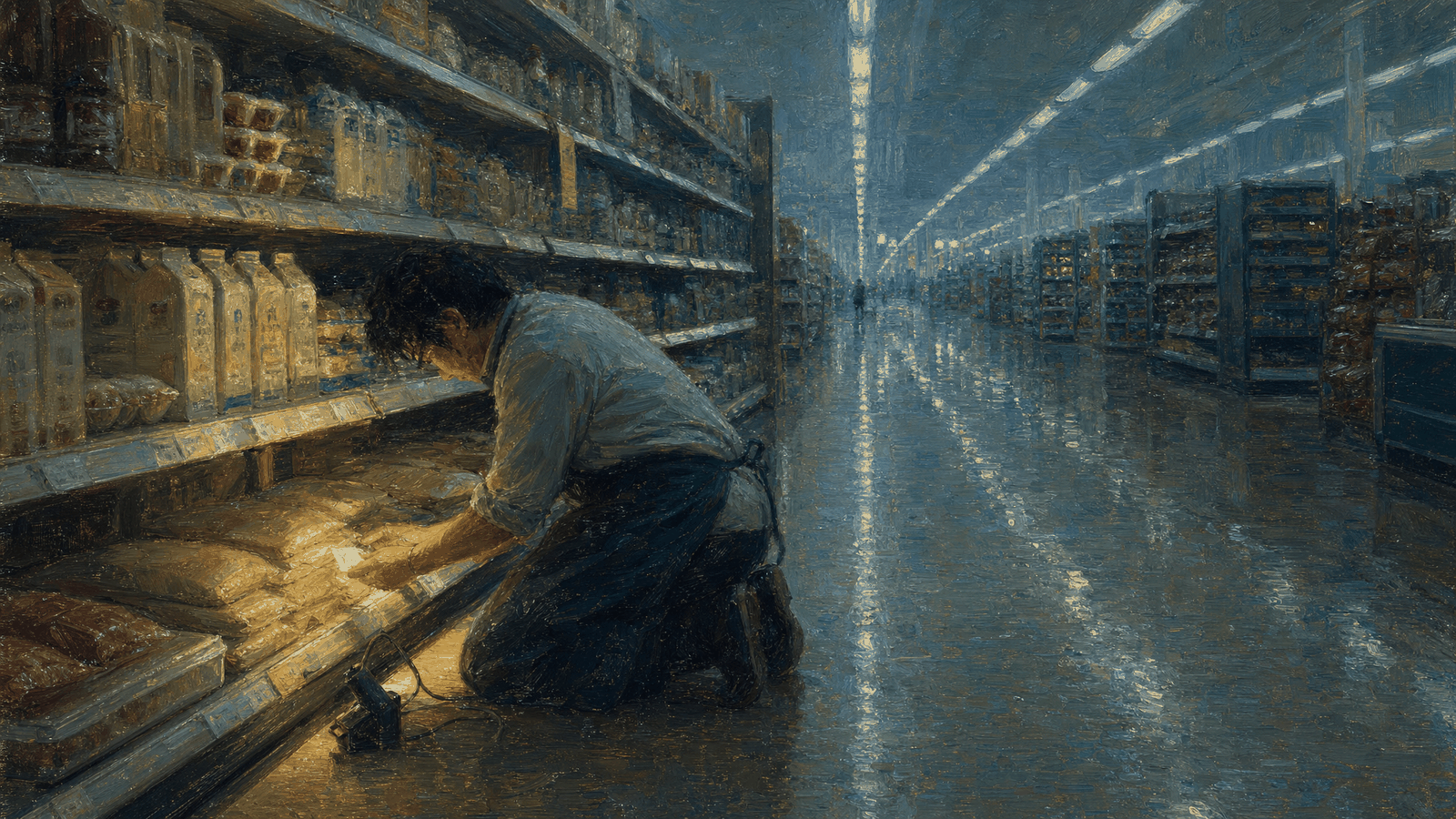
Educational listening notes on the 27 November 2026 episode of Odd Lots with economist Isabella Weber: the economics of essentials, why short-run price stabilization has to be paired with long-run supply build-out, and the old view of mine it corrected. Not investment advice, no stock recommendations.
Contents
Price stabilization and equalized transport exist to level the prices of all goods and thereby serve the common people.
—— Huan Kuan, Discourses on Salt and Iron, “Fundamental Discussions” (Western Han, c. 81 BCE; my translation)
On the 27 November 2026 episode of Odd Lots, Tracy Alloway and Joe Weisenthal brought back Isabella Weber, an economist at the University of Massachusetts Amherst, to talk about her new book Anti-Fascist Economics and what an affordability agenda would have to contain. Her two key figures: US electricity prices are up roughly 40% while incomes of the bottom 20% have risen about 30%, and the bottom 50% of households spend around 70% of their income on housing, food, energy, running a car and health care. Her claim is that short-run price stabilization and long-run supply build-out have to be done together, because dropping either one produces exactly the shortages the textbooks predict. The claim rests on the state being able to work sector by sector — and the back half of the episode admits that capacity is the thinnest part of the whole plan.
I used to hand this question over to a single line
I used to look at prices as one line. Once CPI year-over-year came back near 2%, I filed the question as closed and treated the rest as mood. When “vibecession” was going around over the past two years, I nodded along: unemployment low, spending holding up, people still going out and paying — so complaints about prices were feeling detached from data, and the gap would close on its own.
The ad Joe described at the top of the episode made me laugh and then stopped me laughing. A sitting Mississippi senator, asked by local news about the price of beef, answered that you can pick another protein. The opposing campaign cut that into an ad: a row of people with deep Southern accents repeating “pick another protein” at the camera. The cut is funny because it lands. It stopped being funny when I noticed that my own line — that this is a feelings problem — is the same posture as his. Both are spoken from the position of someone who does not have to switch.
The weighting of one index is enough to count half the population as absent
Weber’s way of taking CPI apart is one I had not considered. Economists sometimes call it a plutocratic index: it weights every dollar of spending equally, so a person spending $300,000 a year carries ten times the weight of a person spending $30,000 a year. And those two people buy different things.

That connects to Tracy’s own story. She bought her first refrigerator in New York, picked a cheap one, and the price surprised her on the low side — roughly what she spends on groceries over a few weeks. Weber’s point is that a large luxury fridge with fifteen functions can deflate while rent and basic food prices rise, and in a dollar-weighted average those two cancel. In the ledger of a household putting 70% of income into essentials they do not cancel. Electricity up 40% against incomes up 30% leaves a gap that does not evaporate; it moves into somebody’s dinner. So when one of those big-ticket items rises another 10%, the buffer is gone and the person is against the wall.

Tracy added the sharper edge: purchase frequency feeds inflation expectations. You buy a fridge once in a lifetime and ground beef every week, so the weekly climb in the beef tag is what calibrates your internal scale. The cheap fridge does not get a vote.

What changed my view was Tracy’s standard challenge: if the government negotiates grocery contracts and caps prices, what happens to supply? The price signal is supposed to call supply forth. Weber did not dodge it. She agrees that capping prices while ignoring the supply side produces, in the medium run, everything economists say it will. But she asks that the proposition be tested in the other direction too. Berlin rents rose 70% over the past decade and supply did not follow. US electricity prices rose 40% and the grid that renewables need did not get built. In both sectors large price increases failed to call capacity out, so “let the price handle it” has not been paying off there either.

She then opened up the stabilization regime we actually run: faced with an oil price shock, we raise interest rates. The oil shock is already cutting real wages, and we respond with an instrument designed to generate unemployment and press on the labour market. Rate hikes simultaneously make investments expensive where upfront capital costs are large and running costs low — which is the shape of a renewable energy system. Her inference is that a stabilization regime not dependent on interest rates leaves more room for the supply-side measures we need. I replayed that stretch; it is the hardest-edged argument in the episode.
Her two examples of stabilization both have concrete shape. Germany’s gas price break during the energy crisis: the amount of gas a person needs to heat, cook and shower gets a capped price, and consumption above that returns to the market price. Mexico’s government drew up a basket of 24 food staples and negotiated with the largest grocery chains to hold the price of the basket as a whole, and Sheinbaum holds regular press conferences reporting which companies kept the deal and which did not. Weber says the clever part is that it exploits how concentrated grocery retail already is: four or five companies’ representatives in one room is enough. It also puts the government back in the position of bargaining on the consumer’s behalf, and whether that position exists decides whether people believe democracy can reach their rent.

On energy she adds that the US Strategic Petroleum Reserve has watched the ceiling and neglected the floor. Oil briefly went negative during COVID, and she sees that as the moment to buy and hold the floor up. The reason is decarbonization: if fossil fuel prices collapse after plants electrify, anyone who can switch back will.
The China stretch is where the episode gets fun. Weber told a joke: pork is the most volatile price in China, and Chinese economists say CPI stands for China Pork Index. Grain is managed far better because grain stores well. She also described a wholesale meat market she visited in China — small processors side by side, identical technology, cutting meat by hand — the closest thing to textbook perfect competition she has ever seen in the field, and a model she does not want back. Large infrastructure runs on increasing returns to scale, and two people with a stall cannot deliver that.
I now treat it as a sector-by-sector engineering problem, with three things I have not worked out
My view has moved: this question has migrated out of macro policy and into sectoral policy. Weber says it plainly — once you enter the world of sectors you enter a very messy reality and there is no silver bullet. Taxes, yes; stabilization, yes; supply build-out, yes. The difference is the time horizon, and relief in the here and now is the piece most missing.
If you have ever thought “the news says inflation is back at target, so why does everything still feel expensive”, the gap has two layers: how the average is weighted, and how often you buy the thing. Back at 2% means prices keep rising at 2%, from a base that has already been lifted. Joe said it himself at the end: a world where groceries and car prices sit at 2018 levels is probably a world that just went through a major recession nobody wants.
The second common knot is “if the government touches prices, won’t we get shortages”. What I changed is the order of the checks: go look at whether capacity in that sector expanded after the price rose. Berlin’s rents and the American grid are two ready-made counterexamples. That test blocks both lazy answers — it will not let anyone close the case with “the price will sort it out”, and it will not let anyone close it with “just cap it”.
Three things I have not worked out. First, terms of office. The Biden administration did a great deal of upstream work whose payoff lands years later, and got punished for it politically. Weber’s answer is institutions: she mentions Saule Omarova’s proposed National Investment Authority, and notes that the US Department of Agriculture has quietly defended price floors for decades, carrying on in the shadows of state bureaucracy straight through the neoliberal era. Institutions create path dependency and outlive a change of government. I find that reasonable, and it takes many years to verify.

Second, state capacity itself. Her description is precise: under neoliberalism we kept saying the state is stupid and incapable, and the longer we said it and the more we outsourced, the more stupid and incapable it became. Her remedy is to start with what can be done — she points to the Mamdani administration in New York starting with potholes and trash, to restore both the public’s trust and officials’ trust in their own ability. I like the ordering. Whether the confidence earned fixing potholes stretches as far as negotiating the price of a food basket is a question I cannot answer; those two tasks are several orders of difficulty apart.
Third, AI and electricity. Tracy said at the close that she forgot to ask, and both hosts simply admitted nobody knows. Data centre build-out competes for power and resources, and competition for resources pushes prices up in the short run — while power is the first of the essentials this episode identifies. The episode has no conclusion there, and neither do I.
Further reading
- Bloomberg’s Odd Lots, episode of 27 November 2026, hosted by Tracy Alloway and Joe Weisenthal with guest Isabella Weber.
- Isabella Weber, Anti-Fascist Economics: In Defense of Affordability, Dignity, and Democracy.
- The three policy cases named in the episode are each worth looking up: Germany’s gas price break during the energy crisis, Mexico’s staple-basket agreement, and the release-and-refill history of the US Strategic Petroleum Reserve.
- To test the weighting point yourself, put the CPI component weights next to your own household’s spending shares for a year.
One thing to take with you
An average that counts every dollar equally will count the people who cannot afford things as absent.
Here is something I tried, and it was not about prices. I laid out a month of household spending and split it into the half I have no way of not spending and the half I can choose not to spend, then watched the month-to-month change in the first half only and ignored the second half entirely. The first time I did it I found that in the months that felt tight over the past two years, total spending had barely moved. All of the movement was in the front half.

You can split something else the same way: a child’s term average, into the subjects they cannot escape by retaking and everything else; a health check score, into the items that turn into an emergency room visit if left and everything else. Split it, look only at the front half, and see which way it has gone this quarter.
This article is an educational discussion of investment method. It is not advice to buy or sell any individual security, offers no target prices, and does not analyze any current holding. Investing carries risk; make your own decisions or consult a qualified professional.
Comments
Loading comments…