The Moment a Good Idea Wakes Up: David Byrne on Why Forgotten Things Come Back
Notes on Odd Lots (2026-10-17) with David Byrne on his book Sleeping Beauties: Roman concrete, Moby-Dick, and Minsky all came back after years dormant. Listener reflection for education only, no stock picks or price targets.
Contents
I offer you one method for settling your doubts, with no need for tortoise shells or divining stalks. To test jade you must burn it three full days; to judge timber you must wait out seven years.
— Bai Juyi, “Fang Yan, No. 3” (Tang dynasty, c. 810; my translation)
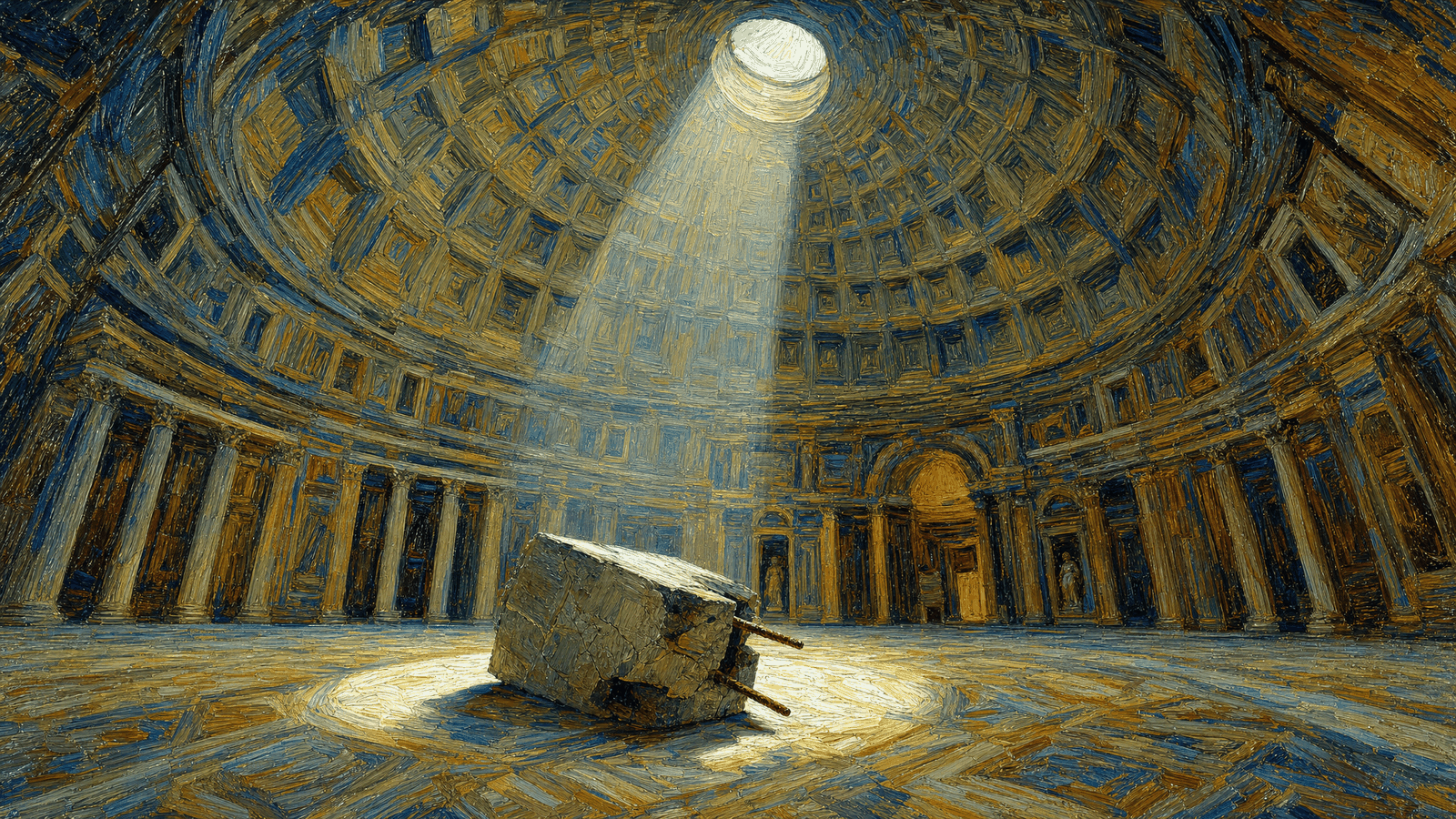
On the 17 October 2026 episode of Bloomberg’s Odd Lots, Joe Weisenthal and Tracy Alloway talk to the musician and author David Byrne about his book Sleeping Beauties: Why Good Ideas Go Dormant and How They Wake Up. Byrne drops one pair of numbers: the unreinforced concrete dome of the Pantheon in Rome has stood for 2,000 years without a crack, while the companies making concrete today rate their own product to last 50 years, maybe 100 if you’re lucky. And the Roman recipe was never lost — Vitruvius wrote it down around 20 BC, and his book resurfaced in the 1400s. One caveat: this episode is about the mechanics of ideas coming back. The materials science in the concrete section comes from MIT work Byrne relays in the book, and whether the company founded on it in 2023 turns into a business is not something the episode answers.
I thought good things slept because nobody could find them
Before listening, I had a tidy explanation. Good ideas get buried because information travels badly: printing was expensive, books didn’t circulate, manuscripts sat in somebody’s basement. Follow that logic and digitisation should have fixed it. Joe describes his own adolescence on the show — in the early nineties, finding obscure indie music meant writing letters to record labels and waiting for catalogues, and reading heterodox political philosophy meant hunting down strange bookshops. Now you type a name into Spotify and the avant-garde sits one click from the mainstream.
That was my model, and I quietly extended it: if everything is findable, forgotten good things will surface on their own, and the only variable is who gets there first. I even ported it to investing — all the filings are public, so neglected cheap things get discovered eventually.
This episode took that apart. It took it apart with examples where the information was sitting in plain view the whole time.

The recipe was in the book; what blocked it was “we know better than the ancients”
The concrete story is the one that stings. Byrne’s account runs roughly like this. Romans used concrete for the Pantheon, the Colosseum, the aqueducts — expensive civic projects. As the empire stretched, resources went to holding borders, and the far provinces had their own methods; Hagia Sophia in Istanbul is brick and mortar. When the empire collapsed in the fifth century, nobody made the stuff anymore. Then Vitruvius resurfaced in the 1400s with the recipe right there in the text. How did people react? They took his material on proportions — Palladio and that generation of architects drew on it — and filed the concrete recipe as an unhistorical curiosity they had no use for.

Centuries later, an Englishman produced Portland cement, and about thirty years after that a Frenchman thought of adding rebar for tensile strength. Byrne says plainly that Portland cement is worse than the Roman material: it takes more energy, emits a lot of CO2 in the making, and lasts shorter. So why did nobody look back? He gives two reasons, neither of them about access to information. First, people saw that the Roman mix used volcanic ash from Vesuvius and concluded that was the secret sauce, unavailable to them, so they’d make do. Second, and worse: Roman concrete has little white specks in it, and the verdict was that the Romans simply lacked good mixing technology, while we have machines, so ours is better.
Those specks are lime clasts. Material scientists at MIT only went and looked about fifteen years ago, and ran an experiment simple enough to be embarrassing: Roman sample, contemporary sample, pour water on both. The water went through the modern one, and getting through is where cracks start. In the Roman sample the water dissolved some of the lime clasts and the cracks healed themselves. Meanwhile the rebar in modern concrete makes things worse — water reaches the steel, the steel rusts and expands, and the expansion opens more cracks. Byrne traces the whole thing to a prejudice: whatever we know is smarter than whatever came before. He files it next to Minsky, as another case of how irrational people can be.

The Moby-Dick thread has the same shape with more human wreckage. Melville signed on as a merchant sailor into the South Seas whaling trade, found it torturous, jumped ship with others onto an island, grew potatoes on another one, and was eventually caught in Hawaii by the ship he’d deserted. He wrote Typee out of it; the American publisher said it was outrageous and could not have happened, until a witness in England confirmed the awful things were real, and the book became a huge hit. Hawthorne suggested the next one be more allegorical, less adventure yarn. So Melville wrote Moby-Dick. The English edition sold maybe 500 copies, and he had left out the epilogue — the part where Ishmael survives. English reviewers produced a rule of writing I’d never considered: you cannot tell this story if everyone dies, because then who wrote it, who is the witness? The Americans looked to British reviewers, the bad notices set the tone, and restoring the epilogue came too late. Melville went back to Hawthorne and said, what have you done to me, I’m destroyed. After his death, the manuscript of Billy Budd turned up in a bread box in his house.

What woke the book up was the question people were left with after the First World War. Byrne’s reading: afterwards people asked how we could do that much killing, what we are made of psychologically. Before that the appetite was for seafaring adventure and heroic westerns; once the doubt was in, this book could suddenly help answer “who are we?” Joe brings up a favourite of his, C.L.R. James’s Mariners, Renegades and Castaways, and the argument that Ahab anticipated the authoritarians of the twentieth century. Byrne won’t accept prophecy, and his alternative convinces me more: an author like that can’t predict the future, but he can see something that was already in us, because he met those people.
Tracy has first-hand standing on the Minsky part. She entered financial journalism in September 2008, when “Minsky moment” was already circulating, and it has since become enough of a cliché that she bristles when a writer presents it as a fresh discovery. What she hadn’t known is that until 2008, much of Minsky’s work had been discarded. Byrne’s summary is colloquial: when things are flush we assume they’ll stay that way, so we pile more in and ignore the danger signs, because we act on emotional instinct. The episode also carries a detail I liked — Minsky on holiday in Italy, skipping the tourist sites to interview people running small businesses in the towns, asking how the work was done and how things functioned there.
Put the examples together and Byrne’s method makes sense. He says he deliberately focused on how things got rediscovered rather than how they got forgotten, because the forgetting stories repeat: institutional hubris, racism, sexism, we-know-better-than-the-past. Mapping the waking-up routes gives you a shot at the ones still asleep out there.
I now treat it as a demand-side question — and the line I still can’t draw
My model moved. Whether a thing wakes up depends on whether the question outside it has changed, not on how good the thing is. Not one word of Moby-Dick was revised; what changed was which question readers were carrying. The Roman recipe was in print for four centuries; what changed was that energy and durability started to count as costs. Minsky’s papers sat there for decades; what changed was a crisis that turned “people behave irrationally” from a fringe assumption into the live situation. Byrne says it most directly about his own career: in the nineties he dropped from large venues back to small clubs, and now he’s playing sizeable places again, performing some of the same material. He didn’t change. The audience, the demographic, the generation, the context did.

So when Joe raises digitisation, Byrne half agrees and half pushes back. He agrees that streaming lets younger listeners reach old material with no friction, building playlists that mix decades and genres because they like the songs. His pushback matters: plenty of things still aren’t online, and he cites Bob Woodward having to go to someone’s basement for boxes of physical files. Then Tracy sharpens it — once everything is online, curation gets harder. In a suburban LA tiki bar she heard a “haunted surf tiki” playlist, a genre she didn’t know existed and would never have typed into a search bar. Byrne answers with Condoleezza Rice’s line about the Challenger: part of it was a filter problem. The warnings about the O-rings were out there and it wasn’t that nobody knew, but with that much information in circulation, nothing jumps up and says look over here.
That’s where I’ve landed: whether a thing can be found and whether it will be found are two different problems, and digitisation only solved the first.
What I still can’t resolve is the most honest exchange in the episode. Tracy asks Byrne how he tells apart two situations — “I was unlucky, the audience wasn’t ready” versus “I made something that didn’t land.” For me that translates straight into the question about a position that’s underwater: is this a sleeping beauty the market mispriced, or did I pick wrong? Byrne says it’s a bit of both. He gives his own case: a stretch of records made with Latin musicians and Latin rhythms, which he loved making and which went down well in Latin America and parts of Europe, while the US reaction was “you’ve betrayed us, this isn’t what we want from you.” He took the signal and decided to self-correct a little — still do something interesting, while acknowledging what the audience hopes for.

Two readings I’m trying to take from that. First, telling a mispricing from a genuine failure turns on whether some external condition is moving, not on how much you like the thing. Roman concrete was waiting for carbon and durability to become costs; Minsky was waiting for a crisis that broke the rationality assumption. If you can’t name what your thing is waiting for, it probably isn’t dormant — nobody wants it. Second, count the incumbent structure. Tracy adds this at the end: some concrete firms have their entire business built on Portland cement and have no reason to switch formulas, and Byrne’s chapter on solar panels has an early technology running into oil interests. Dormancy isn’t always a misjudgement; sometimes somebody is making money off it staying asleep, which stretches the wait for conditions to change.
Then there’s Joe’s confession, which I’d pin to a wall. He says he has a tendency to read anything and think “wow, that’s really applicable right now,” and then the next book, and the next — brains are good at over-metaphorising. He asks Byrne how to avoid it, and Tracy translates: how do we avoid sleeping uglies? Byrne’s answer is funny in its honesty: I do the same thing, and I think it’s pretty good. Then he demonstrates — Lynn Margulis showed that our cells came from a symbiotic merger between an early organism and bacteria, Kropotkin argued that cooperation is sometimes a better strategy than competition, so Byrne gets “cooperation is key” and cuts and pastes it everywhere to see where it fits.
This is the warning for me. Hunting for structural opportunities, the failure I’m most prone to is exactly this: read a new framework, look back at the portfolio, see every holding fitting it. Joe suggests AI may become the ultimate sleeping-beauty discovery engine, since it’s good at cross-disciplinary shape matching — if the shape of one solution resembles the shape of an unsolved one, it can fill it in, the way the shape of particle physics resembles some market behaviour. I agree with the direction, but follow Joe’s own self-diagnosis and the same machine is also the ultimate rationalisation engine, equally good at manufacturing a plausible resemblance between any two unrelated things. The two outputs look identical, and I have no way to separate them in advance. Tracy closes by asking ChatGPT whether she can make Roman concrete at home; it says she can make a test block, and that she must not try hot mixing with quicklime, which reacts violently with water and causes serious chemical burns.

The One Thing to Take Away
Whether something wakes up depends on whether the question outside it has changed, not on how good it is.
Here’s something I’ve tried that takes ten minutes. Pick one thing you put down three years ago — a guitar, a language, a half-written plan, a person you stopped calling. Write down the reason you dropped it, concretely: not “no time,” but something visible like “I was commuting three hours a day then.” Then answer one question in a sentence: does that reason still hold, and what’s different now? If you can’t find anything that changed, let it keep sleeping — that’s a conclusion too. If you can name a condition that genuinely moved, it isn’t dormant. It’s waiting for you.

This article is an educational discussion of investment method. It is not advice to buy or sell any individual security, offers no target prices, and does not analyze any current holding. Investing carries risk; make your own decisions or consult a qualified professional.
Comments
Loading comments…