The 1873 Railroad Bubble and the Twenty-Year Deflation It Left Behind
Meb Faber Show EP642 with Liaquat Ahamed, the Pulitzer-winning author of Lords of Finance, on his new book about 1873. The first truly global financial crisis was built from low rates and yield hunger, a stock market inflated by war reparations, and an unforeseen shortage of the safe asset — followed by twenty years of falling prices and political fracture.
Contents
Its rise was sudden;
its fall, just as sudden.
—— Zuo Zhuan (4th c. BC)
What this episode is about
This instalment of The Meb Faber Show is part of Meb’s series on American financial history. The guest is Liaquat Ahamed, author of Lords of Finance — the Pulitzer winner that sits on most people’s shortlist of the best financial history ever written.
His new book is 1873: The Rothschilds, The First Great Depression and the Making of the Modern World — in many ways a prequel to Lords of Finance, about the first genuinely global financial crisis.
Original episode: The Meb Faber Show #642, “Liaquat Ahamed on the Railroad Bubble That Crashed the World” (~44 min)
The notes I took
Start with the boom nobody remembers. The years before 1873 were the first era of globalisation: world trade grew fivefold and rose two and a half times as a share of GDP; the four major economies roughly doubled. The engine was enormous British and French capital flowing into infrastructure worldwide — ports, but above all railroads. There was a railroad boom in America, one in Europe, one even in Argentina. It was the first time a single factor and a single source of capital drove the world economy.
Why so much money was hunting for a home. A new saving class had emerged in Europe — upper middle class, children of early-19th-century entrepreneurs, sitting on substantial savings. Real interest rates fell sharply: a British gilt paid 3%, a French government bond 4%. Savers went looking for something better.
And they deliberately avoided equities. This is the detail I find most interesting. The equity bear market from roughly 1845 to 1850 was the worst they had lived through, and it left them shunning stocks. So this was a boom built on bonds, by bond investors. The Rothschilds are in the title because they were the masters of that universe — they essentially invented the global bond market, and after 1850 they and Barings underwrote 70% of global bond issuance.

Germany’s mania was lit by a war indemnity. France declared war in 1870, lost, and was fined a billion dollars in reparations — multiply sums from that era by a thousand for today’s feel, so call it a trillion. The Rothschilds raised it in two bond issues, and it was injected into a German economy of $4–5bn over two years: roughly 20% of GDP in twenty-four months.
The path matters. Most of it went to German states, who used it to retire their debts — so savers holding government bonds suddenly held cash instead. Burghers in Hamburg, Munich and Berlin were all asking the same question at once, and for the first time in their lives the answer was the stock market.

Promoters noticed the flood and started floating companies. The German word is Gründerzeit — the founders’ era: two or three years of relentless IPOs, banks, railroads, anything. Ahamed’s verdict: the first IPO bubble in history, not unlike the dot-com boom.
The contemporary journalist quoted on the show could be describing any era:
Everyone flew into the flame — the shrewd capitalist and the inexperienced petty bourgeois, the general and the waiter, the woman of the world, the poor piano teacher and the market woman. A shower of gold rained down on the drunken city.
J.P. Morgan, asked the secret of his success: “Selling too early.”
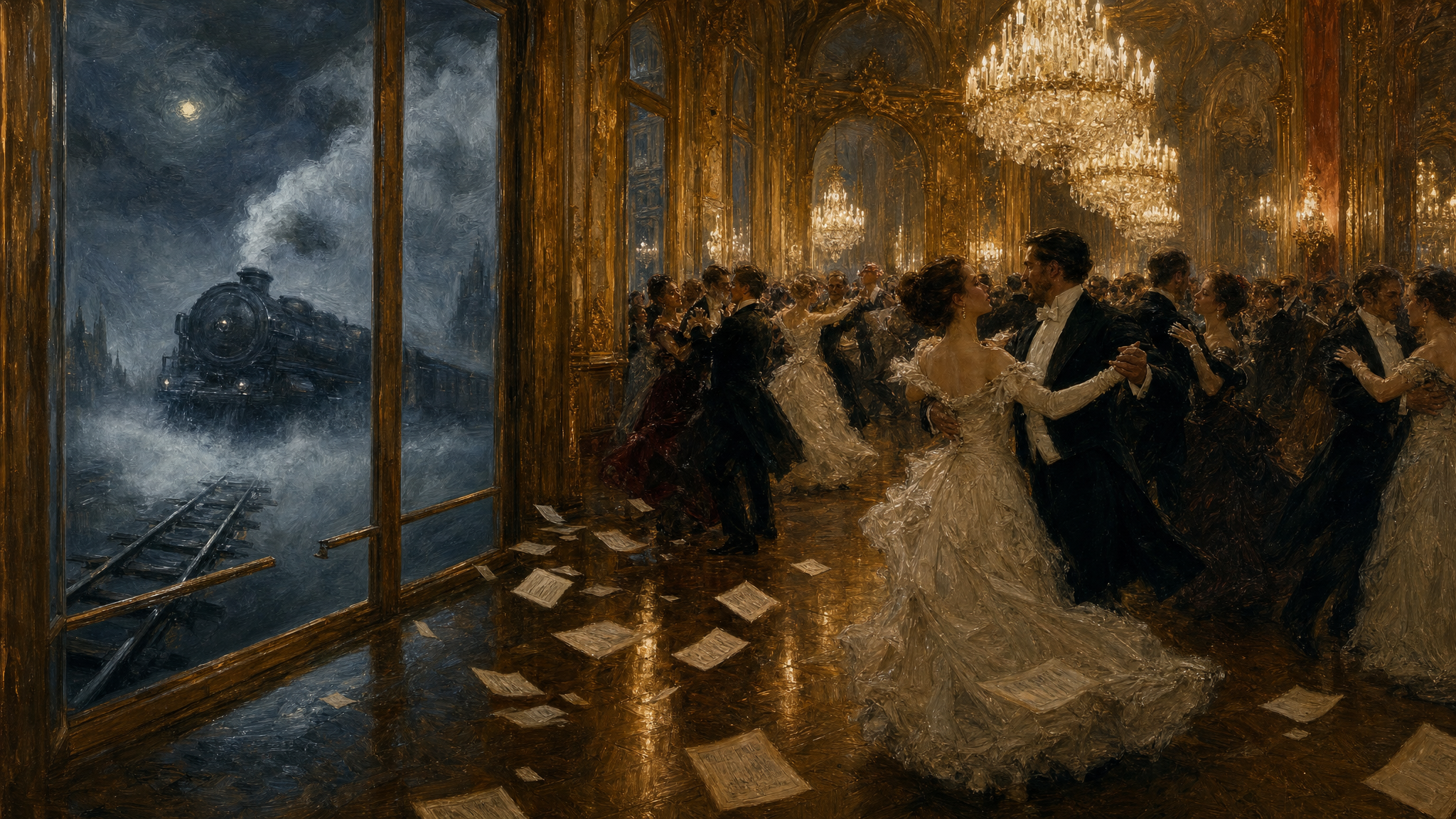
The crash came in three acts, with a fake calm in between. Act one was Central Europe: the Vienna and German bubbles burst and major stocks fell 50% in a single day. The scene was surreal — the emperor’s daughter was being married, so every royal family in Europe was in Vienna waltzing to Strauss and dining nightly, while the market collapsed a few streets away. It produced the first wave of ruined-speculator suicides — except in Vienna what seems to have happened is that they folded their clothes by the canal, swam to the other side and vanished, so their creditors couldn’t find them. Much of it had been bought on margin.
Then nothing happened. The conclusion was: a one-off, Vienna simply got overpriced, we’re fine.
Act two was New York in September, and it was a different animal. Not a stock market crash but a cascade of railroad defaults. At the centre was Jay Cooke & Co, the premier investment bank in the country, which had raised $2bn for the Union during the Civil War — a friend of the president, the best-connected banker in the world. In September he announced he was out of money and could no longer finance the railroad he was sponsoring.
Ahamed’s analogy is Lehman: if Jay Cooke can’t fund himself, what about Citibank? What about Bank of America? The dominoes went through the railroads. By year end a third of railroad companies had stopped paying interest; within five years, half. And why couldn’t Cooke raise money? Because Europe was in turmoil — about a third of the capital in US railroads was European.
Act three was emerging markets. Through the early 1870s countries had raised money on the London exchange, Egypt and Turkey among them, borrowing $1.5bn between them — about the same as US railroads. As Ahamed dryly notes, the notion that Egypt and Turkey offered the same future as American railroads looks laughable now, but they got the money. Then they defaulted.

What turned a crisis into a twenty-year disaster was a shortage of the safe asset. In a panic everyone runs to the safe asset, which then meant precious metals. But a third of the world ran on silver (Central Europe, thanks to the mines of Bohemia), a third on gold (Britain, Portugal and others), with the US and France on a mix. France was the linchpin: the Banque de France held the largest metal stock in the world and acted as a balance wheel, absorbing silver when silver was plentiful and shifting when gold was — with the Rothschilds standing behind it.
Then in 1873 Bismarck, having beaten France on the battlefield, went after its financial system: he sold Germany’s silver and moved to gold. Silver collapsed — hurting Germany, hurting France more. One after another, European countries abandoned silver. Every flight-to-safety bid in the world was now concentrated on one asset, producing an acute shortage and a violent credit contraction.

Wholesale prices fell 30% by the end of 1873, and then deflated for twenty years.
The political consequences outlasted the economic ones. Inflation is too much money chasing goods; deflation is too little. People hate inflation, and they hate deflation just as much — your goods get cheaper, but your debts become a millstone. Deflation suits owners of financial assets; it destroys anyone with a mortgage, farmers, households who borrowed. His example is Japan: buy a house in 1990, thirty years later it’s worth half, and the mortgage is still there.

The US was hit hardest because deflation split the country along a new axis: farmers in the west, bankers in the east. Fresh from a civil war that split north from south over race, it now faced an east–west split over economics — fracturing both parties and producing twenty years of political stalemate.
The modern parallel he reaches for is 2008, not 1929. Housing crashed, mortgages went bad, the banking system nearly failed, and Geithner and Bernanke bailed out the banks — exactly the right thing to do, he says. The problem was that they didn’t bail out the homeowners. The rift between people who owed money and people who got rescued fractured the Democratic Party, produced Bernie Sanders on the left and the Tea Party on the right, and left a large group of people saying: this system doesn’t work for me, it works for insiders and for whoever can get bailed out.
Exactly what happened after 1873. Twenty years of falling prices, a population concluding the system was rigged against them, and extremely fertile ground for conspiracy theories. In Europe, blame landed on Jews — and antisemitism changed shape, from religious to economic. In America, western farmers blamed British bankers: if abandoning silver starved us of credit, and Britain is the country that benefits most from gold, then British bankers must have arrived with $100,000 in their pockets and bribed Congress. It got a name — the Crime of ‘73 — and eventually a target: the Rothschilds.
What I took away
1. The fuel for a bubble is often not greed. It’s having been burned last time.
The counterintuitive detail: the generation of European savers who financed 1873 deliberately avoided equities, because the 1845–50 bear market had hurt them. So they bought bonds, infrastructure, sovereign credit — and that is precisely where the explosion happened.
That lands on a real blind spot of mine: shifts in risk appetite are usually not “getting greedier” but “fleeing where I was last hurt.” Wherever the last injury happened, the next crowded trade sits on the opposite side of it. Today’s version: everyone hurt by 2022 growth stocks moved money into something that looked steadier — how crowded is “steadier” now?
2. The fake calm between act one and act two is the passage to remember.
Vienna halved. Then months of nothing, and the market concluded: one-off, overpriced, we’re fine. Then New York blew up.
I’ve seen this shape in my own records: the first bad headline lands, gets digested, everyone exhales, and the real transmission surfaces months later somewhere else entirely. The quiet between the first event and the second is not, by itself, evidence.
3. The geography of your funding is the path of contagion.
Jay Cooke failed not because something broke in America but because Europe seized up, and a third of US railroad capital was European. To an American investor at the time this was nearly invisible — they were watching their railroads’ operating numbers.
So one more question to ask: who funds the thing I own, and how are they doing? It’s an entirely different axis from revenue or moat, and 1873 says it can be the decisive one.
4. What made the crisis lethal was the safe asset itself shrinking.
The crash alone wasn’t fatal. What was fatal is that after Bismarck dumped silver, a third of the world’s safe asset was cancelled in short order, and every hedging bid crowded into gold. That’s not a demand problem — the denominator shrank.
Which gives me a checkpoint: when stress hits, where does everyone run, is there enough of it, and who has the power to make it smaller? 2008 was money market funds; 2020 was Treasury liquidity. Same shape.
5. What grew out of twenty years of deflation is the book’s real subject.
Prices fall for twenty years → debt becomes a millstone → “this system doesn’t work for me” → find someone to blame → conspiracy theory shifts from religious to economic. Putting 1873 next to 2008 isn’t about crash mechanics; it’s about who got rescued and who didn’t, and how that decides the next two decades of politics.
For someone who just wants to invest well, the implication is direct: the tail of a macro event comes back at you through politics — regulation, tax, trade, hostility toward specific industries. None of it shows up on a financial statement, and the seed of all of it is planted in who got bailed out.
6. Morgan’s “selling too early” contradicts my own discipline, and I’m not going to pretend otherwise.
My framework leans the other way: when conviction is high you should hold, because returns are power-law distributed and selling early means handing away the right tail. Morgan says selling too early was the secret.
The honest reconciliation is that they apply to different things. For a position you genuinely understand whose fundamentals are still improving, selling early is a disaster. For something you’re holding because money is flowing into it, selling early is the only exit. The question was never whether to sell early — it’s which of the two I’m actually holding right now.
Companion piece: what this century’s railroad is
In another episode from the same batch, Jim Bianco calls AI the most transformative technology since the railroads, while also saying every technology ends in a bubble and that we are still building this one rather than popping it.
Listening to both back to back is a strange experience: one man tells you what this century’s railroad is, the other tells you how the last one ended. That piece is here: Bond Traders Panic When the Fed Doesn’t.
Further reading
- The episode: The Meb Faber Show #642, “Liaquat Ahamed on the Railroad Bubble That Crashed the World” (2026-07-31)
- Liaquat Ahamed, 1873: The Rothschilds, The First Great Depression and the Making of the Modern World; and his Pulitzer winner, Lords of Finance
- The couplet from the Zuo Zhuan is my own footnote to the episode, not part of it
Disclaimer: This is a listener’s reflection and general education, not investment advice, an offer, or a solicitation. Historical events, institutions and figures mentioned come from the public episode and public sources; nothing here recommends any security or offers a price target. Investing carries risk — judge for yourself against your own circumstances, and consult a qualified professional if needed. Copyright in the original episode belongs to its producers; please go listen and support them.
This article is an educational discussion of investment method. It is not advice to buy or sell any individual security, offers no target prices, and does not analyze any current holding. Investing carries risk; make your own decisions or consult a qualified professional.