Two Chairmen Asked Him the Same Question — Listening to MacroMicro's Dr. Sun Special
MacroMicro's Dr. Sun special, published 15 November 2026: Taiwan Institute of Economic Research's Sun Ming-te on this year's growth forecast revised up to 12.3%, exports up 25%, and the answer he gave two brokerage chairmen who asked why the index would reach 80,000. Educational listening notes on reading the gap between hardware and applications, and why the cost structure differs from the internet era — no price targets, no stock recommendations, not investment advice.
Contents
- The first question he got at the first brokerage
- The show of hands he ran at another venue
- He went back and did the arithmetic, and AI is not the internet
- He takes the clock back to the steam engine
- The news says AI investment has overshot — should I get out first?
- I am not in tech — does any of this touch me?
- Further reading
- One thing to take away
The sage, in his dealings, seems slow yet is urgent, seems late yet is swift — he is waiting for the moment.
— Lüshi Chunqiu, “Shou Shi” (Warring States; translation mine)
In MacroMicro’s Dr. Sun special, published on 15 November 2026 and recorded on 12 November, Sun Ming-te, director of the business forecasting centre at the Taiwan Institute of Economic Research, says the institute raised its 2026 forecast for Taiwan’s growth to 12.3% on 9 November, with exports up 25% and private consumption up 5% against a twenty-year average of 2%. He then tells the story of giving talks at two brokerages where both chairmen asked him the same thing: why will the index reach 80,000, or 100,000. His answer is the killer application, and he adds that if the story is nothing but AI servers, 50,000 looks like the ceiling. That conclusion holds only if the paying side catches up with the hardware spending — in a show of hands he ran, fewer than one in ten senior finance managers were paying more than NT$1,000 a month for AI.
The first question he got at the first brokerage
Sun gave a talk at a brokerage where the chairman turned up with every first-tier manager in the firm, a hundred or two filling the room. The first hand in the air during Q&A was the chairman’s own: “Director, I have been telling my colleagues the index will reach 80,000. Why do you think that is?”
He repeats his reaction on the show: that is your number, why am I the one explaining it. The chairman said this is our first question.
So he split the 80,000 into two pieces. With AI servers alone, 50,000 looks like where it stops; to get to 80,000 you need a killer application. As for what that application looks like, he said on the spot that he does not know either.

Two days later he was at a larger brokerage, where the chairman had changed the number: I have been telling my colleagues 100,000, Director, why do you think so. He says he is not going back to brokerages, because each firm writes a bigger cheque than the last and the one signing is always him.
Both scenes are worth writing down because the people asking sit in the front row of the sell side, and both wanted the same thing from him: the reason that would make the number stand up.
The show of hands he ran at another venue
He has measured the application side himself. At one event the audience was senior finance managers with budgets to spend, from many different firms. He asked for hands from anyone paying more than NT$1,000 a month for AI. Fewer than one in ten went up. He lowered the bar to the NT$500–600 range, an ordinary subscription price, and got to two or three in ten. The remaining six were paying nothing, or getting by on the free tier.

He treats that as evidence the application side has not formed yet: on the hardware end orders arrive faster than the buildings can go up, and on the paying end even this group has not started.
Then he follows the money to the supply side. The model companies do not earn enough to pay for the equipment they buy, so where does the money come from? Partly investment from firms like Nvidia, partly the pile of debt issued lately — he says the high-yield corporate bond market is full of their paper. In Taiwan, Hsinchu companies are issuing convertibles, because straight debt costs too much in interest and new shares dilute the existing ones. His question is plain: if the killer application keeps not arriving, how long can this burn go on.

He went back and did the arithmetic, and AI is not the internet
This is the part I most wanted to write down. Sun says he ran an analysis, and the conclusion is that treating AI as a repeat of the internet era points you the wrong way.
In the internet era, one more user did not raise the cost of serving them, so platforms wanted everybody on board. In the AI era, one more user means another slice of compute, and every image and every answer burns electricity. He calls the increase geometric. He names Warsh at the Federal Reserve for comparing the present to the Greenspan-era computerisation and expecting new technology to lower costs, and says the analogy breaks: computers and networks cost almost nothing extra per user, while AI stacks compute and power together with each one.

So today’s low prices are a subsidy. You pay NT$600 and it does this much; you pay NT$3,000 and it does more, while the bills for machines and electricity sit there. His own line: if AI costs so little, how could anyone justify spending that much on all those machines. He mentions hitting a usage limit himself and being asked to come back in five hours — being told to knock off while you are mid-task, he says, is not going to happen.
He also slips in something a user ought to know. Quoting Chien Li-feng, the people who get the most out of AI are the ones who talk to it a hundred times. His own experience is that one exchange gets you little — you tell it to do something, it hands you a thing, and you think you could have done that yourself. By the tenth, the fiftieth, the hundredth exchange, your instructions have filled out and it knows what you want. So he names two winners in this wave: Taiwan’s hardware makers, and the users willing to spend the time learning the tool now, while the American companies are letting you use it cheaply at any cost to themselves.
He takes the clock back to the steam engine
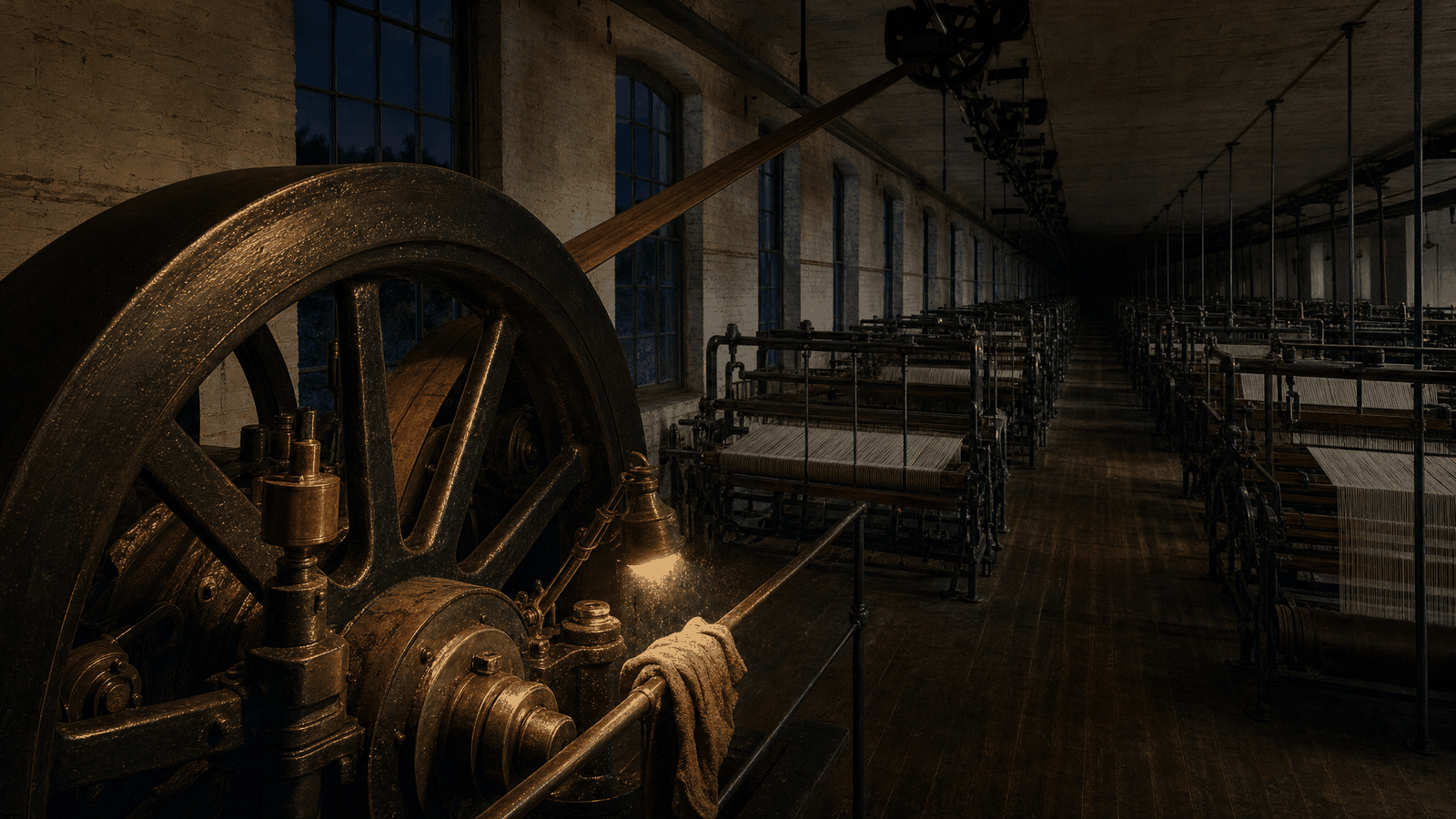
He closes with the steam engine. In the seventeenth century it sat in mine shafts pumping water, its motion vertical, lifting water out. Then the British changed one thing in the mechanism and turned vertical motion into rotation — and rotation can drive a loom. Looms had stood by rivers, pushed by water wheels; bolted to a steam engine they ran twenty-four hours a day, and the textile industries of China and India were beaten down.
Later somebody put the engine on a wagon. The carriage became the train, loads grew, and a transport revolution followed the industrial one. He offers a detail: the width of railway track comes from the gap between a carriage’s two wheels, which is to say the width of two horses’ backsides — a story that circulates, which he uses to make the point that the train is descended from the carriage and the gauge was not invented out of nothing. On a ship the engine made the steamer: no sails, no waiting for monsoon winds, no need for a crew that size. Why does everyone in those seafaring tales have such thick arms, he asks — because they used to row.
Then he brings it back: what everyone is building today is the steam engine. The engine has to go into the factory, onto the wagon, onto the ship before manufacturing and services get the part that follows. Chasing this component, that material, this server, he says, is something you will find funny a few years from now, because the space outside is far larger.

He talks about bubbles too. He cites an economist who lined up humanity’s bubbles — electricity, railways, the internet — and found they share a pattern: the break comes before the building. The internet’s real flowering came after the bubble burst. In 2000 there were plenty of dot-coms and online retailers, long on talk and short on use; today we hail cars, order delivery, and a food stall down an alley can make a living. He uses his own family for the shift: his father drove a taxi, circling the busy parts of town waiting for passengers, and today a driver knows from the system where someone needs a car and where they are going.
Has it burst yet? His answer is not yet.
The news says AI investment has overshot — should I get out first?
A few days after the US midterms, Asian markets sold off, with AI investment doubts given as the reason. The way Sun handled it is worth copying: he went and counted what each governor had actually said.
Of seven states, one governor said he would pause data centres. Some said they would issue no new permits, while permits already granted stand and construction continues next year. Some want a bigger share of community payments. Above all of that sits the presidential veto — if the Democrats pass a bill restricting AI, the president can veto it, overriding takes two thirds, and the Senate seats do not get there. His conclusion: AI may come slower and cost more; it will not stop.

That method swaps “the market is worried” for “who, standing at which step, holding which tool.” Applied to Taiwan, his ordering runs the other way round from the headlines: whether data centres get built sits further down the list, and tariffs sit at the top. The president’s tariff power needs no congressional consent, next year may bring a new round under Section 301 covering a dozen or more countries, and a semiconductor tariff is itself the instrument for forcing investment into the United States — go, or pay. He notes Taiwan’s government is rushing to close its agreement before year-end, because negotiating again with a new Congress is a different game.
His four risks for next year are worth copying down as well: prices (oil this year, possibly grain next year on the back of a strong El Niño), AI, tariffs, and the yield rises coming out of fragile public finances. He says the root is the first one — prices climbing pull money away, and that is what presses on the other three. The use of that for me is an ordering: when the market worries me, look at prices and rates first, then look at individual stocks.
I am not in tech — does any of this touch me?
He says Taiwan’s industry classification needs replacing: the old split was traditional versus tech, and the working split now is with AI and without. The glass company making fibreglass cloth, the petrochemical company making specialty chemicals, the steel company doing the structural work on fab buildings — all of them stand on the with-AI side. The tech companies making phones and laptops had second sources lined up for them long ago, and their margins go nowhere. He points to this year’s strike at Samsung: the memory division earns so much more than the rest that bonuses came out uneven.

This part works for people who do not invest, because he hands every industry the same question: how does your work connect to AI. His suggested order is use it first, then think — do not wait for somebody else to find the application, start with one thing in your own daily work that AI can help with. He uses MacroMicro itself as the example: it used to supply data and analysts’ readings, and with AI attached the same data yields more.
What I thought about here was the other side. He says the word “software” misleads in this context, because software took the worst of this wave — India has five million programmers, and AI writes code faster and does not sleep; American banks, law firms and accounting practices are all cutting staff. So “connecting to AI” runs both ways for most people: what it can take off your plate, and what it can take from you. Those two have to be counted together, and counting only one of them gives you an answer that is too cheerful or too grim.
Further reading
- MacroMicro, the Dr. Sun special (recorded 12 November 2026, published 15 November), hosted by Roger with Sun Ming-te, director of the business forecasting centre at the Taiwan Institute of Economic Research
- The Taiwan Institute of Economic Research’s upward revision to its Taiwan growth forecast, released 9 November (the version cited in the episode)
- MacroMicro’s report published the day after the US midterms, with historical statistics on how markets behaved under divided government
- Lüshi Chunqiu, “Shou Shi” (Warring States, public domain)
One thing to take away
One idea: an engine being built does not mean the use for it has arrived, and the test for whether it has arrived is whether anyone has started paying. The six in ten who kept their hands down in Sun’s survey and the model companies borrowing in the bond market to buy machines are two sides of one thing — no money coming in on one side, money still going out on the other. The steam engine was the same. It pumped water out of mine shafts for decades, and only when somebody turned vertical into rotary did it go from a machine to an era.
Here is something I have tried, and it has nothing to do with investing: find something in your home you bought and never use — a bread maker, a camera, a treadmill, some subscription — use it once today, then write one line saying whether the reason you left it alone was not knowing how, not having time, or buying the wrong thing. That line sorts itself: the first two mean the use never got connected, the third means the machine should not have been bought. Come back to the line in a fortnight and you will know whether you got it right.
This article is an educational discussion of investment method. It is not advice to buy or sell any individual security, offers no target prices, and does not analyze any current holding. Investing carries risk; make your own decisions or consult a qualified professional.
Comments
Loading comments…