You Feel Nothing at All When You Cross the Line
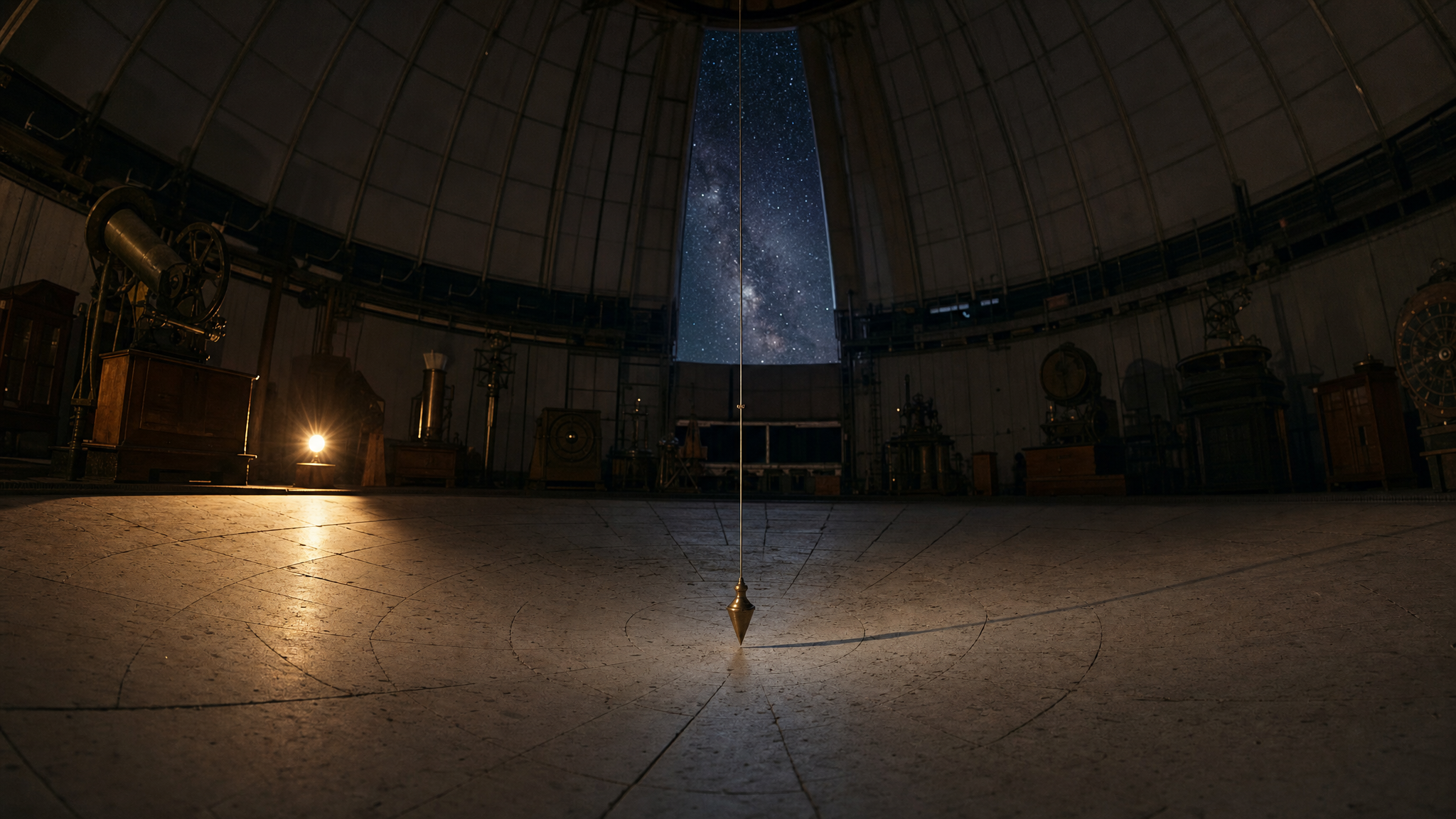
Dwarkesh Podcast brings on physicist Adam Brown to build general relativity from the ground up in twenty minutes. What stayed with me wasn't the black holes. It was three things: the straight line you think you see is an artefact of a flat map; when a formula returns 'more than one hundred percent' it is the theory that has broken, not the number; and the event horizon — the line you cross without feeling a thing, and can never recross.
The river passes like this, and yet it has never gone.
The moon waxes and wanes like that, and yet in the end it neither grows nor diminishes.
Look from the side of change, and heaven and earth cannot hold still for an instant;
look from the side of what does not change, and the world and I alike are without end.
—— Su Shi, First Rhapsody on the Red Cliff (1082)
Su Shi is looking at one river from a boat, and finding that a change of vantage changes the answer entirely — without ever saying which vantage is the correct one.
This episode pushes that thought to its limit: where you are and how you move decides what you measure. But Einstein went one step further than Su Shi. He distinguished two cases. Some vantages really are equal, and neither is more right. Others are not, because something in the world has broken the symmetry. Confuse the two and you will keep mistaking a different position for a different fact.
What this episode is about
Dwarkesh Podcast’s guest is Adam Brown, who now leads the BlueShift team at Google DeepMind and who, in a previous life, was a physicist at Stanford working across cosmology, string theory and general relativity.
The brief was simple. People say general relativity is the most beautiful thing a single human mind has ever produced — is there any way for someone who will never take the twenty-lecture graduate course to see why? So this is not a chat about physics. It is a lecture, whiteboard and all.
I have no physics background and I am not going to pretend I followed every step. But one thing kept making me rewind: the way he advances is structurally the same as the way a good investment judgement has to advance. You notice a coincidence that has no business being a coincidence, you refuse to let it go, and to explain it you are forced to abandon an assumption you never thought was up for negotiation.
Original episode: Dwarkesh Podcast, 10 July 2026 (English)
The notes I took
A decade of one man’s work now fits into ten weeks, and the students end up understanding it better than he did. That opening remark is worth more than any of the equations that follow. Not because we are cleverer, but because the people in between have already walked the wrong paths for you and boiled an idea once thought incomprehensible to anyone of sub-Einstein intelligence down to its core. That is what compounding knowledge actually means.
Two slogans. Special relativity (1905): nothing travels faster than light. General relativity (1915): not even gravity. The first covers electromagnetism; the second brings gravity in and completes the set.
Newton’s law of gravity collides with that limit immediately. Taken literally, jiggle the Sun and the force felt at the Earth changes at once — not eight minutes later. That is a faster-than-light telephone. Something has to give, and Einstein decided it was gravity that gives. Note what survives: F = ma survives, and “no force means a straight line” survives. It is straight line that needs rebuilding.
Electrostatics is the precedent, but you cannot simply copy it. The electric force is also inverse-square and also looks incompatible with the light-speed limit — until you notice it is only one limit of the full theory, and the magnetic terms restore consistency. So why not do the same to gravity? Because of the sign. Like charges repel; like masses attract. Run the identical mathematics and you would predict masses pushing each other apart. (Underneath: the photon that carries electromagnetism is spin-1, and gravity is carried by something spin-2.)
The only clue is a coincidence that should not be exact. The mass in Newton’s second law is inertia — resistance to being accelerated. The mass in his law of gravity is how hard you get pulled. In electromagnetism the analogous quantities are unrelated: a neutron is heavy with no charge, an electron light with plenty. In gravity the two masses are exactly equal. Newton himself checked it to a part in a thousand; by Einstein’s day it was a part in a billion; today it is a part in 10¹⁵. The feather and the brick hitting the floor together in a vacuum chamber is this fact. In Newton’s framework, it is sheer coincidence.

Einstein’s genius was refusing to accept that. Because there is one family of forces where “charge equals inertial mass” is guaranteed: inertial forces. Swing a bucket of water in a loop and the water stays put — either because the bucket moves on before the water can fall, or, riding along with the bucket, because centrifugal force pins it to the bottom. And how strongly you feel that force is necessarily set by your inertial mass, because the force exists only on account of inertia. So he asked: what if gravity itself is an inertial force? Impossible for electromagnetism, since charge is not mass. For gravity, the door is open — and the coincidence stops being a coincidence and becomes a necessity.
The price is steep: we have to be wrong about what a straight line is. You only feel inertial forces when you are not moving in a straight line. So the free-falling astronaut is the one going straight, and you, sitting motionless in your chair, are the one taking the corner.
Which sets up the best image in the episode: the map on the seatback screen. Fly San Francisco to London and the route arcs absurdly far north over Greenland. It looks like a detour. It is the shortest path. The map is what’s wrong — flatten a round Earth onto a rectangle and distortion is guaranteed. Pretend something curved is flat, and you will inevitably be wrong about which line is straight. Spacetime is the same: the thrown piece of chalk traces a parabola only because you insisted on plotting it on flat paper.

The field equations, in one line: matter tells spacetime how to curve, and the curvature tells matter how to move. Newton uniting the falling apple with the planets was already extraordinary. Einstein’s equation covers the apple, the orbit of Mercury, and the expansion and fate of the universe — an unreasonable span of orders of magnitude.
The origin story of black holes is faintly ridiculous. Einstein assumed his equations were far too complicated for anyone to solve exactly. Within months Schwarzschild solved them — a Prussian artillery officer, doing it between ballistics calculations at the front. And then, for roughly half a century, people got the meaning of that solution wrong. The worst offender was Einstein himself, who wrote various confused things about objects bouncing off the horizon.
Eighteenth-century thinkers had already found the radius. Set escape velocity equal to the speed of light and out drops 2GM/c². The Newtonian reasoning behind it does not really hold up — yet the answer is right, factor of two included, entirely by coincidence.
The compelling argument is a brick on a pulley. Lower a brick slowly from far away down toward a heavy body and you extract energy. The heavier and more compact the body, the larger the fraction you get. At the Earth’s surface it is about 7×10⁻¹⁰ of the brick’s rest-mass energy; at the Sun’s surface about 2×10⁻⁶; more still on a white dwarf. But extrapolate the formula and you reach an absurd regime: you extract more than one hundred percent. Energy from nowhere. Something must break.

And it breaks in the opposite direction from the intuition. Do the same trick with electric charges and what saves you is the force getting weaker — quantum effects fuzz the charges out. Gravity does the reverse: the force gets stronger, so strong that you cannot lower the brick slowly at all. It is ripped out of your hand. That boundary is the horizon. General relativity resolves the paradox by letting you extract exactly one hundred percent and not a scrap more.
Which makes a black hole the most efficient power plant physics permits. Burning chemical bonds gets you about 10⁻¹⁰; fission about 10⁻³; fusion about 10⁻². None of them touches the 99% locked in the rest mass of protons and neutrons — chemistry cannot reach it, and neither can nuclear reactions. Gravity can.

Then a coincidence that stops you dead. The chemical binding energy of a hydrogen-oxygen mix is about 1.5×10⁻¹⁰ of its rest mass. The gravitational binding energy at the Earth’s surface is about 7×10⁻¹⁰. Two utterly unrelated calculations — one chemical, one astronomical — landing in the same order of magnitude, with chemistry ahead by only a few times. That is exactly why chemical rockets reach orbit but barely: most of what stands on the pad must be burned before you get there, which is why payload fractions are so poor. From the surface of the Sun it would simply be impossible.
What saves you far out will sink you close in. The space station stays up on orbital angular momentum; the centrifugal effect holds the astronauts off the Earth. But inside 3GM/c², orbiting becomes counterproductive — because in general relativity all energy gravitates, kinetic energy included. The faster you go round, the more that energy pulls you down. Past that line, no ballistic orbit escapes.

Time dilation — and this time there is no symmetry. A clock deeper in a gravitational well simply runs slow: two atomic clocks at different floors of a Harvard building measured it in the 1950s, and GPS subtracts the effect every day or the fixes would drift. Here is the crucial difference. In special relativity two observers in relative motion each see the other’s clock running slow, and neither is more correct. In a gravitational well they are not equal: we both agree that your clock is the slow one and that you see me in fast-forward. The mass broke the symmetry.

The exchange rate for time is the exchange rate for energy. Send a photon up from deep in the well and it arrives redshifted — lower frequency, less energy. The mc² you hold down there is worth less to me out here; to collect the full amount I have to pay the cost of hauling it out of the well. One square-root factor governs the clock and the price alike.
Falling in has two views, both correct, and wildly different. Mine: you accelerate, then slow, then redden, and after one final photon you fade to black — I never see you cross the horizon. Yours: nothing happens. Your watch ticks at one second per second and you sail straight through. The horizon is not a violent place. Make the hole large enough and tidal forces are imperceptible; you could live a full life inside it, and have descendants there. “You are doomed, but you are not dead.” And the horizon is not locally measurable — no local experiment tells you that you just crossed it. It is a fact about your future, not about your surroundings.
The evidence is now beyond argument. At the galactic centre, Sagittarius A*: you cannot see it, but decades of watching stars whip around it give you something heavy, small and dark. In 2015, weeks after LIGO switched on, we felt spacetime shake — detectors far apart shaking identically, so not a passing truck — and back-calculated two roughly thirty-solar-mass black holes colliding 1.6 billion light-years away. Later the Event Horizon Telescope imaged the glow of infalling matter. Seen, felt, and computed, all agreeing.
And how the world came to believe it: an eclipse. Mercury’s perihelion anomaly was a number already known — getting it right was good, but it was retrodiction. The bending of starlight was a prediction: write down the answer, then ask the sky. There is an absurd twist. The 1911 expedition to Argentina was clouded out; the German expedition to Crimea was arrested when the war broke out. Both failures rescued Einstein, because the prediction he had written down at the time was wrong — equal to the Newtonian value. During the war, with nobody chasing eclipses, he found the mistake and revised it to double. In 1919 Eddington sailed out and measured double.
Theorists are cheap and experiments are expensive — but cheap has a limit. Asked why we spend billions on apparatus when the most beautiful theory in physics looks like one man thinking in a cave, his answer is honest: general relativity is the extreme case, not the norm, and the trick did not even keep working for Einstein’s own later career. String theory is the all-in bet on it — the wager that only a very small number of self-consistent theories exist, so that consistency plus correct behaviour in known limits can carry you to the truth. If instead the consistent theories are unlimited, that road never arrives, because they are all consistent and consistency is the only ruler you have.
On AI and science, his view runs against the gloom. Mathematicians fear what Terry Tao calls indigestion: a billion lines of machine-checked proof that certify a theorem without conferring any understanding of why. He doubts that future, because these models should be superhuman explainers as well as superhuman provers. There is early evidence: a recent proof of an Erdős problem was informal and human-readable, and human mathematicians took the new idea and used it to prove other theorems. He also cites the unit distance conjecture — perhaps the reason nobody disproved it for so long is that everyone believed it. And models have a rare property: extreme patience for work that looks like a waste of time.
Where my mind went
1. The discount rate is a gravity well — and near the horizon it eats everything.
“The exchange rate for time is the exchange rate for energy” is, literally, discounting. The mc² you hold deep in the well is worth less to someone far away, and the gap is the cost of hauling it out.
What matters is the non-linearity. At the Earth’s surface the correction is of order 10⁻¹⁰ — small enough to ignore for a lifetime, much as a near-zero rate lets you push cash flows out a decade at almost no cost, which is when every story starts to sound valuable. The same formula near the horizon crushes the same energy to nearly nothing. The discount rate is not a knob that nudges the answer a few percent; it decides whether the distant future counts at all. A valuation that loads its worth into the far years is a bet that the well will not deepen.
2. When the answer exceeds one hundred percent, it is the theory that has broken.
Push the lowered-brick calculation far enough and it says you get back more than you put in. He does not patch the number. He concludes that something more fundamental has to give.
Investing has its own version of free energy: riskless arbitrage, returns durably above the cost of capital that nobody competes away, a hedge that never costs anything. The right reaction is not a more careful calculation; it is to hunt for the assumption that snaps.
The valuable half is what comes next: the fix runs opposite to intuition. Electromagnetism is rescued by the force getting weaker, so you naturally expect the same of gravity — and gravity instead gets stronger, strong enough to tear the brick from your hand. Likewise, when a too-good strategy finally fails, most people picture returns decaying gently toward the ordinary. What actually happens more often is that at the closest point, the thing is ripped away. Knowing something is wrong is not the same as knowing how it will break.
3. The straight line you see is an artefact of the map.
Take the flight path straight across: flatten something curved and you will manufacture forces that do not exist.
In investing the map is your benchmark and coordinate system. Nominal returns across a decade of high inflation; a track record computed over only the companies that survived; a price threshold applied to a series that has been adjusted after the fact. Each flattens something curved. The result is not merely noisier — you invent forces that were never there, seeing edge where there is none and crediting skill that did not act.
And note how Einstein got out. Not by staring harder at the flat map, but by picking up a globe. When a conclusion is strange enough to be inexplicable, suspect the projection before you start writing the story.
4. The bottleneck is a ratio of constants, not a measure of effort.
Chemical binding at 1.5×10⁻¹⁰, Earth’s gravitational well at 7×10⁻¹⁰: two unrelated calculations in the same order of magnitude, with chemistry ahead by only a few times. Hence rockets that work but with dismal payload fractions. That is not insufficient engineering. The ratio is simply what it is.
Applied to industries, this is the layer most easily buried under a growth narrative. When a story says costs will fall once it scales, ask: is the binding constraint a learning curve, or a physical ratio? The first improves with volume; the second does not, unless someone replaces the operating principle at that layer — the way going chemical → nuclear → gravitational is a change of principle, not an improvement. The genuinely scarce position usually sits exactly where that ratio is tightest.
5. What saves you far out will hurt you close in.
Orbital angular momentum keeps you alive at distance and becomes a liability inside 3GM/c², because kinetic energy gravitates too. One mechanism, sign flipped by proximity.
I hold this as an analogy, not a theorem, but it points at something real: risk tools can change sign with the regime. Leverage that damps volatility in calm markets, correlations that diversify, hedges that work — they have an unpleasant habit of turning together in extremis. The lesson is not “don’t use them.” It is: never extrapolate an effect measured in the normal regime into the extreme one. Risk management validated only in good weather is an orbit measured only from far away.
6. The horizon is not locally measurable — so the line has to be drawn in advance.
The sentence that stopped me: you are doomed, but you are not dead. Crossing is imperceptible, no local experiment reveals it, and in a large enough hole you can live out a whole life on the far side.
That is the shape of nearly every slow-motion mistake. Adding to a position that has already fallen a long way. Moving the stop down, just this once. Letting one holding grow into half the portfolio. No alarm sounds on any given day. By the time the tidal forces are obvious, the options are gone.
Which gives a direct conclusion: since you cannot measure it locally, you need a global map drawn beforehand. Which number falling to which level, which assumption proven false, means the original judgement is dead — written down while nothing is wrong, precisely because on the day you cross you will feel nothing.

7. Retrodiction is not validation — and one failed checkpoint does not kill a framework.
Mercury’s orbit was a known answer; matching it was good but limited. Light bending was written down first and measured after. That distinction is the acid test for any model that can explain everything in hindsight.
But the episode supplies the harder half. Had the 1911 eclipse been clear, the measurement would have come back at double the value Einstein had then predicted — a “failure” landing on a theory that was in fact pointed the right way. He later found and fixed the error himself.
So verification discipline has to hold two opposing things at once: no revising the answer after the fact, and no discarding the whole framework on a single miss. The difference lies in whether you specified in advance which kind of failure means “this particular prediction was wrong” and which means “the underlying assumption was wrong” — or whether you waited for the result and then decided how to read it. The first is science. The second is looking for a way down.
There is one more note to self buried in the closing section. The unit distance conjecture may have stood so long simply because everyone believed it and nobody spent time attacking it. Never trying and trying without success look identical in the record.
Worth a look
- Original episode: Dwarkesh Podcast, 10 July 2026, with Adam Brown (English)
- The guest: Adam Brown leads the BlueShift team at Google DeepMind and previously taught at Stanford, with research spanning cosmology, string theory and general relativity
- All three strands of black hole evidence mentioned are publicly documented: the decades-long stellar orbit observations around Sagittarius A*, LIGO’s gravitational wave detections since 2015, and the Event Horizon Telescope images
- If you want to work through it yourself, one factor recurs throughout: √(1 − 2GM/rc²). Clocks, redshift, and whether you can remain static at all are governed by it
- The Su Shi passage at the top is my own annotation, not part of the episode
Disclaimer: This is a personal set of listening notes and study jottings, written as educational content. It does not constitute investment advice, an offer, or a solicitation. The physics here is my own restatement and may contain simplifications or errors — consult the original episode and proper textbooks. Every passage extending physics into investing is analogy, not theorem, and carries no predictive weight. Nothing here recommends any security, target price, or course of action. Investing carries risk; make your own judgement in light of your circumstances and risk tolerance, and consult a qualified professional where appropriate. The original episode is the copyright of its producers — please listen to it directly and support the creators.
This article is an educational discussion of investment method. It is not advice to buy or sell any individual security, offers no target prices, and does not analyze any current holding. Investing carries risk; make your own decisions or consult a qualified professional.
Comments
Loading comments…