Nobody Can See the Future, Yet Forecasts Are Never in Short Supply — Notes on Michael Santoli and the Money Game
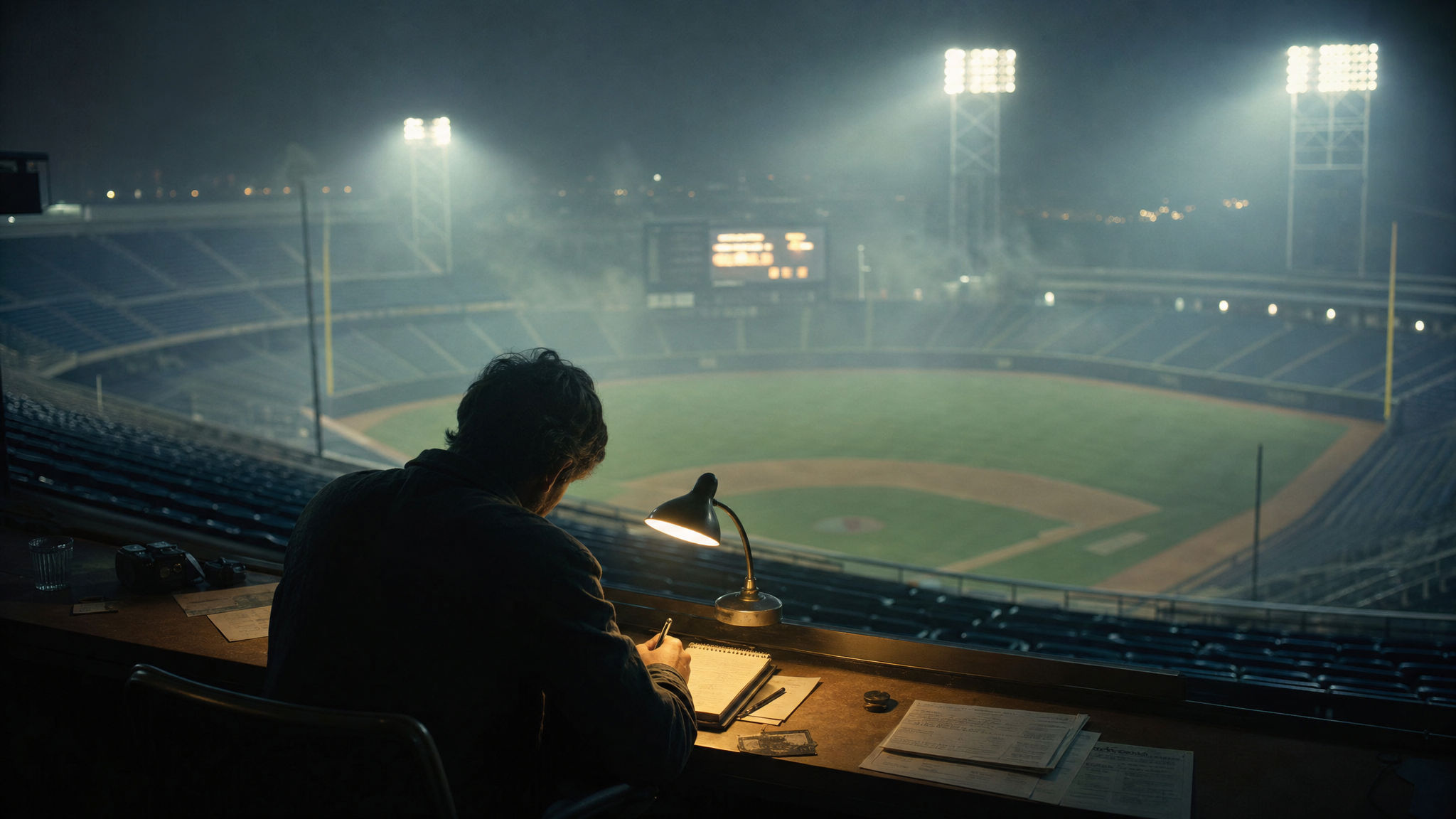
This episode of The Compound and Friends features CNBC senior markets commentator Michael Santoli. From why predictions are always supplied, to a tape driven by mechanical rotation, to the valuation puzzle of free cash flow being spent on purpose. Educational commentary, not investment advice.
Contents
When young, I knew nothing of sorrow, yet loved to climb the tower. Loved to climb the tower, and forced out sorrow to fill a new song. Now that I know sorrow through and through, I would speak, and stop. I would speak, and stop — and say instead: what a fine cool autumn this is.
— Xin Qiji, “Chou Nu Er: Written on a Wall at Boshan” (Southern Song, c. 1181; translation mine)
What This Episode Is About
The August 21, 2026 episode of The Compound and Friends hosts Michael Santoli — co-anchor of CNBC’s Closing Bell: Overtime, senior markets commentator, and before that fifteen years as a columnist at Barron’s. The hosts open by treating him like a hero, one of them explaining that Santoli is literally how he learned the stock market: as a rookie at a small Long Island brokerage in the nineties, the only person in the room who seemed to know anything told him to read the Journal’s C section every day and Barron’s every Saturday.
What makes Santoli interesting is his own positioning. Three decades covering markets, and he has never wanted to trade, has never felt the pull of being right on a bet. He describes himself as a color commentator — not the neutral kind, the kind with a feel for how the game is played — but one who stays off the field. His satisfaction, he says, comes from capturing what’s happening in six hundred words, efficiently and well, not from calling it.
That vantage point produces a different conversation. This one wanders widely: why the forecasting business never runs short of supply, who is actually moving prices day to day, how to think about valuation when capital spending has eaten free cash flow, and why a book from 1968 still lands.
The Main Points
One: the supply of predictions exists because the demand does. He cites Adam Smith — the pen name of George Goodman — in The Money Game from 1968: everyone knows the future can’t be seen, so why the flood of forecasts? Because the demand being there, the predictions must be supplied. The episode offers a wonderfully domestic illustration: a host’s relative asks whether Josh is still bullish on CrowdStrike. He answers that the relative probably knows as much about the stock as he does, that he likes cybersecurity long term and likes the CEO, but what does he really know? The relative replies: I know, but does he still like it? You cannot convince people you don’t know the future. Santoli also recalls the anonymous “mystery broker” he used to write about at Barron’s — readers became so attached to this person they’d ask for updates for years. He kept telling them they’d be disappointed, that it was nobody they’d heard of. It didn’t help. Someone on the show cites a figure: thirty-one percent of US adults say they believe in magic.
Two: bulls and bears are not equally honest, and not in the way you’d guess. Asked which side is more disingenuous, Santoli says bears — not because bearishness is wrong, but because bears tend to change the argument while keeping the stance. The example is concrete. Two years ago the central bearish thesis was extreme index concentration in a handful of megacaps. Then the market broadened; several of those names sat in twenty percent drawdowns while the index made new highs. That specific worry was, in fact, cured. Did anyone announce that the thing they were bearish about had resolved, and reassess? No — the argument moved to the national debt. Bulls, by contrast, will almost universally concede the bear case exists. That isn’t moral superiority; it’s a pattern you can test yourself against.
Three: most of the intraday tape isn’t reacting to news. Santoli calls the current regime an “immaculate rotation” — semis down two percent means Apple is up a point and a half and healthcare is flying, almost programmatically. A host adds the crucial clarification: when you talk to a trader today, you’re usually not talking to someone trading the news. You’re talking to somebody at a hedge fund acting as a market maker — Jane Street, Susquehanna, Citadel — and they do not care what the headline says. One statistic captures it: there hasn’t been an all-or-nothing day, where essentially every stock moves the same way, since December 31, 2025 — the longest such streak since 2001.
Then Santoli applies the brake, and this is the part that matters most: none of this means the machines are mindless or that prices are disconnected from fundamentals. If a genuine macro shock arrived — something that actually changed the underlying equation — the machines’ first move isn’t to trade erratically. It’s to turn off. The mechanical feel is a product of calm, not evidence that the market has lost its mind.

Four: the valuation problem has moved. He’s written that it’s prudent to assume the multiple peak is in, while staying open to pleasant surprise. The reasoning: forward P/E hit 23x last October, and since then earnings have grown faster than prices, so the multiple has compressed. What’s blocking a rebuild of that premium is free cash flow — the S&P now trades near 30x forward price-to-free-cash-flow, because this cycle’s growth drivers are capital intensive. A host pushes back immediately: but it’s voluntary, they’re doing it on purpose, and Wall Street knows it’s on purpose, so it’s tolerable. Santoli agrees, and agrees the demand signals are genuine rather than speculative. But he leaves a sharp question hanging: capitalism shouldn’t work such that everyone all at once decides to spend all their free cash flow building the same thing and everybody gets a great return on it. He adds that if a year from now we’re still saying it’s coming, it’s coming, it’s about to pay off — the market may be less relaxed about it.

Five: everything ends in a boring place. He reads the 1968 passage where a young man recites, like a cadet quizzed by an upperclassman, “computer leasing stock, sir” — the need for computers is practically infinite, leasing is the only way to sell them, the computer companies lack the capital, therefore earnings double this year and again next year and again after that, the surface has barely been scratched, the rise has scarcely begun. It rhymes. But his point isn’t mockery: the mainframe revolution was real. His point is that whatever company excites you now, if everything goes beautifully, ends up as a utility — plumbing in the guts of the economy. He uses Circle: congratulations, you’re a custodian earning a spread off T-bills; Bank of New York Mellon holds trillions and trades at twelve times earnings. Ride the exciting phase, then work out how it decelerates. (A host offers one exception: Elon, who will cannibalize his own product line and start over.)
Six: the example that broke the veterans’ brains. Santoli relays a story from Byron Wien, who entered the business around 1958 — precisely when dividend yields crossed below Treasury yields. Before that, this had been an iron rule signaling a market top: stocks are massively overvalued, sell. Instead the relationship stayed inverted for fifty years, until the financial crisis. Wien watched the senior men at his firm break over it. They set their watch by that rule. The watch stopped working, and they moved from the corner office to an interior one. Wien’s annual “Ten Surprises” list grew out of exactly this: let me test myself for where my blind spots are.

Seven: he admits his own bias. After July’s selloff reversed, he sat in front of the screens listening to every guest recite the same mantra — earnings are the north star, earnings are the lifeblood of a bull market, betting against it is foolish. He bristles. Not because he thinks they’re wrong, but — quoting Mad Men, where Dr. Faye Miller tells Don Draper “you only like the beginnings of things” — because he only likes the beginnings of things too. He likes a rally that happens in the face of challenges. And then the most honest line in the episode: “What I don’t do anymore is say that’s why it’s over, because it probably isn’t over.”

Going Further
”The news was good. Why did my stock go down?”
This is where most people get stuck. A good headline lands, the stock doesn’t move or drops, and the suspicion starts: did somebody know already? Did I read it wrong? Is the market lying?
The episode offers a colder explanation. You assume price is responding to that headline, but a large share of today’s volume comes from participants who never read it. What they’re doing is hedging one factor against another, keeping exposure roughly neutral while not being out of the market — semis fall, so something else has to rise to hold the risk profile steady. Your stock’s move may just be a consequence of which basket it sits in.
The point isn’t that news is useless. The point is to turn this into a ruler: separate weather from climate before you react. Santoli reaches for a good analogy discussing fiscal deficits — they’re like an underlying autoimmune condition. Dormant most of the time, flaring under systemic stress, at which point everyone panics about it, even though it isn’t really the cause of that particular fever. Intraday rotation belongs in the same category. It’s fair-weather weather.
Practically: if a piece of news moves your stock for a day and then gets absorbed by rotation, it was probably weather. If it changes orders, pricing power, or cost structure over the next several quarters, it will keep showing up in the numbers and you have time to confirm. The signal that should actually raise your pulse isn’t “it went down today” — it’s liquidity vanishing. Because the machines’ first response to a real shock is to switch off. When spreads widen, volume thins, and no basket can absorb the move, that’s what a rewritten equation looks like.
”I’m underwater. Do I cut it or hold it?”
The passage from The Money Game deserves to be taped to the edge of your monitor. A stock is, for all practical purposes, a piece of paper sitting in a bank vault that you will most likely never see. It may or may not have intrinsic value. What it’s worth on a given day depends on the confluence of buyers and sellers that day. And the most important thing is almost embarrassingly simple: the stock doesn’t know you own it. Every marvelous or terrible feeling you have about it is unreciprocated. Unreciprocated love turns into masochism, narcissism, or worse — losses.
It doesn’t know your cost basis either. That sounds obvious, and yet a host admits on air that he still catches himself doing it — treating his entry price as though it exerts some gravitational pull.
Santoli follows the thread into a real behavioral habit: retail investors don’t like to crystallize losses. Something’s down, it’ll come back, so the next move is always more likely to be a buy than a sell. In 2020 that habit looked like genius — Vanguard’s clients responded to the COVID crash by doing nothing, and that was the best investing behavior in the country, better than any hedge fund.
But two things have to be kept apart, and this is the whole game: “I don’t sell because I’m scared” is discipline. “I never sell no matter what” is faith. The way to tell them apart isn’t to look at how far underwater you are. It’s to ask a question that has nothing to do with price: is the reason you bought this still true? If it’s been refuted — the product got displaced, customer concentration broke, cash flow went negative with no path back — then your cost basis is just a number that hurts. If the reason still holds, the paper loss is just that day’s confluence of buyers and sellers.
”Someone very persuasive is permanently bearish. Should I be scared?”
The asymmetry discussion hands you a tool you can use immediately.
Don’t try to judge whether a bear is right. That’s hard, and the data they cite is usually real. Ask an easier, more verifiable question instead: when their stated reason got cured, did they change?
Use the episode’s own case. Two years ago the core bear thesis was concentration. The market broadened, megacaps drew down, and that specific concern was factually resolved. The honest move is to say: that one’s off my list, let me reassess. What happened instead was a seamless pivot to the national debt. This doesn’t mean the debt isn’t a real issue. It means that person’s conclusion wasn’t derived from the argument; the argument was recruited to support a conclusion that was already there.

The same ruler has to be turned on yourself, and that’s the real exercise. When did you last change your mind about a stock, a sector, a person? What changed it? If you can’t remember, what you’re holding may not be a judgment. It may be an identity.
Watch the mirror-image trap too. Santoli says he bristles at the fashion of lionizing retail traders as the actual smart money. They do buy the dip and they’ve been rewarded — but they also sell when it’s been ugly for a few weeks. Any claim that some group is always right is just a stance wearing different clothes.
Worth Looking Up
- The Money Game, Adam Smith (pen name of George Goodman), 1968. Two passages are read on the show; both hold up after nearly sixty years. One host calls it his favorite investing book by a distance.
- CNBC’s Closing Bell: Overtime, 4pm Eastern, co-anchored by Santoli and Melissa Lee. The post-game show, and it lands in the earnings window.
- Mike’s Market Memo, the newsletter his CNBC Pro column has become. He promises some pop-culture grumbling alongside the markets.
- Byron Wien’s annual “Ten Surprises” list, as the prototype of using a surprise inventory to probe your own blind spots.
One Thing to Take With You
The part I most want to keep is his description of bears who swap the argument but never the stance — the concentration worry got cured by the market, and the case slid seamlessly over to Treasuries. It’s the reason I started suspecting that a few of my own views aren’t judgments at all, but identities.
Here’s a small thing I tried. Pick something you’ve been consistently for or against all year — a colleague, a sports team, a restaurant that’s “just bad.” Today, go back and find the reason you gave someone six months ago; it might be in a group chat or in your own notes. Copy that reason out word for word, put the date beside it, then write your current reason underneath. If the two match, the stance is standing on its evidence. If the reason changed and the conclusion didn’t budge, it’s worth asking where the conclusion actually came from. The first time I looked, I couldn’t find a reason from six months ago at all — only the conclusion. That was the answer.
This article is an educational discussion of investment method. It is not advice to buy or sell any individual security, offers no target prices, and does not analyze any current holding. Investing carries risk; make your own decisions or consult a qualified professional.
Comments
Loading comments…