Catalyst Notes: The Electric Supercycle's Flywheels Are Real, and Transmission Doesn't Have One
Notes on the Catalyst with Shayle Kann episode 'Enter the electric supercycle [re-published]' (24 Nov 2026): host Shayle Kann and Energy Impact Partners partner and head of research Andy Lubershane argue power is entering an electric supercycle — a gas turbine ordered today takes about five years, grid equipment three or more, at two to three times the price of five years ago, while electricity is only about 20% of US final energy demand. Andy cites IEA data showing EVs and data centers contributed roughly equal shares of 2025 global electricity demand growth. I give the four-building-block flywheel case and the three holes in it — rates, magnitude, transmission — equal space. Educational notes, not investment advice; no price targets, no stock picks, and my reading may be wrong.
Contents
I suspected the smoke could be put to use, so I swept up its soot and made ink of it: black with a lacquer sheen, beyond what pine soot can give… This substance will one day spread widely through the world, and it began with me.
—— Shen Kuo, Dream Pool Essays, “Miscellaneous Records I” (Northern Song, c. 1088; my own translation)
In the Catalyst with Shayle Kann episode “Enter the electric supercycle,” re-published on 24 November 2026, host Shayle Kann and Andy Lubershane — partner and head of research at Energy Impact Partners — say power is entering a long cycle they call the electric supercycle. Their numbers for where things stand: a gas turbine ordered today arrives in about five years, transformers and switchgear in three or more, and anything in the grid supply chain costs two to three times what it did five years ago, while electricity accounts for only about 20% of US final energy demand, with the other 80% still held by fuels burned directly. Andy’s most counterintuitive citation comes from the IEA: in 2025, the increment in global electricity demand from electric vehicles came out about even with the increment from data centers. For the bull case to hold, one gate has to be passed first, and he concedes it has no technology solution — whether new transmission lines actually get built.

The case at its strongest: four building blocks pushing each other up
Andy says he and Shayle have spent three years talking about the electricity gauntlet: surging demand on one side, bottlenecks popping up at every level from generation through transmission to distribution on the other, and they have been in the narrow part for about eighteen months. Those lead times and prices up top are what the gauntlet looks like; the increases that arrived with the pandemic were expected to ease along with the rest of global supply chains, and because demand kept climbing they stayed well above inflation instead. In a market like that, Andy says, if you can deliver any piece of equipment that relieves a bottleneck at any level, you feel pretty good right now.
Data centers are the largest source of new demand, and yet his reason to be bullish sits elsewhere. That other 80% is still held by fuels — passenger and heavy-duty transport, heating, the precision manufacturing processes that run on electrical work — and it had been shifting toward electricity notch by notch before AI showed up, a slow trend with decades of legs. The IEA number is the evidence for that trend. He expects 2026 and 2027 to look different, but a purely US vantage point glues your eyes to data centers.

What the episode is really about is flywheels. Andy compresses the whole stack into four building blocks: solar photovoltaics, lithium-ion batteries, electric vehicles with the motors inside them, and power electronics — the layer that shifts voltages and moves between DC and AC, invisible to most people, which he calls the unglamorous fourth leg of the stool. The loops run like this: the more solar goes into a power system, the more storage is worth, because you can hold the excess from the middle of the day and release it into the few deficit hours, and grid-scale batteries gain a market. He calls electric vehicles the keystone species of the ecosystem, on the strength of sheer unit volume, which is what built out mass manufacturing for batteries; and EVs themselves benefited from the solar industry’s early bets on wide-bandgap semiconductors, which allow the higher-voltage, higher-frequency switching that traction motors and fast charging depend on. Now that line runs back to the grid, into solar inverters and transformer replacements. Shayle says the line I wrote down here: they are investors in one of the companies doing it.
The same shape ran once already through microgrid controllers. Hospital and campus microgrids spent a decade-plus learning how to orchestrate generation, storage and load on a single site; data centers then took it to gigawatt scale — “taking it to 11,” in Andy’s phrase — and he expects the expertise to flow back down to charging depots at ten or twenty megawatts, with batteries on site, able to island themselves and reconnect, the highway ones possibly tied to a solar project next door. Robotics is the next set of wheels. Every autonomous vehicle on the road is electric, and Andy says that isn’t coincidence, because GPUs run on power and bolting a lawn mower engine onto a machine making low-latency decisions makes no sense. For fun he worked out a humanoid: run one five or six hours a day on chores and yard work and it eats three to four times what a typical refrigerator does in a year, making it the largest electrical appliance in the house apart from HVAC. The drone line is harder evidence: quadcopters already ship in the hundreds of millions heading toward billions, and defense buyers pay for performance — ARPA-E ran a program called 1K targeting a 1,000 Wh/kg battery, roughly three times the best on the market today, and he recently saw a DoD initiative looking for 2,000 Wh/kg. Land that, and heavy-duty transport looks different.
From the other side: every flywheel sits on something manufacturable, and the binding layer isn’t
The first thing I want to poke at from the other side is that chain. The solar industry’s early wide-bandgap bets being amplified by EVs is a half-loop that already happened; the “and back to the grid” half is still in progress, and the people telling the story hold a position in it — Shayle said they are investors. Of the four blocks, the two with costs demonstrably crushed by volume are solar panels and lithium-ion cells; power electronics returning to the grid is a far smaller business than either. Using one closed half-loop to infer that the other half closes at the same speed is an analogy.

The second hole is the price gap. Electricity takes market share from fuels by being cheap, and equipment at two to three times the price with three-to-five-year lead times eventually lands in rates. Andy himself says US retail electricity prices over the past five years have tracked inflation in real terms — up a lot in nominal terms, flat in real ones — and his phrase is that the worst is yet to come, with electricity being a foundational good, which makes it a driver of inflation in its own right. Affordability has already reached elections. If real rates run above inflation for several years, the decision to swap heating, processes and fleets over to electricity slides to the right, and that decision is the 80% he is bullish on. The same AI demand is crowding it out from the side: as Shayle puts it, good luck finding a 100-megawatt site a data center developer hasn’t already taken.

The third hole is magnitude. Three to four refrigerators per humanoid draws Shayle’s on-the-spot verdict that it is meaningful without being a scary number; he cares more about industrial robotics and industrial electrification, where a large chip fab runs from tens of megawatts up toward 100. And Andy’s own footnote flattens all of it: whatever new vector of power demand you come up with, it won’t compare with data centers, which are big enough to block out the sun. The compounding can be real and still invisible in the totals for the next five to ten years.
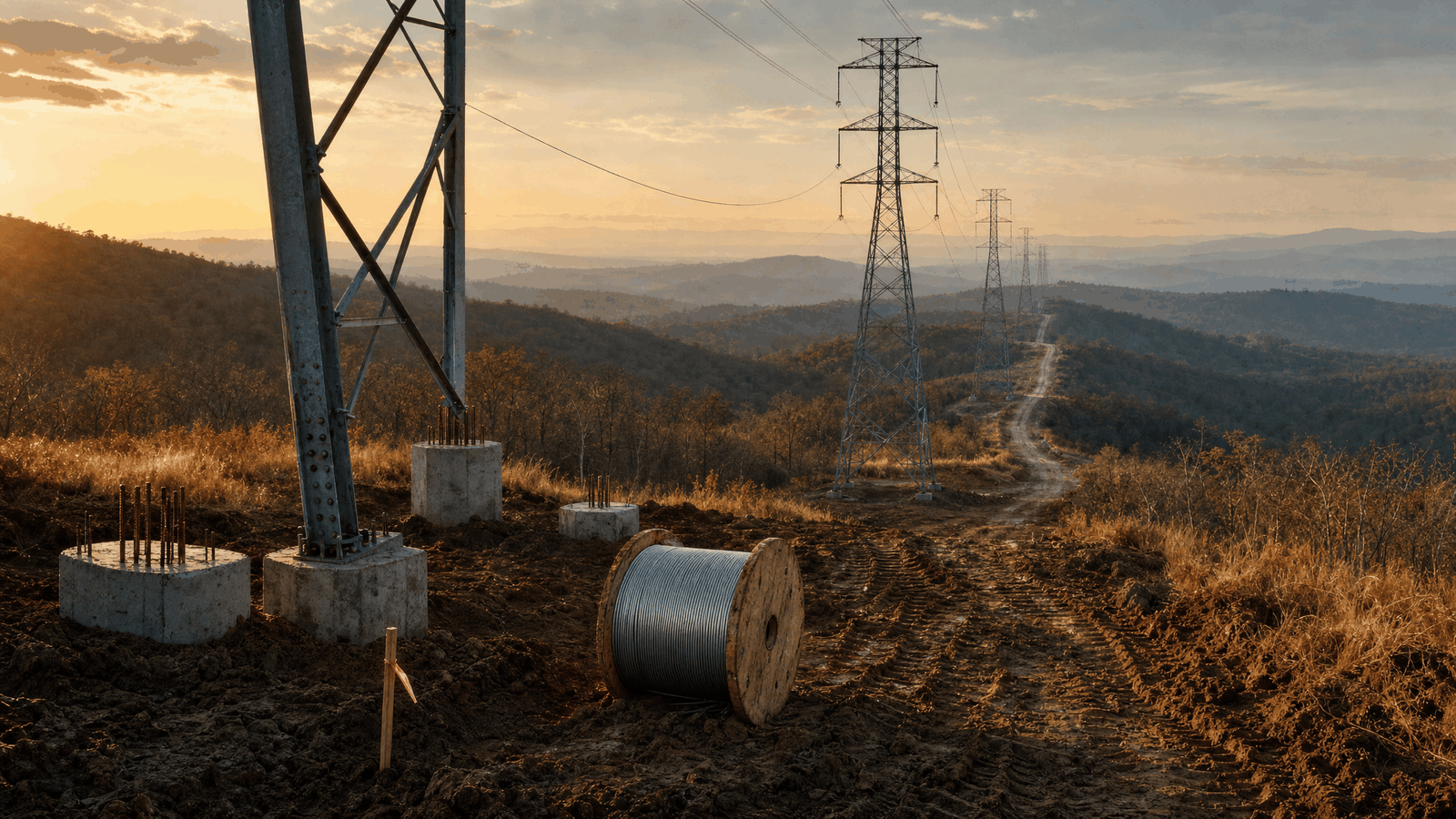
The fourth hole is the hardest. Pressed at the end to name a single rate limiter, he picks the grid, then narrows it to transmission. His reasoning is worth reading word by word: he has not seen a technology solution that changes the amount of transmission expansion investment needed, and what’s needed is new lines and new corridors; pull a long-distance high-voltage line and you run into society’s willingness to tolerate that kind of infrastructure, you run into NIMBYism, and NIMBYism has no technology fix. Flywheels turn on things you can finish in a factory, load onto a ship, and make cheaper by building them again; transmission needs land and other people’s consent, and the hundredth one isn’t cheaper. The battery transfer chain is weaker than it sounds, too: the military pays for performance, and the judgment on the show is that even a 2,000 Wh/kg cell at four times the price wouldn’t get traction in the EV market, because today’s lithium-ion is already good enough on range. Which is why Shayle laughs at himself at the close: every one of these conversations ends with “why don’t we just go off-grid,” and this one does too — Andy’s hope is new data center load running on an off-grid hybrid of solar, gas and batteries. Going off-grid solves not being able to connect, at the cost of turning a system-level problem into a pile of private solutions.

Which side I land on, and the condition it turns on
Start with the sentence I suspect a lot of people are carrying: my power bill is going up, and the news says electricity demand is exploding and anything power-related is hot — so is this good news or bad news? What I do is split it into three questions: does the demand show up, does the electricity get delivered, and who ends up with the money. On demand I’m with the bulls: the 20-versus-80 headroom, the IEA figure where EVs tie data centers, Andy’s confidence over ten to forty years — those hold up, and notably he will only vouch for data centers themselves within five years. On delivery I’m with the skeptics, because the rate limiter is transmission and he says himself there’s no technology fix. Both can be true at once, and when they are, what rises is prices and lead times.
The difference comes down to one condition: flywheels only turn on things you can manufacture. A learning curve requires making the same object tens of millions of times — solar panels, cells, power devices, motors all qualify. A cross-state transmission line is a one-off project needing land, permits and consent along the route; the tenth is barely cheaper than the first, and arguably dearer, because the good corridors go first. So my read is that this supercycle gets delivered in modular form — finished in a factory, assembled on site — and the bottleneck stays on anything that has to be built in place with somebody else’s agreement. It also explains why every conversation ends off-grid: going off-grid is a way around the consent gate. If transmission approval timelines start shortening over the next two or three years, or real rates run above inflation for a year or two and then settle, my side doesn’t hold and the smooth version of the bull case wins.

The other sticking point is “how do I use a ten-year trend without buying the hottest part of it.” The mistake I made this year was treating certainty about demand as certainty about outcomes: once demand looked nailed down, I assumed delivery would keep up, and went looking at who told the best story instead of who on the chain is waiting for someone else’s nod. The correction is concrete enough — draw a supply chain from the end customer upward and ask, layer by layer, whether the output is a box finished in a factory or a project built on site. The first gets cheaper with volume; the second gets dearer.
Further reading
- Catalyst with Shayle Kann, “Enter the electric supercycle [re-published]” (24 Nov 2026), with Shayle Kann and Andy Lubershane
- Andy Lubershane’s piece from a few weeks earlier on the electric supercycle and its hidden feedback loops, which this episode walks through
- The IEA’s recent data on global electricity demand growth, so you can check the 2025 EV and data center increments yourself
- ARPA-E’s 1K battery program documents and the DoD’s 2,000 Wh/kg initiative, to see what the targets and acceptance conditions actually say
- Your own region’s transmission approval and interconnection queue data, the most direct yardstick there is for this episode’s conclusion
The one thing to take away
Demand being nailed down doesn’t mean the thing gets delivered; the layer that jams is the layer you can’t finish on your own side. The bull case here lays the four-block flywheel out beautifully, and then, pressed to name one rate limiter, Andy picks transmission — and picks it because that layer has no technology fix and runs on other people’s consent. What you can manufacture gets cheaper; what needs a nod doesn’t.
Here’s something I’ve tried. Take one thing you’re sure is going to happen — a move, a job change, a room in the house you’re redoing all count — and write it out as a chain, one link per line. Then circle exactly one: the single link you can’t finish on your own side, the one waiting for someone’s approval or a slot in someone’s schedule. Spend the next few weeks’ attention on that line rather than on the links you’re best at.

This article is an educational discussion of investment method. It is not advice to buy or sell any individual security, offers no target prices, and does not analyze any current holding. Investing carries risk; make your own decisions or consult a qualified professional.
Comments
Loading comments…