Nobody's Against Data Centers. They're Against You.
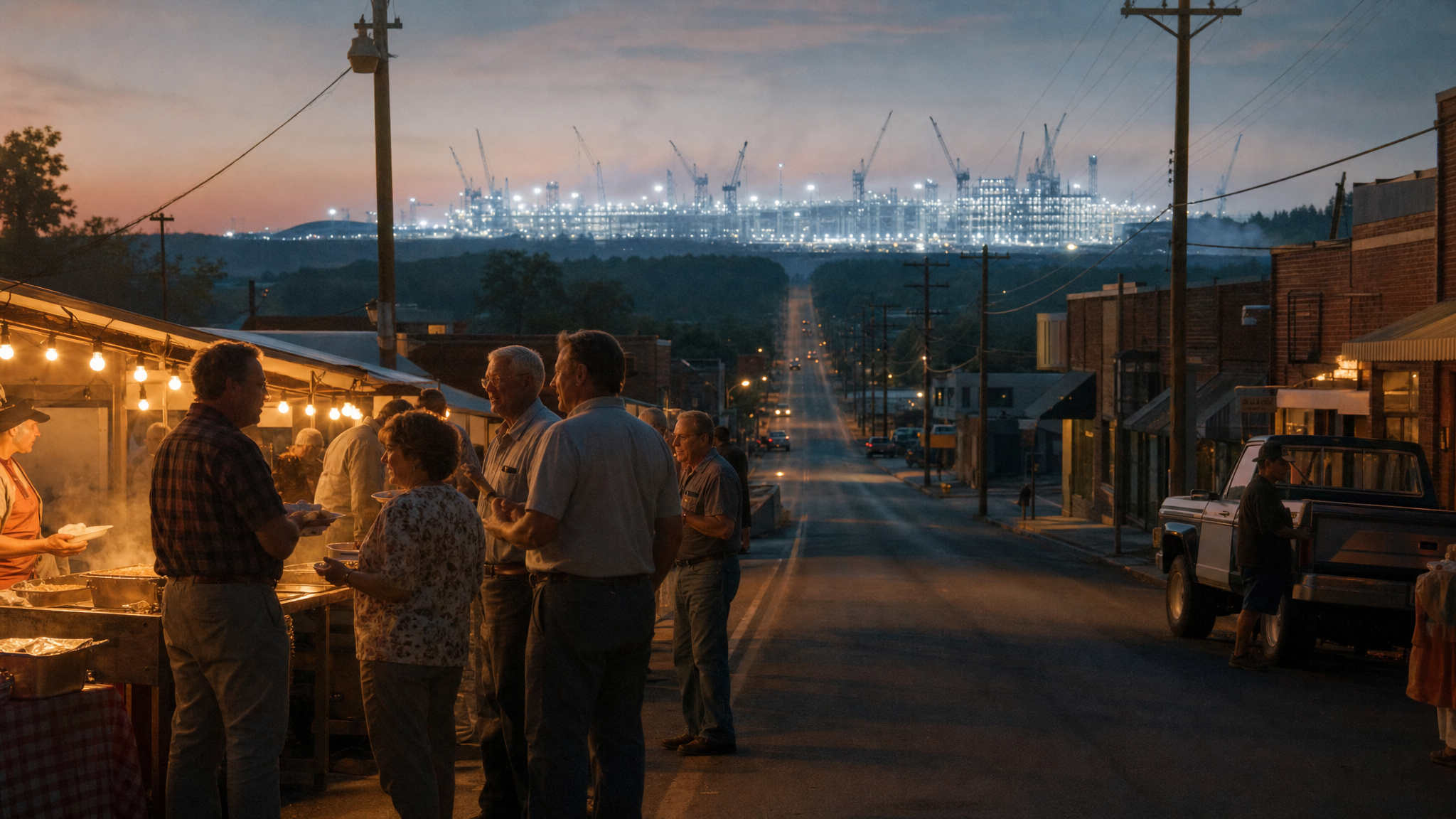
Notes from Bloomberg's Odd Lots (2026-08-21) with independent writer Jasmine Sun on why the AI industry misjudged where the public backlash would ignite: not jobs, not doom, but the 700-acre construction site down the road — and what that says about reading the buildout cycle. Educational, not investment advice.
Contents
A government flourishes when it follows the people’s heart; it fails when it goes against it.
—— Guanzi, “On Shepherding the People” (Warring States period; translation mine)
What this episode is about
On the August 21, 2026 episode of Bloomberg’s Odd Lots, the hosts brought back independent writer Jasmine Sun. She had just done something refreshingly low-tech: got a few friends into a car and spent July driving through Michigan and Wisconsin looking at data center sites, proposed and under construction. Part of why she picked those states, she admits, is that July by the Great Lakes sounded a lot more pleasant than crossing the Texas desert.
The result was a piece called “No Data Centers in My Backyard.” And what she brought back looks almost nothing like what Silicon Valley had spent three years bracing for.
The AI industry prepared for two things: mass job displacement — hence all the essays about needing a new social contract — and existential risk, the rogue-model scenario. What actually caught fire in American local politics was a third thing nobody had on the calendar: the 700-acre construction site next door.
Sun put it sharply: there are no kids and no data centers in San Francisco, so no wonder nobody there worried about either one.
The main points
1. What opponents lack isn’t information. It’s a reason to believe you. She calls this the biggest shift of the trip. She expected to find people who’d watched too many videos claiming data centers would drain the Great Lakes — and she did meet one, outside a campaign event. But the people actually organizing opposition knew more than she expected. They could tell closed-loop from open-loop cooling and explain which uses more water. They knew an AI hyperscale facility isn’t the same animal as the old internet data center. Some of them used AI to draft their own emails. The gap wasn’t knowledge, it was trust: when the utility says it will absorb rate increases, residents don’t believe it, because that utility has raised rates every year for five years. When the company promises 500 jobs, they don’t believe that either, because they remember the factory that promised far more and never materialized.
2. This is not classic NIMBYism. Classic NIMBY says: I want the housing, just not next to me. Data centers break the pattern. Polling shows roughly 70-30 opposition among people who live near a proposed site — and roughly 70-30 among people in zip codes where nothing is proposed at all. The only difference is salience: if a giant project is going up next door, it enters your top five voting issues; otherwise it doesn’t. Which means the objection isn’t “not near me.” It’s “do we need this at all?”

3. It polls worse than dirtier things. The same polling stacks data centers against solar farms, nuclear plants, power plants, battery storage, chip fabs, and fulfillment centers. Data centers come last. Several of the comparisons are objectively dirtier, equally noisy to build, and equally dependent on out-of-town labor. The difference is that those things have an implicit pro-faction — cars have to be built somewhere, electricity has to come from somewhere. What’s the pro-faction case for a data center? “So people in San Francisco get coding assistants” does not land in Janesville.
4. The balance of power flipped in about two years. When these proposals hit city councils in 2023 through 2025, there was no backlash yet. Small towns were afraid of losing the project to the next town over; some set up tax subsidy districts to compete — the same script as the Amazon HQ2 auction. Now it’s inverted. Local officials aren’t offering subsidies; they’re asking for money up front and bonuses for public school teachers. The nondisclosure agreements signed early on are near-universally regretted — even pro-data-center people told her the NDAs massively amplified community distrust, and Microsoft has said it won’t sign them anymore. Her summary: two years ago the question was what your community can offer us; now it’s how much we can offer your community.

5. Making the bribe bigger doesn’t help, and sometimes backfires. Back in San Francisco, she hears industry people ask whether the fix is just mailing bigger checks to every household. Her observation from the Midwest runs the other way: the bigger the number, the more suspicious it looks — like dark money, like late-bubble cash-splashing. This is also why she came home more sympathetic to statewide moratoriums than when she left. Not because pausing construction regulates AI, but because a town of 3,000 people should never have been expected to negotiate a good contract in the first place.
6. Even the people making money on it think it’s a bubble. She spoke to a senior union VP, the CEO of an electrical contracting firm, and an HVAC engineer. All three are earning from this buildout. All three said it’s probably a bubble. One framed it as: yes, it worries me that the biggest seven companies are half the stock market, but when this bubble pops we’ll move to the next one, we’ll diversify. That matters locally: if the people on the job site aren’t sure how long it lasts, then asking a town to accept a project that may not start paying real taxes for a decade is a fundamentally different bet.
7. The most human moment came from a man who operates cranes. Terry McGowan of the operating engineers’ union thinks about this historically. Growing up in Milwaukee, he says, noise was money — you saw the smokestacks and heard the racket, and that was what fed your kids and sent them to school. It was the lifeblood of the community. What baffles him is the shift over a few decades, from industry as the thing that sustains us to industry as the thing to distrust. And when he tried to get union members to speak up at council meetings and say this project is helping me, his guys were reluctant — being pro-data-center gets your neighbors angry at you. The fight has gotten intense enough, she notes, that there have been death threats, council resignations, and bad blood between neighbors.
Going further
”AI is booming — so where’s the actual constraint?”
Most people track this by watching chips, memory, and power. This episode offers another axis: permitting, public opinion, and local politics are becoming a real capacity constraint.
The chain runs like this. First, capital isn’t the bottleneck — the hosts say it plainly, investors are happy to fling money at hyperscalers. Second, the physical inputs are: power, water, land, approvals. Third, in America the first three are still findable; it’s the fourth that binds — and permitting is decided by people who don’t report earnings and don’t care about your valuation model. Fourth, and this is the step that gets skipped: this constraint never shows up in the news as “construction halted.” It shows up as a two-year timeline becoming four, as a project relocating to Arizona, as a project relocating to Australia or Canada. It seeps into the realization pace of capex. Sun says explicitly that some of the international buildout is driven by exactly this — and that people are seriously funding research into data centers in space, which she calls the ultimate NIMBY solution, since there’s nobody up there to stop you.
What’s usable here for an ordinary observer? A variable you can track yourself without inside information: state-level rulemaking progress. When a state sets clear standards — community benefits per megawatt, cooling requirements, ratepayer protections — that’s an accelerant, not a brake, because developers stop having to negotiate town by town. Conversely, a state with a moratorium and no replacement framework is where things are genuinely stuck. Sun changed her own position this way: she went in thinking moratoriums were a blunt tool and came out seeing them as raising the negotiation to a level that can actually negotiate.
Note the condition under which this reasoning fails: if the buildout genuinely migrates offshore or into permissive states at scale, then American local politics stops explaining much about total capacity, and tracking it stops paying. Judgment criteria have to follow reality, not your framework.
”Even insiders say it’s a bubble — should I get out?”
This is the easiest part of the episode to misread. The instinct on hearing “even the tradespeople say it’s a bubble” is: see, the people on the ground know.
But read the union official’s full sentence and it’s a hedging statement, not a forecast: if it’s a bubble, we’ll move to the next bubble, we’ll diversify. He isn’t calling a date. He’s describing his own position — his skills transfer, so he doesn’t need to know when this ends. Likewise, the electrical contractor said “probably a bubble” while actively taking the work.
A useful test: when someone calls something a bubble, ask what that belief made them do differently. If the answer is nothing — they’re still bidding, still on site — the statement carries almost no information. It’s social language, not judgment. If the answer is that they shortened contract terms, demanded payment up front, or declined to expand, that’s a real signal, because they converted the sentence into a cost.

That said, the episode does contain one genuine signal — just located elsewhere. The bubble framing has now reached the implementers at the far end of the supply chain, including the people earning from it. That predicts no timing whatsoever, but it changes the decision conditions for local government. Ask a town to accept a project that repays in a decade while residents read “bubble” in the news every morning, and the contract naturally gets tighter: more up-front payment, more guarantees. She mentions communities now asking developers to prepay 80% of forecast electricity demand, because forecasts are often wrong and residents shouldn’t be left holding it. Each of those clauses becomes a liability on someone’s balance sheet. The hosts do that arithmetic at the end: one parish’s teacher bonuses don’t move the needle, but every project carrying these terms changes the whole cost structure.
”The company’s pitch sounds great — can I trust it?”
This is the part of the episode that travels furthest outside investing.
The residents’ distrust is specific, not emotional. Their logic: this utility raised rates every year for five years, so discount “we’ll absorb the increase.” That factory promised jobs and didn’t deliver, so discount “500 jobs.” And the NDA itself doesn’t read as professionalism, it reads as something to hide — which is why even the supporters came to regret signing.
That logic ports directly onto earnings calls. The same sentence — “margins should improve next year” — is worth wildly different amounts depending on whether it comes from a company that has said it six times in eight quarters and delivered twice, or from one that does what it says. Most people evaluate whether the claim is plausible. The better first move is to look up the speaker’s delivery record and decide what discount to apply.

The reverse holds too, and it’s harder to swallow: if someone doesn’t trust you, more information usually doesn’t help. That’s exactly what the data center companies have been doing — explaining cooling loops, explaining the tax base. But residents already understood. What was missing wasn’t the explanation. It was the track record.
Where to look next
- Bloomberg’s Odd Lots, episode of August 21, 2026, hosted by Tracy Alloway and Joe Weisenthal, with Jasmine Sun
- Jasmine Sun’s reported piece, “No Data Centers in My Backyard,” published on her own newsletter
- On the balance-of-power thread, the same show’s earlier interview with New York Governor Kathy Hochul about her data center moratorium
- Heatmap News polling on relative acceptance of different facility types — the source behind the claim that data centers poll worse than nuclear plants
One thing to take away
This episode overturned one of my reflexes. When someone won’t accept my case, my first move is always “they don’t understand yet,” so I add data and add explanation. Yet the fiercest opponents in this story were the best-informed people in the room. They weren’t unclear on what was being said; they remembered what was said last time and what happened after. It’s the reason I stopped trying to persuade by saying more.
The thing I tried is small. Pick someone you’ve been failing to move lately. Today, scroll back through your messages with them and find the last time you wrote “sure, I’ll do it,” then check whether that thing ever got done. If it did, note the date. If it didn’t, do it today before anything else, and send only one line — “that thing from before is sorted” — without mentioning what you’re trying to convince them of. The first time I did this I scrolled back three months to find it, and I had completely forgotten the promise. They probably hadn’t.
A week later, look back at that thread and see whether their replies have changed.
This article is an educational discussion of investment method. It is not advice to buy or sell any individual security, offers no target prices, and does not analyze any current holding. Investing carries risk; make your own decisions or consult a qualified professional.
Comments
Loading comments…