Natural Capital: The Things You Think Are Free Are Sending You an Invoice
Personal notes from the MacroMicro (財經M平方) knowledge-point episode of 2026/09/09, on natural capital, biodiversity, the EU's CSDDD, and how pressure travels down a supply chain. Educational reflections only — not investment advice, and no individual stocks are recommended.
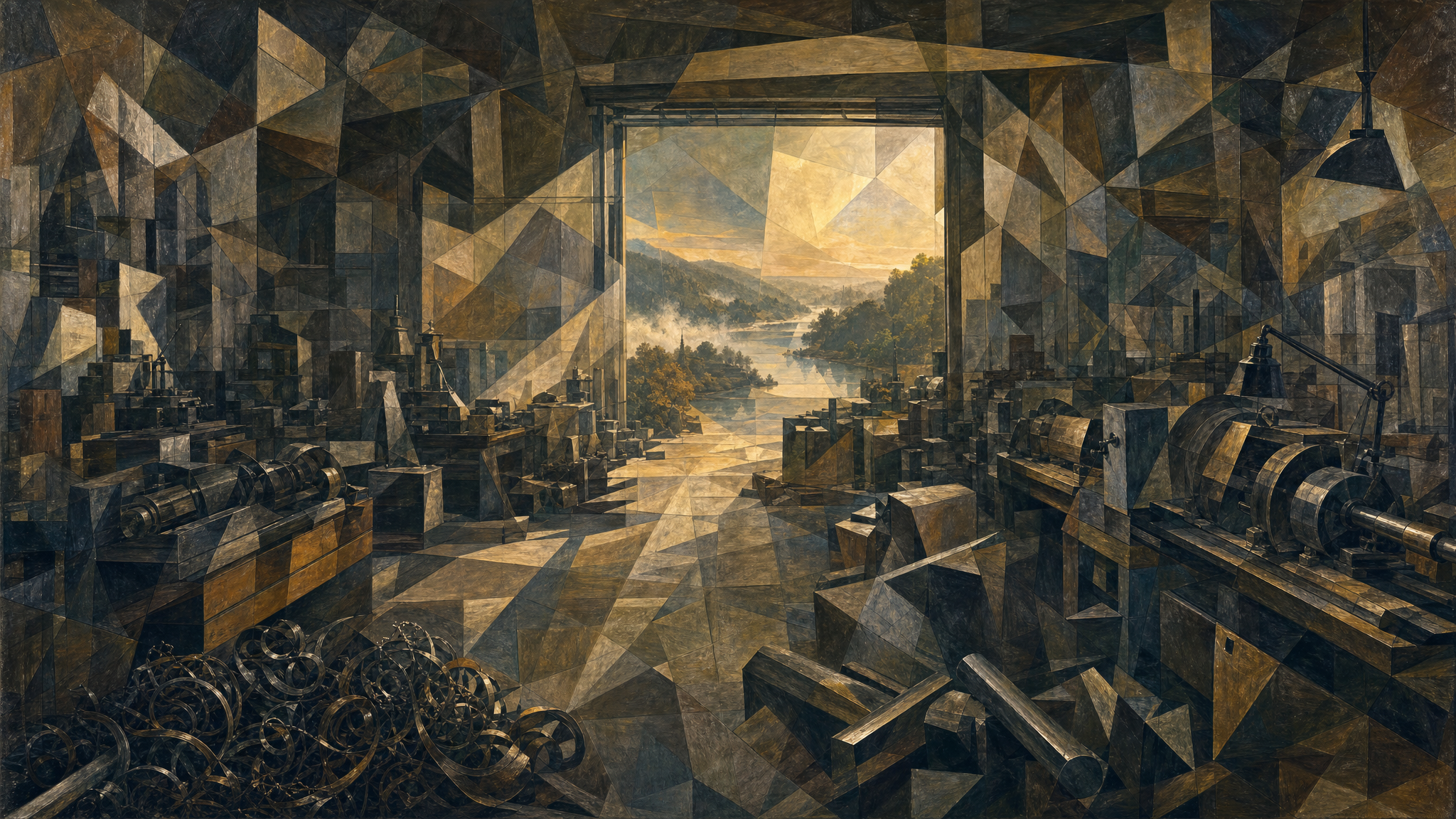
The trees on Ox Mountain were once beautiful. But because it stood on the edge of a great state, axes hewed it. Could it stay beautiful? What the days and nights restored to it, what the rain and dew moistened — shoots did come up. And then oxen and sheep were pastured on it. That is why it looks so bare.
—— Mencius, Book VI: Gaozi I (Warring States period; translation mine)
What the Episode Is About
In the MacroMicro knowledge-point episode of 9 September 2026, host Roger sits down with Chang Kai-ping of Taiwan’s Business Council for Sustainable Development to talk about something that sounds like it has nothing to do with investing: nature.
The thread is not environmentalism. It asks a different question — now that the largest asset managers are putting nature into their risk models, now that a bank’s questions before lending run past carbon emissions into water sources and plant locations, now that European rules are already live, when does this land on the desk of a man running a 200-person machining shop in central Taiwan?
The version I kept turning over while listening was the mirror image: if even an electronic components maker gets pulled into this, then when I read a company’s financials, how many cost lines are still missing?
The Points Worth Keeping
1. When a bank asks how much water you use, it isn’t asking about volume. It’s asking about location. The episode’s example is clean: identical withdrawals mean different things if one plant sits in a water-rich basin with high system resilience and the other sits where water is scarce, contested between industries, and the watershed is fragile. Volume is the ticket in. What’s being priced is whether the natural conditions this business runs on will keep showing up.

2. The word “capital” was chosen on purpose. Natural capital is defined as a stock; ecosystem services are the flow of benefits that stock keeps producing. Chang uses a retirement account: the principal is natural capital, the annual return is what nature provides, and human production and consumption are a standing withdrawal. When withdrawals outrun the principal’s ability to regenerate, you are no longer spending income. Current estimates put humanity at roughly 1.7 Earths — not a future deficit, a present overdraft.
3. Putting nature back on the books is about measurement, not sentiment. What you cannot measure, you cannot manage. Companies manage capital, headcount and equipment because those carry numbers. Water, soil, forests, flood regulation carry none, so they became background — and background never appears in a decision document.
4. External costs do not stay external. A low price does not prove low resource intensity; it may just mean part of the bill sat with society, government, other industries, or the next generation. Raise the regulation, require the cleanup, let affected people file claims, let a customer change its procurement terms, let the resource get scarce — and those costs walk back onto the company’s own ledger as higher inputs, operating limits, lost orders or reputational damage.

5. For an electronics firm, the distance to nature isn’t outside the fence — it’s several layers upstream and several layers downstream. The copper, aluminium, nickel, gold and rare earths a components maker buys arrive already processed through multiple hands. Run it backwards and you reach extraction, separation, smelting and refining: mine development reshapes land and habitat and consumes water. Run it forwards and you reach end-of-life: products that resist repair, disassembly or recycling can end up in regions with weaker waste management, where local residents absorb the health and environmental cost. So the question isn’t how far the plant sits from a forest. It’s where the material came from and where the product goes.
6. The order of pressure is: big customers first, regulators last. For me this was the line of the episode. Large firms make Nature Positive commitments — halt and reverse the loss of nature and biodiversity by 2030, full recovery by 2050 — and then, to verify they’ve done it, they walk the supply chain asking for data. The first round is rarely an ecological survey. It’s: where is your site, how much water do you draw, how is your waste handled, are you near a protected area.

7. Keep the two EU instruments apart. CSRD asks a company to explain its problems. CSDDD — the Corporate Sustainability Due Diligence Directive — asks it to go find and manage them: identify the human-rights and environmental harms its own operations and business partners may cause, then prevent, mitigate or remediate. The first ends in a report. The second ends in procurement and supplier management. The road that reaches a Taiwanese SME runs through the second one.
Where My Mind Went
”The financials look clean and margins are stable — what else is there to look at?”
This is the hole I fall into most often. A good income statement tells you that every cost which has already been priced got paid, with something left over. What it cannot tell you is how many costs have yet to be priced at all.
The episode offers an angle that connects to valuation discipline. When you value a business, you carry a cost structure forward — inputs, utilities, waste handling, compliance. Natural capital says that behind those assumptions sits a set of line items currently reading zero, and they read zero not because they are absent but because nobody’s turn has come to pay.
The habit I changed afterwards is small: with a manufacturer, I now ask where the very front end of the material was dug out of the ground. Not because I expect an answer — usually you can’t find one — but because the question forces me to see how much of the cost structure rests on “everything upstream carries on as before.” It’s the same move as hunting for the bottleneck layer: if you want to know which layer snaps when demand doubles, you should also ask which layer reprices when supply conditions turn.
”Isn’t this just another round of ESG slogans that fades in a few years?”
That was my first reaction, and I’ll own it. ESG has been talked into inflation, and plenty of pledges end life as a chart on page forty of a report.
What moved me was the ordering in that pressure-transmission segment. A thing driven by regulation can stall when the political wind turns. A thing driven by customer questionnaires, credit reviews and insurance renewal terms does not need a vote, and does not care who won the election. It answers one question: does this risk threaten the money I expect back?
So my test for whether a sustainability topic is noise or structure is no longer how many people discuss it. It’s whether anyone has changed how they pay because of it. Carbon moved from slogan to cost line via carbon fees and border levies. Natural capital reaches the same place when new fields appear in procurement contracts and credit terms. What I like about this test is that it can be proven wrong: if three years from now the European customer questionnaire still has no boxes for site location and water withdrawal, then this piece was me overthinking.
”I’m not a business owner or a supplier — why should I care?”
The closing advice to owners is to sit down with sales, procurement and finance over coffee, pick the one or two nature-related issues most likely to affect operations, orders or access to capital, and establish what data exists, who can answer, and what’s missing. No report yet.
The value of that runs past SME owners, because of the shape of risk it handles. One line stayed with me: what gets underestimated about nature issues is the lag. Conditions degrade over years without anyone feeling it; the external demand, by contrast, arrives fast — a customer’s questionnaire lands tomorrow and wants answers in a fortnight.
The speed at which something deteriorates and the speed at which you’re asked to account for it can differ by orders of magnitude. That structure is everywhere: slow-moving health markers, accumulated strain in a relationship, a system nobody maintains. It rots quietly, and then one day someone wants a written answer in two weeks.

The response isn’t to prepare every answer to perfection. It’s to know in advance what you’re likely to be asked. Those two cost wildly different amounts and end up in nearly the same place.
Worth Reading Next
- MacroMicro MM Podcast Knowledge Point Special, 9 September 2026: “Understanding Natural Capital — the keyword coming after carbon”
- The Natural Capital Protocol, Chinese edition — the guest led that translation project; a reasonable entry point for definitions and the measurement framework
- EU CSRD and CSDDD — one governs disclosure, the other due diligence; reading them separately avoids blurring the two
- ISSB S1 and S2 — Taiwan aligns with international sustainability standards in 2026 with annual-report disclosure from 2027, which sits right alongside the nature disclosures discussed here
- TSMC’s 2050 commitments on net-zero deforestation and no net loss of nature and biodiversity, plus the environmental review over grass-owl habitat at the Shalun campus in southern Taiwan — one shows how a pledge is written, the other shows what a pledge looks like when it meets an actual development plan
One Thing to Take With You
The price you pay is not the full cost of the thing. The part that never made it into the price hasn’t vanished — your turn to pay it simply hasn’t come.
Here’s something I tried that has nothing to do with investing, and that you can finish today. Take a sheet of paper and write down three things you currently treat as free. Not water and air — something specific: the errands a family member quietly absorbs for you, the patience one friend keeps extending, the two hours of sleep you cut every night.
Then, for each, write two lines: what the principal is, and when you last put something back.
The first time I did this, the third line stopped me for a long while. Not because I couldn’t recall what I’d put back, but because I realised I’d been reading “still holding up” as “plenty left.” Those aren’t the same thing. Shoots still come up on Ox Mountain — that doesn’t mean it can take the sheep every day.
This article is an educational discussion of investment method. It is not advice to buy or sell any individual security, offers no target prices, and does not analyze any current holding. Investing carries risk; make your own decisions or consult a qualified professional.