The Little Robots on the Ceiling: The Invisible Line That Actually Decides a Fab's Output
Asianometry's 2026-08-30 episode on the overhead transport systems inside semiconductor fabs — from cleanroom floor space costing more than prime Taipei real estate, to why material movement is the real bottleneck, and how a generational transition reset an entire industry. Educational only; not investment advice, no stock picks or price targets.
Contents
- What This Episode Is About
- The Main Points
- Going Further
- ”The company keeps adding tools and announcing expansions — why doesn’t output follow?”
- “The news says they’re investing billions in a new fab. How should I read that number?”
- “There are so many layers upstream — which one actually has pricing power?”
- Sources and Further Reading
- The One Thing to Take Away
One action, and three tasks were done; the savings ran into the hundreds of millions.
— Shen Kuo, Dream Pool Essays, “Governance I” (Northern Song, c. 1088; my translation)
Shen Kuo was describing how Ding Wei rebuilt the imperial palace: dig up the street for clay to fire bricks, flood the resulting trench with river water to float building materials in, then fill the trench back with construction debris. One move solved sourcing, transport, and disposal. What he chose to record wasn’t how magnificent the palace was. It was how the stuff got moved — that was where the money was.
Nine hundred years later, the semiconductor fab tells almost the same story.
What This Episode Is About
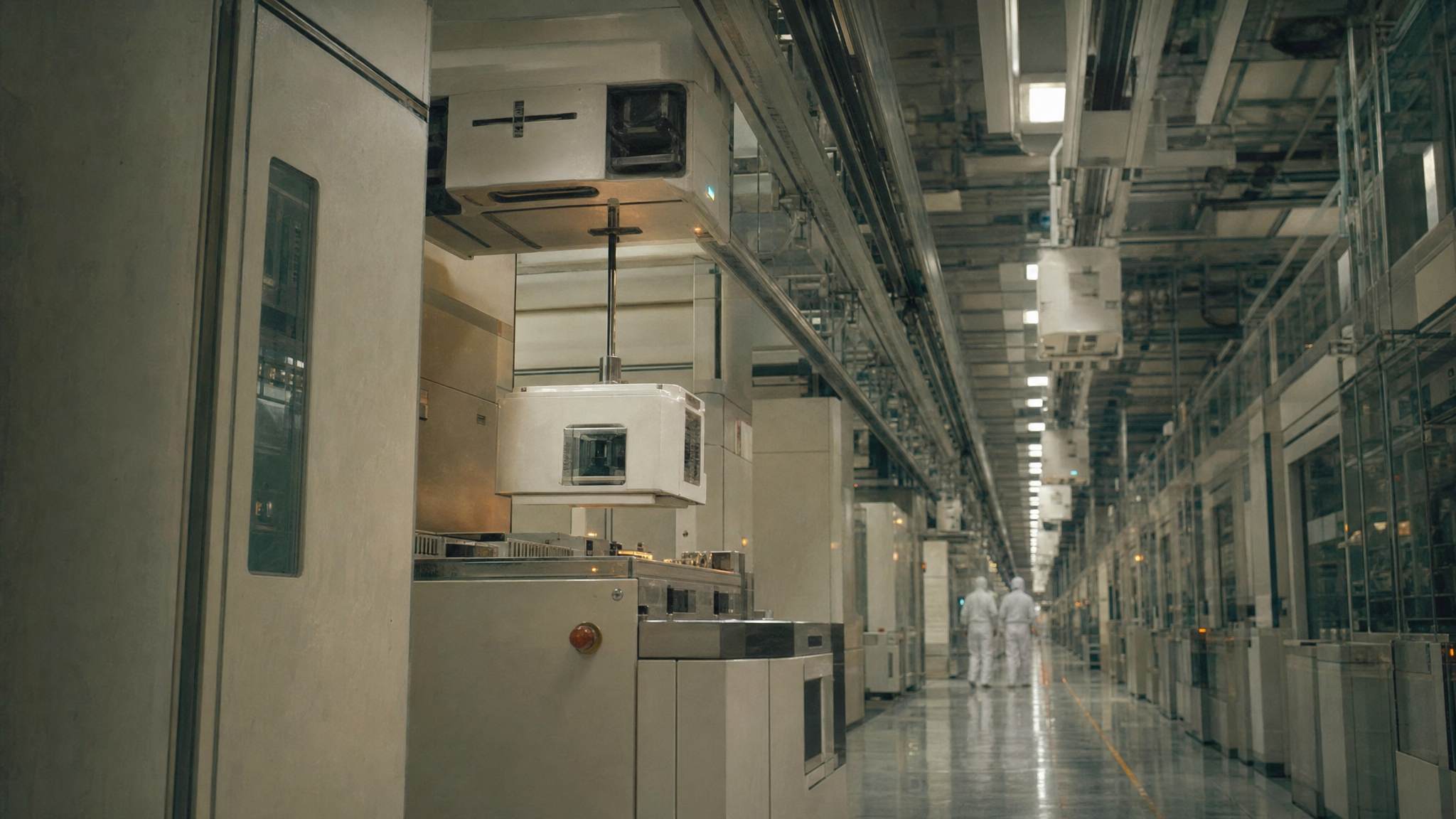
Asianometry’s episode of 30 August 2026 is about the second thing you notice when you walk into a fab cleanroom. The first thing is the equipment — massive, inscrutable, expensive. The second thing is above your head: hundreds, thousands of small vehicles puttering along ceiling tracks, stopping, starting, switching lanes, occasionally lowering themselves to pick up or drop off a box of wafers.
The host calls them the coolest part of the fab. The whole episode is about this invisible production line — the one nobody photographs and no earnings headline mentions, yet which directly determines how many chips a fab can produce. How it evolved from people pushing carts, why it became non-negotiable in the 300mm era, and how the business ended up in the hands of two Japanese companies.
The Main Points
1. Wafers travel much further inside a fab than you’d guess. Fabs are organised into processing zones (lithography, etch, ion implantation), and within each zone the tools sit in rows called bays. Each bay has an automated storage unit called a stocker — essentially a robotic parking garage for wafers, holding roughly 150 to 250 pods when full. Moving wafers within a bay is “intrabay”; moving them between bays is “interbay”. The host cites older data from the late 1990s: a 200mm wafer running a 400-step node might travel 8 to 10 miles inside the fab and visit up to 250 tools. Leading-edge nodes now exceed 1,000 steps. Why all the walking? Because a wafer goes through the same process repeatedly — at the 45nm node, it visits lithography twelve separate times.

2. Cleanroom floor space costs more than prime Taipei property. This is the episode’s most vivid number. ISO 4-3 cleanroom floor space for a leading-edge fab runs roughly $89,000 to $265,000 per ping (a local real-estate unit); prime Taipei apartments, excluding common areas, go for about $150,000 to $300,000 per ping. The host adds, “Guess how I found this out” — he’d clearly been looking at apartment listings. That comparison explains every design decision that follows: every square foot of floor burns money, so the material handling system eventually had nowhere to go but up.

3. The evolution was forced by floor costs and human bodies. The 1980s brought automated guided vehicles rolling along the floor, navigating by overhead cameras or tape. But they shared the floor with people, so for safety they couldn’t move much faster than a foot per second, and anyone in the way meant slowing or stopping. Some fabs switched to rail-guided vehicles, which were faster but needed dedicated lanes and safety partitions — eating that expensive floor again. So in the 1980s an American company, PRI, introduced the Aerotrak: a monorail hung from the ceiling. By 1988, interbay systems like it were common.

4. The 300mm transition was the breaking point. Three layers of pressure, all laid out clearly. Tools got far more expensive, uneconomical unless constantly running — a mid-1990s SEMATECH study found 15 to 20% of tool time in older fabs was wasted waiting for an operator or a pod. Tools got bulkier, leaving even less floor. And human bodies couldn’t keep up: 300mm wafers are 2.25 times larger than 200mm, and a full pod of 25 weighs about 9 kilograms — 1.55 times the older pod. Nine kilos doesn’t sound like much (the host’s comparison: two average house cats, or one Maine Coon), but it exceeds the maximal acceptable weight of lift, the ergonomics term for what a person can lift and move repeatedly across an eight-hour shift without injury. Surveys of workers in Taiwan’s 200mm fabs found 40 to 60% reporting shoulder discomfort and 30 to 50% reporting back problems — and those were the smaller wafers. Add traffic rising from 125–175 moves per hour to over 300 in busy bays, and automation stopped being optional.

5. The overhead hoist won because it never touches the floor. The centrepiece of the second generation is the Overhead Hoist Transport. The vehicle aligns itself above the tool, lowers a hoist, and picks up or drops off the pod directly at the tool’s front end — a matter of seconds. It uses no floor space, annoys nobody, and travels up to 60 metres per minute. The costs: expensive installation, inflexible routing, and one very practical hazard — it sits directly above the tool, and things can fall. Making it work with every tool vendor’s front end required common standards from the SEMI industry group, defining how loadports are configured and what optical signals pass between vehicle and tool. The standard itself is the saving.
6. Automation still can’t handle a SUPER hot lot, so a human runs it over. This is the funniest and most honest stretch of the episode. A “hot lot” is a batch the customer wants done fast; a SUPER hot lot outranks everything on the line. Programming that exceptional behaviour into the dispatcher turned out to be hard enough that the practical answer was to have someone grab the lot, throw it on a trolley, and wheel it across the fab as fast as possible. The host finds the mental image amusing — but “it’s not the futuristic stuff we might imagine.” Equally human: visiting a DRAM fab, he heard incessant beeping, and was told it was the tool letting the operator know it needed its diaper — sorry, its wafers — changed. It beeps precisely because humans don’t always arrive on time.
7. A generational transition reset the entire market. PRI dominated the 200mm era on key patents. The 300mm transition wiped the board clean. Its hoist product, the Aeroloader, was expensive to develop, and the wafer transition itself slowed because of its cost — so PRI ran into financial trouble and sold itself to Brooks Automation for half a billion dollars. Brooks later exited too, selling the patents off. Today the market belongs to Japan’s Daifuku and Murata Machinery. Daifuku started in 1937 making forging machines for the steel industry; after the war it changed its name to distance itself from its trading-house parent (and maybe to sidestep the Occupation’s zaibatsu dissolution policy), taking one character each from Osaka and Fukuchiyama, where its factories stood. The resemblance to a certain sweet is coincidence. Through the lean years of the late 1940s it made whatever sold: grain crushers, ice shavers, movie theatre seats. The turning point was president Kenjiro Masuda licensing technology from Jervis B. Webb — the American firm that built the first rivetless chain conveyor for Ford in 1919. That knowledge let Daifuku deliver the conveyor system for Toyota’s Motomachi plant in 1959, and Japan’s carmakers pulled it upward from there. In 2007, Daifuku bought Webb outright.

Going Further
”The company keeps adding tools and announcing expansions — why doesn’t output follow?”
This is the standard frustration of reading manufacturing financials: capex looks great, capacity lags.
The episode offers a concrete explanation. Output isn’t tool count times theoretical throughput. Two things sit in between. First, utilisation — how much of the time a tool is actually running; that SEMATECH figure of 15 to 20% idle time was spent entirely waiting for an operator or a pod. Second, cycle time — how long one wafer takes end to end. The host closes by noting that Intel and TSMC are both obsessed with cycle time, because shorter cycle time means faster iteration and turnaround.
Push that one layer down and you get a useful reading habit: when you see “expansion”, ask whether they added machines or added flow. Both raise output, but they behave differently. Adding machines is capex — visible, quotable, press-release-shaped. Improving flow is process and scheduling work — invisible, hard to headline, and it doesn’t wait for a building to be finished. That’s part of why some companies’ capacity numbers materialise quickly and others drag.
The inverse holds too: if a fab’s true bottleneck is movement and dispatch, the most expensive new tool you can buy will simply spend more time in the queue.

“The news says they’re investing billions in a new fab. How should I read that number?”
The common retail error is to treat the investment figure as future output. This episode is a good counterexample.
A full 300mm-class interbay/intrabay system is priced at $50 to $100 million and takes two years to install. And it isn’t plug-and-play: it must interface with every tool vendor’s front end, where misalignment or timing errors stop the tool. Before standards existed, fabs invented their own interfaces. The host notes that the sheer size, complexity and cost made these systems intimidating to implement — for many years afterward, fabs still relied on humans carrying wafers.
So when you read that number, three questions are worth asking. How much of it is infrastructure that earns nothing yet? How long is the gap between groundbreaking and volume production? And what is the slowest element in the whole system? Because the timing is set by the slowest element, not the most expensive one.
It also explains why a new fab so often sits in an uncomfortable limbo between “built” and “making money”. That gap isn’t the company slacking. It’s the invisible line being installed, tuned, and synchronised with a thousand machines.

“There are so many layers upstream — which one actually has pricing power?”
The most instructive passage in the episode is how PRI died.
It held key patents and led the 200mm market. It lost not by getting the technology wrong but because the generational transition reset the market: old-era patents didn’t carry over, the new product had to be developed from scratch, and that R&D burned cash precisely during the years when customers slowed the transition because of its cost. A leader’s advantage doesn’t automatically survive a generational boundary. It has to pay the entry fee again — at the moment revenue is least certain.
The two survivors share a trait: their capability is portable across industries. Daifuku’s foundation is conveyance — steel first, then cars, then wafers. Murata’s is textile and machine tools. That capability doesn’t reset when wafers go from 200mm to 300mm; each transition is another chance to apply it.
From which you can extract a way of interrogating any upstream layer: is its moat attached to a specification, or to a capability? Spec-attached moats get reshuffled when the spec changes. Capability-attached moats treat the change as an opportunity to extend the lead. The question works for any industry with generational cycles, not just semiconductors.

Worth flagging: this is one slice of history in one industry — an n of one. It can’t establish a general rule. What it offers is a question rather than an answer, and good questions age better anyway.
Sources and Further Reading
- Asianometry, “The Little Ceiling Robots Inside a Semiconductor Fab,” 30 August 2026. This piece is a listener’s reflection; the figures and cases come from the episode.
- Keywords for going deeper: SEMI standards for loadports and handoff interfaces; SEMATECH’s 1990s work on tool idle time; the ergonomics concept of maximal acceptable weight of lift; and cycle time management in wafer fabs.
- Shen Kuo, Dream Pool Essays, Volume 11, “Governance I,” on Ding Wei’s palace reconstruction. A logistics memo from nine centuries ago.
The One Thing to Take Away
What determines output is usually not the most expensive step, but how things move between the steps.
A fab can hold a thousand of the most advanced machines on earth and still spend 15 to 20% of their time waiting for someone to wheel a box over. The expensive things are visible, so we stare at them. Waiting is a blank — it occupies no space, has no shape, and nobody photographs it. That’s how it goes unnoticed for years.
An exercise you can do today: pick the one thing you’ve been dragging out this week — it needn’t be about investing; an expense claim, a doctor’s appointment, that broken thing at home all qualify — and draw it as a single horizontal line from “started” to “now”. Then mark the segments where you were actually working on it. Everything else is waiting. Work out the ratio.
Most people are startled by the result: twenty minutes of real effort, spread across three weeks. And the waiting usually clusters in one place — waiting on a reply, waiting for someone to be free, waiting until you feel ready to make that one call.

Finding the longest blank is far more useful than telling yourself to work harder. What you need isn’t more effort. It’s the little vehicle on the ceiling whose only job is to get the thing to the next station.
This article is an educational discussion of investment method. It is not advice to buy or sell any individual security, offers no target prices, and does not analyze any current holding. Investing carries risk; make your own decisions or consult a qualified professional.
Comments
Loading comments…