# TechWave EP148: The Ranking Is Real, the Cheapness Is Not
> Notes on TechWave EP148: an open-weight model reached third place globally, and the internet immediately produced two opposite rumours about it — that it costs a tenth as much, and that it is merely a copy. Neither survives contact. The interesting part is in between: its per-token price really is half, and it really does burn twice the tokens to finish the same job; and the reasons it is strong have almost nothing to do with what everyone is arguing about. Educational notes, not investment advice.
Published: 2026-08-08
Locale: en
Tags: techwave, podcast-notes, ai, semiconductor, valuation, education
TL;DR: Third place is real; cheap is not — half the price per token times twice the tokens per task leaves the cost of getting something done exactly where it was. And underneath that misunderstanding sits a thread worth more than the ranking.
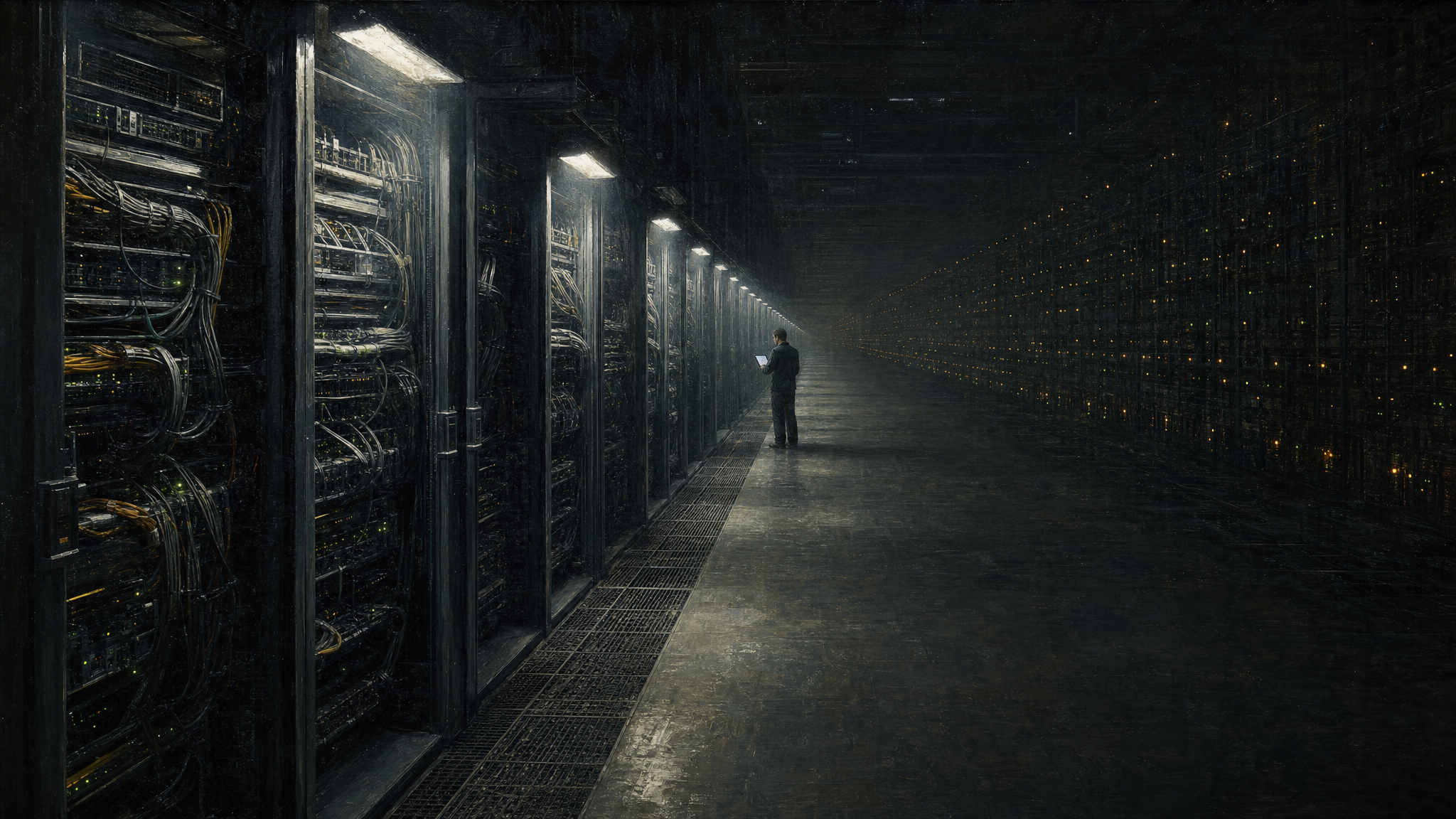
> *My life has a limit, but knowledge has none.*
> *To pursue the limitless with the limited is perilous;*
> *and knowing this, to keep pursuing it, is perilous indeed.*
> —— *Zhuangzi*, "The Secret of Caring for Life"
> These are my **personal notes** on TechWave **EP148** (released 2026-07-20). They are not a transcript and not official content. Please listen to the original show in full. What follows is what the episode sparked, organised the way I think about it.
## What the episode is about
In one line: **an open-weight model genuinely broke into the global top three, and the internet immediately produced two opposite claims about it, neither of which holds.**
One camp says it matches the strongest models at under a tenth of the cost. The other says it is just a distillation of somebody else's model and therefore unremarkable. The host dispatches both, then splits the episode into three questions: is it really that strong, why is it that strong, and what does it change.
His opening self-deprecation is good: in the past fifty weeks he has probably announced "major tech news last week" about forty-five times, but this time he means it. He is also unimpressed by the quality of the discourse — his feed was nothing but this story for days, and the loudest voices in the Chinese-speaking corner, he says, "skip past all the logic and all the facts, look at who they want to support, and then describe the facts to match." So this episode is him putting the logic and the facts back.
There is also a line very much in his register: if you have a mouth on you, like I do, you are probably still stuck using Opus 4.8 in that tool, because the top model won't answer you. **A summary throws that away, but it carries a real signal — what you can actually get your hands on and what sits on the leaderboard were never the same thing.**
## The main points
**1. Third place holds. "A tenth of the cost" does not.** On the composite intelligence index he likes, it scores 57, behind GPT 5.6 at 59 and Fable 5 at 60, but ahead of Opus 4.8 and GPT 5.5; his own hands-on impression and the wave of public testing land in the same place, which is why he treats third as consensus. What has been mistold is the other half: its price per token is roughly half of GPT 5.6's, but it spends about twice as many tokens finishing the same job. **Multiply those and the cost per task comes out flat.** Hence a conclusion with no mercy in it: for the same money, why would you take the one that is slower and less smart.
**2. "Slow" has a very specific shape here; this is not a vibe.** He gave both sides the same game-building task. The comparison finished in sixteen minutes. This one ran for an hour and twenty and still had not finished, incinerating his entire five-hour credit allowance along the way — he cheerfully admits that running six agents in parallel was his own doing. The interesting part is *where* the time went: forty minutes spent confirming whether its own understanding of the game's rules was correct, when the version it had written down before going to check was already essentially right. It went off reading patch notes from years ago. The comparison spent three minutes on the same step. **It isn't computing slowly; it's taking long detours** — and those two cost very different things.
**3. Telling models apart now requires an absurdly large project.** A web-based macOS simulation built with it went around the internet, and the host passed it on himself: every app opens, the music player actually plays music, you can genuinely download a chess game from the store and play it, the fake contacts reply to your messages and even like them, and **when you press the number keys on a call, each digit emits its own correct tone.** He walks through how fast the bar has moved: two years ago everyone compared snake games, last year it was which model's bouncing-ball physics looked better, and now none of that separates anything — his own favourite game test was declared saturated an episode ago.
**4. Distillation isn't the main reason, and his three rebuttals hold.** First, it outscores Fable on the front-end coding arena, and pure imitation cannot beat the teacher. Second, the timing doesn't work: to approach those two you would have to distil those two, and they were only opened up a fortnight ago. Third and most structural: what these models now do is spend half a day building a macOS simulation, and that kind of work has infinitely many possible trajectories — the situations you hit midway are not the ones your teacher hit, so **there is nothing to copy from**. What distillation actually solves is the cold-start problem for reinforcement learning: it makes you learn faster on less compute; it does not make you learn better. His line is worth keeping: the only thing built purely by distillation is the distilled water in your house.
**5. The real reasons are three: size, architecture, and reinforcement learning.** It is a 2.8-trillion-parameter model, the largest open-weight model ever, twice the size of its predecessor, with 896 experts of which 16 activate per token — the scaling law everyone was writing obituaries for last year appears to be in excellent health. Two architectural innovations: one replaces the key-value cache that grows with your context with a fixed-size state that new information is continuously compressed into, which the paper says cuts up to about seventy-five percent at a million tokens of context; the other lets deep networks weight which earlier layers matter as they stack, reaching the same target on eighty percent of the compute. The third is reinforcement learning, where he guesses they went the carefully-curated-data route while admitting nobody outside knows.
**6. His explanation of the memory-saving technique uses a very clean example.** Suppose the first sentence is "Argentina reaches the final, opponent to be determined," and the second is "Argentina in the final, facing Spain." The traditional approach computes and stores every word of both, treating all of them alike. The new one maintains a single fixed-size note: the first half of the second sentence carries information the note already has, so barely anything changes; only "facing Spain" requires the pen. **Repeat the same sentence a hundred times and the memory footprint doesn't grow, while the information that matters is all still there.** In practice you don't do this in every layer — compression always loses something, so it gets mixed with the full version.
**7. Two invisible things sit behind the public ranking.** The first is a compute ceiling: running this well officially wants at least 64 tightly interconnected GPUs, and China cannot buy the full-rack high-speed-interconnect machines; the best chip available there links only eight at a time, with slower networking between groups. From this the host suspects the smuggling volume is substantial — stating plainly that he has no evidence — while also noting they are optimising their low-level code for domestic chips. The second is release cadence: Chinese labs ship soon after training, American labs sit on models — one existed in January and shipped in June or July — so "only one or two months behind" is comparing launch dates. **His estimate of the substantive gap is around six months: shorter than the eight-plus of before, but not as close as people think.** He also flags a thread just beginning to show: an early version of the model helped write the low-level optimisations now used to run the final version. AI has started accelerating the development of AI.
## Going further
### 1. The unit price isn't the cost; finishing the job is
The most useful lesson here is a demonstration of how a very common error happens: treating "dollars per million tokens" as the cost. The host has already written the correct arithmetic — **unit price times the volume required to finish something is the cost** — and here that is one half times two, which is one.
The inference is direct: any claim about how much cheaper something is needs its denominator named first. Price lists compare units; your bill comes from tasks. The reason this step gets skipped is that the unit price is public and printed on the website, while how many tokens a job takes has to be discovered by running it. **The public number always gets compared first, not because it is the right one, but because it is the available one.**
The conclusion comes with an explicit expiry, which should be stated honestly: token consumption is improvable through post-training, deployment still has headroom, and the host himself says costs coming down further is entirely possible. So "flat" is a dated judgement, not a property of the model. To check it later, the thing to re-measure is what each side spends on the same task through the same toolchain — not the price list, which will only hand you the same wrong answer again.
Can the other reading rescue "it really is cheaper"? The usual version is "it's open, so you can self-host." What that misses is also in this episode: running it well takes 64 tightly interconnected GPUs, and that money never appears in the per-million-token quote. **What open weights save you is licensing and lock-in, not compute.**
### 2. A very persuasive chain of reasoning, with its timeline hanging on an unestimable parameter
The host sets up a hypothetical: if a genuinely open model arrived with ninety to ninety-five percent of frontier intelligence at a tenth of the cost, how would things reorganise. He states up front that today does not meet that assumption, then runs a rather elegant chain: mixed usage becomes the norm (the expensive model on the steps that matter, the cheap one on the easy ones, the easiest running on your laptop) → closed labs lose pricing power and margin → but total volume needn't fall, because cheap unlocks work nobody would previously have handed to AI → and the closed labs can defend some profit through product and stickiness.
The line worth keeping is the structural one he tosses off along the way: **open weights are unlikely to actually surpass closed models, because the moment a lab genuinely passes the frontier, it stops open-sourcing.** That isn't a prediction, it's an incentive structure — meaning the "open source eventually eats closed source" story ships with its own ceiling built in.
But the chain has a weak link, and it is the first one. Mixed usage requires everybody to already know which step calls for which model. Nobody does, so everybody just fires up the strongest one — not out of laziness, but because during the experimental phase you have to find the ceiling before you know what can be downgraded. His own framing is sharp: building a tool for your company, are you going to sit down and decompose it into steps of varying difficulty and assign a model to each? No. You open the strongest one and tell it to cook.
So the timeline of the entire chain hangs on "how long the experimental phase lasts," which nobody can estimate. **The lesson: every link holding does not entitle you to schedule anything with it.** Which also yields the test — to see whether this has begun, watch not for new model releases but for tools shipping automatic task-routing between models. That is the signal the experimental phase is ending.
### 3. Efficiency gains are a one-time step; demand growth compounds — but this is a judgement, not a conclusion
Cutting memory use by seventy-five percent is real, so people jumped straight to what that does to memory demand. The host answers from the demand side: ask any white-collar worker you know — in marketing, in finance, in analysis — what fraction of their work is now handed entirely to AI. He guarantees you won't find anyone above fifty percent. That number is going to seventy or eighty, and that is before counting robotics at all. His phrase is that we are still absurdly early.
Put the two sides together and the test is clear: **whether efficiency gains absorb demand growth depends on whether the efficiency is one-off or ongoing, and whether the demand is linear or compounding.** Seventy-five percent is a step — once taken, the next version has to invent its own. Penetration moving from fifty percent to eighty is ongoing.
But this needs an honest label: neither side has a directly checkable number, so it is a judgement rather than a conclusion. It can still be verified — just not by looking at next week's quote. It gets verified year by year, against deployment volumes and penetration rates.
Which lands on the most human passage in the episode. The host complains that his page is full of people who hear him say he is bullish long term, buy, and come back to yell at him when it falls the following week. His defence is really a piece of methodology: nobody can predict short-term moves, while confidence in a long-term trend is far higher. I would push one step further — **the difference isn't difficulty, it's whether you can ever check your answer.** Short-term drivers are too many to enumerate, so afterwards you never learn whether you were right, only what happened. Long term gives you penetration, deployment, and whether the open-closed gap converges — things you can hold up against reality one year at a time. **A prediction without a test teaches you nothing even when it lands**, because you never learn what you were right about.
Back to Zhuangzi: to pursue the limitless with the limited is perilous. The episode contains that shape twice — once in the model, spending finite compute chasing an infinite verification path, still reading years-old patch notes forty minutes in; and once in us, spending finite attention chasing an infinite stream of daily price moves. **Both have the same fix, and it is not to chase harder. It is to decide first what deserves chasing.**
## Worth reading alongside
- **TechWave EP148** (released 2026-07-20) — the source of these notes. Listen to the original show in full and support the creator
- **TechWave EP146 and EP121** — the two episodes the host points to himself, covering key-value cache storage and the "shortcut" mechanism inside deep networks respectively; they are the background for points five and six above
- *Zhuangzi*, "The Secret of Caring for Life" — the origin of "my life has a limit, but knowledge has none," a good companion to that forty-minute detour
- *Analects*, Book XIII — "do not crave speed, do not chase small gains; craving speed you do not arrive, chasing small gains you accomplish nothing large," a good companion to the half-price-but-flat-cost section
---
**Disclaimer**: These are personal notes and learning material, written for educational purposes. **They do not constitute investment advice, an offer, or a solicitation.** No specific security is recommended and no price target is given; no company, industry, model, or product mentioned in the episode is evaluated or endorsed here. Companies and products are named only because they are the parties to the news events themselves, and any related description exists purely to illustrate reasoning. The observations, figures, positions, and experiences in the episode are the host's own account; they are quoted here to illustrate a method of reasoning and have not been — and cannot be — independently verified. In particular, the supply-chain speculation is one the host explicitly labelled as guesswork with no evidence behind it, and readers should not treat it as fact. Investing carries risk, past performance does not indicate future results, and you should reach your own conclusions based on your financial situation and risk tolerance, consulting a qualified professional where appropriate. The author may hold positions in the types of assets discussed.