# The Yen Is Back to 1970s Levels, and Japan's Cars Aren't Selling Any Faster
> Odd Lots gets Brad Setser to talk through three seemingly unrelated things: Japan's yen intervention, the gap between the value and the volume of China's exports, and a paper on financial interdependence. They turn out to be one thing — when price differences form a slope, goods and capital find their own way down it. The part worth keeping isn't a currency call. It's the excavator as a prism, and the counter-argument he makes against himself.
Published: 2026-08-06
Locale: en
Tags: odd-lots, podcast-notes, currencies, japanese-yen, china-exports, excess-capacity, portfolio-risk
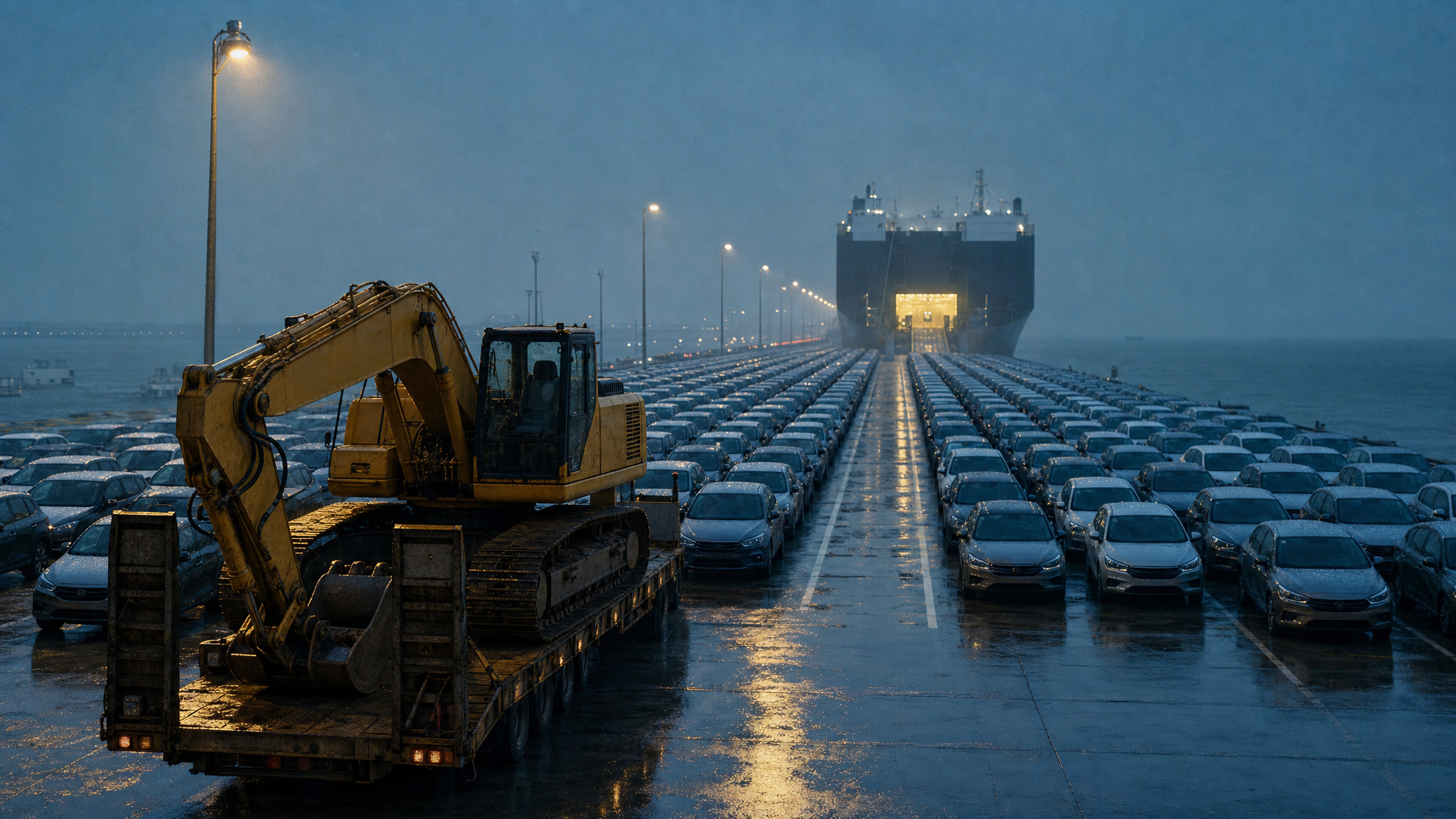
> *The form of an army is like water: water in its course avoids the heights and hastens to the lowlands; an army avoids strength and strikes at weakness.*
> *Water shapes its course according to the ground; an army shapes its victory according to the enemy.*
> —— Sun Tzu, *The Art of War*, "Weak Points and Strong" (5th c. BC)
Sun Tzu is writing about war, but he starts with water. Water doesn't choose a direction. It just follows the slope. That is what this episode is about from beginning to end — the slope. Interest rate differentials, exchange rates, cost gaps, idle capacity. And the path that goods and capital find for themselves once the slope exists.
## What this episode is about
This is *Lots More*, the short-form sibling of Bloomberg's *Odd Lots*. Hosts Tracy Alloway and Joe Weisenthal bring in Brad Setser, senior fellow at the Council on Foreign Relations, and cover three subjects in one sitting: the yen intervention, China's exports, and a paper he has just published at the French Institute of International Relations.
Three subjects on the surface. One subject underneath.
The opening question is blunt: what's going on with the yen. The answer is equally blunt — Japan's Ministry of Finance has been using the country's reserves to sell dollars and buy yen, which took the rate from roughly 160 to 152, after which it drifted back toward 155. Joe throws in a complaint I have a lot of sympathy for: currencies are his most hated asset class, because everything is relative — the yen is down, but is that dollar strength or yen weakness?
Setser closes that question immediately: **the yen is weak against the dollar and weak against the euro. Either way it's weak. This is the yen's own problem.**
**Original episode**: Bloomberg's *Odd Lots*, *Lots More* segment, "Brad Setser on the US's Unusual Japanese Yen Intervention," 6 August 2026.
## The notes I took
**"Is something wrong with Japan" and "how weak is the yen" are two different questions.** Setser doesn't think there's anything structurally or fundamentally wrong with Japan. Japan has clearly had difficulty generating sustained inflation, and the Bank of Japan is determined to get inflation up this time — which puts its monetary policy at odds with the Fed and the ECB. **That's where the differential comes from.** But then he gives a coordinate that made me stop: **in real terms, the yen is back to its levels of the early 1970s.** That is Japan before its electronics industry took on the world, before Toyota's export wave, before the globalisation of Japanese automakers. His phrasing is restrained: that level of purchasing power seems "a bit at odds" with the underlying strength of the economy today.
**So the real argument isn't whether the yen is weak. It's whether it has overshot.** One side says this is the natural consequence of large interest rate differentials, and since there's now less expectation that the Fed will cut, the differential persists. The other side says the yen has reached a level of weakness divorced even from a differential that supports a weak yen. He doesn't pick a side.
**His account of what intervention is actually for is the most practically useful part of the episode.** Some argue the goal is to change the direction — to turn yen weakness into yen strength. **He calls that unrealistic, and doesn't think it's Japan's goal.** What the Ministry of Finance wants is **a floor under how weak the yen gets**, keeping it in something like a 150-to-154 range. So in the short run intervention works: it moves the market back toward 150. The real question comes after. **If the Ministry has to intervene continuously, you eventually get two questions — whether it's running out of firepower, and whether the Bank of Japan needs to join in and adjust short-term rates.**
**Joe then asks an unprofessional but very honest question, and Setser takes it seriously.** Economists keep saying Japan can't generate inflation, Joe says — but the US has inflation now and it doesn't seem that great, while Japan doesn't have much and, from the pictures, looks like a peaceful, prosperous society with great food, housing that isn't outrageous, and rail that works. All the things we supposedly want. So who cares?
Setser's answer has two layers. The textbook layer first: **zero inflation plus zero interest rates leaves monetary policy very little room to respond to a downturn.** And it makes wage adjustment hard — if a sector needs a lower real wage, you have to do it through weaker nominal wages, and people hate watching the number on their paycheque fall.
**The second layer is the real point, and it bites back at the strategy of using a weak currency to manufacture inflation.** When your rates are far below everyone else's, the main transmission mechanism in theory is a weak currency. What Setser questions is **whether that generates the right kind of inflation.** A weak yen pushes up the price of imported energy and food; imports feed straight into Japanese consumer prices and are also an input into parts of Japanese industry. The result is falling real wages — **he mentions a headline from the previous day about real wages in Japan declining for close to two years.**
**Then he names the winners and the losers, and this part is worth copying down.** The winners from a weak yen inside Japan are **the multinationals, the big exporters, and financial investors with long dollar positions in their portfolios.** But — **there is no immediate transmission from a big company earning more yen on its operations in Thailand and the United States to real wages in Japan, or to spending inside Japan.** You have fewer yen for Japanese services because more of your money went to imported oil, so you go out less. His conclusion: this hasn't yet generated the inflationary dynamics other economies have seen, and **what the Ministry of Finance is actually worried about is that yen weakness isn't reflating Japan's economy.**
**The conversation moves to China's exports, and the first thing is the split between value and volume.** That morning's data showed a 1.5% increase in dollar terms against a 1.3% forecast — unremarkable. But Setser points out that Chinese export prices have been falling significantly: yuan weakness, a price war in electric vehicles, a price war in solar panels, price wars across a lot of what China ships. So **export volumes are up more like 10%** (he says that was certainly the case for the first quarter). Same data. 1.5% by value, 10% by volume.
**The "new China shock," in his reading, is mostly tied to autos.** Five years ago China wasn't a big car exporter — it was an importer, taking a lot of high-end luxury cars from Germany. Today China is **the world's biggest exporter of cars**: its EV manufacturers are exceptionally competitive, they're taking share from the foreign joint ventures inside China, and they're now seriously exporting; meanwhile old internal-combustion capacity is being repurposed to serve global demand. On top of that there is enormous capacity to produce solar panels and batteries — China can meet global demand simply by expanding out of what it already has, **which makes it very hard for any other country trying to get its own solar or battery industry going.** He's also honest about the technical factors: everyone bought computers and appliances during the pandemic, which pushed China's exports to a very high level two years ago; they dipped, and now they're coming back. So there are two dynamics to separate — **traditional exports are one, cars and clean energy are the other, and the China shock now is much more about the second.**
**Joe asks a good question: in this era, do currencies still matter?** His reasoning: the yen can keep falling, but that doesn't give Japan a BYD. The Malaysian ringgit is pretty weak and Malaysia doesn't have a BYD or a Xiaomi either. When the action is in non-commodity, cutting-edge technological exports, how much weight does an exchange rate carry?
**I liked Setser's answer: "I'm super retro on this question. Currencies, in my view, still matter."** But he immediately complicates it with Japan itself: **the response of Japanese exports to yen weakness has been relatively modest.** One reason is that Toyota wants to protect its transplants — its factories in the United States — and hasn't wanted to engage in a price war. **It has preferred to take the weak yen as a source of greater profit rather than fight for volume.** The control group is Korea: the won is also very weak, and Hyundai's US sales and exports **responded very clearly**, producing a large increase in Korean auto exports to the US that hasn't gotten much attention.
**He also offers a rule you can check against later.** Because Chinese inflation has been very low relative to the rest of the world, and the yuan has come down against the dollar, **there's been roughly a 10% real weakening of the yuan** — which he thinks is one of the factors behind the export boom. People love comparing Chinese EV prices to EV prices elsewhere; part of that is that BYD got very good at making EVs very fast, and part of it is that **the yuan is below where it was fifteen years ago against the dollar while inflation differentials bring Chinese costs down.** His rule of thumb: **if the yuan isn't appreciating, China tends to gain global market share.** He says that has held over time and is asserting itself now. His baseline: **over the next couple of years you'll see a clear reassertion of the traditional, well-established relationship between currency values and export volumes.**
**Then come the excavators, which is the best passage in the episode.** Twenty years ago China was already making a lot of excavators, Setser says — but those excavators were often made by Caterpillar or Komatsu. Two things then happened. First, Chinese firms sprang up, produced at a lower cost point, and probably got some local preference (if you're a state-owned construction company you'll likely use a Chinese excavator when it's price competitive) — **so inside China, domestic brands took share from foreign ones.** Second, China went through one of the world's biggest property booms, demand for excavators was enormous, and capacity kept expanding. Then the boom turned to bust.
**"Chinese companies are making competitive excavators, and guess what — those excavators are being exported globally."**
He says there's a bit of the same dynamic in steel, and the numbers stop both hosts: **Chinese steel exports now exceed US steel production, and he thinks they exceed Japanese steel production too.** The more important half is what comes next — **that has not exhausted Chinese export capacity.** China can export a hundred million metric tons of steel and still export another hundred million. China is exporting five million vehicles, and there is clearly capacity inside China to export ten. **Five is already more than Japan, more than Germany. Ten would be record-breaking.** That forward-looking concern among China's trading partners, he says, is very real.
Joe has a nice lightbulb moment here: when the internet bubble burst in the US, people consoled themselves that at least it left behind all that unused fibre optic cable, which laid the groundwork for the next twenty years. **China's property bubble has left the rest of the world an incredible unused capacity of excavators — and the know-how to make them.**
**The last stretch is his new paper, on the asymmetry between financial interdependence and real interdependence.** The first observation is an accounting identity: **if there is an enormous trade imbalance, by definition there has to be offsetting financing** — a financial imbalance, even if it's a bit hidden and hard to trace. One clear trend over the past fifteen years: China has moved from having the central bank buy up the dollars its export surplus generated and put them into treasuries and agencies, to doing far more diverse things with its reserves. He quotes the State Administration of Foreign Exchange's own phrase, "the diversified use of foreign exchange reserves," and notes drily that what this actually means is putting them into financial assets **that are in no way foreign exchange reserves.** Add low interest rates, and the accumulation of financial assets has moved to the exporters, to the private side of China's economy — **so it no longer shows up as a huge, sustained bid for treasuries.**
**The second observation is about power, and it's the sharp end of the paper.** When do you genuinely *need* financial assets? When you have an overvalued currency you want to defend, or foreign-currency-denominated debts you really want to pay. In those conditions, **cutting off access to financial assets can be a very powerful sanction.** But China by and large doesn't need its legacy financial assets to do much of anything right now: it has a big ongoing trade surplus and not much foreign-currency external debt. Frozen reserves would certainly hamper intervention, but **if the worst outcome is a weak yuan, that's probably something China can manage.**
**The reverse is the problem.** The countries selling financial assets to China are receiving real goods and services — **and losing access to real goods in a crisis can be quite devastating.** You lose imported components, and the rest of your production process can't continue until you find an alternative source; **for some products there is no alternative source that isn't also Chinese.** He lays out both sides of the weaponisation: for the US, chip export controls and financial sanctions; for China, economic coercion — not buying commodities from countries that say the wrong things (Australia being the famous case), squeezing Korean automakers after Korea agreed to host a powerful US radar, cutting off package tours so a country loses its Chinese tourists. **His judgment: in the most extreme scenarios, restrictions on the real flow of goods may matter more to Sino-American leverage than the financial ones.**
Tracy draws the conclusion: if the US someday did to China what it did to Russia, the impact might be limited; if China did the reverse, the impact on the US would be large.
**And Setser doesn't let that conclusion stand unchallenged — he supplies the counter-argument himself.** To be fair, he says, note two things. Xi Jinping does have an idea of reducing dependence on the rest of the world by substituting out the manufactured goods China imports and stockpiling the commodities it imports, so the economy could keep functioning through a big interruption in trade. He calls that an aggressive thesis — **aggressive in that it prepares for a negative contingency, and aggressive in that it engineers out every other country's manufactured exports into China.** But — **an enormous and growing part of the Chinese economy depends on access to export markets for its jobs.** The people making excavators. The people making combustion-engine cars for export. **China's dependence on external demand has gone up very significantly over the past three or four years, even as its reliance on imported manufactured inputs has gone down.** So China has its own very significant vulnerabilities.
Which is how the episode ends up back where it was most fun — as Tracy puts it, the excavator as the prism through which to understand China's economy.
## Some thoughts this left me with
**1. What I normally do is hunt for the bottleneck layer. This episode demonstrates its mirror image: hunting for the surplus layer.**
Bottleneck analysis asks: when demand doubles, which layer snaps first? This episode asks the reverse — **once a layer is in surplus, where does that capacity go?**
The excavator passage answers it cleanly: capacity does not disappear just because the demand it was built for did. **It goes looking for new buyers, and the market it lands in gets its prices pushed down.** Steel exports exceeding US steel production, with capacity still unused — the real content of that sentence isn't "China is big." It's **the pressure hasn't finished releasing yet.**
So I'm adding a question to the checklist I run on a company: **is there a pile of capacity built for somebody else that is now flowing down into my price band?** That question is completely independent of whether the company's own end demand looks healthy, and it will still decide which way margins go. Joe's fibre analogy flags the other side of it — **excess capacity is a disaster for whoever owns it and can be a subsidy for whoever uses it**, so the same fact flashes opposite signals up and down a supply chain.
**2. Noise and structure are unusually well separated here, which makes this a good practice run.**
160 pulled to 152, drifting back to 155, a Ministry that would rather see 150 to 154 — those are all **price levels.** They oscillate, and Setser says outright that the point of intervention **isn't to change direction**, only to **set a floor.** Which means **the oscillation is inside the design. It isn't new information.**
The structure is two things, and both are **relationships** rather than levels: the interest rate differential persists as long as the Bank of Japan is running policy at odds with the Fed and the ECB; and his rule of thumb — **if the yuan isn't appreciating, China tends to gain global market share.**
My test is still the same one: **if this number reverses, does the story collapse?** The yen going from 155 back to 150 — the story survives. The Bank of Japan actually moving short-term rates and the differential starting to compress — the story has to be rewritten. The first is noise. The second is structure. **Most of my bad decisions have been decisions made on noise.**
**3. "A weak yen is good for Japan" gets taken apart here into a distribution question — and that's a piece of valuation discipline.**
Setser names the winners and losers plainly: multinationals, big exporters and investors holding dollar positions on one side; real wages and domestic consumption on the other. **The aggregate accounts may look fine while wealth moves around inside them.**
The practical consequence for me: **a narrative that looks good for a country is usually only good for one category of company inside that country's market — and you have to look hard at what kind of profit that category is booking.** Toyota's choice makes it unmistakable: **it took the weak yen as profit rather than spending it on volume.** Translation gains and volume growth both show up as earnings growth, but their durability is nothing alike — translation gains reverse when the currency reverses; volume doesn't.
The same macro variable landed as profit at Toyota and as units at Hyundai. **There is a corporate decision sitting in between, which is why you can't run a macro variable straight down into a single stock.** That's the step I most often skip.
**4. His asymmetry between financial and real interdependence, translated into portfolio terms, is a question about what happens when something is cut.**
The core of the paper is directional: **financial assets are leverage only when you need them**, and China largely doesn't right now — little foreign-currency external debt, a persistent surplus, and a worst case of a weaker yuan that it can manage. Cut the other way, the side that loses real goods stops its production line, **and for some inputs there is no non-Chinese substitute.**
Running that against my own holdings changes the question from "how much of this company's revenue comes from China" to **"if a physical input were cut, how long until the line stops, and is there a second source?"**
The difference matters: **revenue exposure is two-way and usually substitutable; input exposure is one-way and may not be.** The first hurts. The second halts. And diversification often only diversifies the first — if several holdings quietly share one irreplaceable upstream input, **that portfolio is diversified in names and not in risk.**
**5. He states the counter-argument himself, and he leaves behind things you can check later.**
The most quotable line here is "China has the leverage and the US is in a bad spot." Setser doesn't stop there. He volunteers the other half: **China's dependence on external demand has risen significantly over the past three or four years** — the people making excavators, the people making combustion cars for export, their jobs run through export markets. **He drew the second edge on the knife he had just handed over.**
And what he leaves behind can be falsified by future facts: five million vehicles exported against capacity for ten; steel exports already exceeding US steel production; **the traditional relationship between currency values and export volumes reasserting itself over the next couple of years**; and the rule of thumb about the yuan and market share.
All of those have a number, a direction and a window. You can check them. Whereas "China has excess capacity" and "currencies matter" **can never be wrong, which is exactly why they carry no information.**
**A judgment that can be proven wrong is the only kind you can compound.** One sentence that the future might embarrass is worth ten that are permanently correct — which is the habit I'm most trying to change this year: **record fewer conclusions, and more of the checkable number, along with its expiry date.**
## Where to look this up
- Original episode: Bloomberg's *Odd Lots*, *Lots More* segment, "Brad Setser on the US's Unusual Japanese Yen Intervention" (6 August 2026). *Lots More* is the short-form sibling of *Odd Lots* and runs on the same podcast feed
- Brad Setser is a senior fellow at the Council on Foreign Relations; his blog and published work track global imbalances, reserve accumulation and trade financing, and are publicly available
- The paper mentioned, "Power and Financial Interdependence," was published at the French Institute of International Relations (IFRI) and can be read directly
- Japan's Ministry of Finance publishes the amounts of its FX intervention, and Japan's real wage statistics are released regularly by the Ministry of Health, Labour and Welfare — both public, if you want to verify the "close to two years of falling real wages" claim
- China's General Administration of Customs publishes monthly export data; the value-versus-volume split discussed here only shows up once you look at export price indices alongside it
- The two lines from Sun Tzu's *The Art of War* at the top are my own footnote to the episode, not part of the show
---
**Disclaimer**: This is a personal set of listening notes, written for educational purposes. **It is not investment advice, an offer, or a solicitation.** Countries, companies, figures and prices mentioned come from the publicly released episode and other public sources. Nothing here recommends any specific security, offers a price target or an entry or exit point, and no forecast of any exchange rate is intended. Investing carries risk; make your own judgments based on your financial situation and risk tolerance, and consult a qualified professional where appropriate. Copyright in the quoted material belongs to the original programme — please listen to the original and support the creators.