# Daijoubu: A Novelist Who Can't Write a Card | A 55-Second Short Film with Three AI Characters
Source: Realpha Blog (blog.getrealpha.com)
Original article and charts: https://blog.getrealpha.com/en/blog/daijoubu-ai-short-film/
> Our original short film Daijoubu: AI novelist Shen Wan is asked to write a good-luck card for a friend, spends half an hour on it, and ends up with three characters. 55 seconds, 15 shots, all made from three photos, plus a behind-the-scenes note on shooting with only three locations and what to do when the model starts speaking fake Chinese. All three leads are AI characters.
Published: 2026-10-12
Locale: en
Tags: original short film, AI characters, behind the scenes, writing
TL;DR: A novelist can't write a card that only needs one line, and what she finally writes is her friend's own favorite three characters. 55 seconds, 15 shots, three photos, and three AI leads.
> *Therefore, since brevity is the soul of wit,*
> *And tediousness the limbs and outward flourishes,*
> *I will be brief.*
> —— William Shakespeare, *Hamlet*, Act 2, Scene 2 (c. 1600)
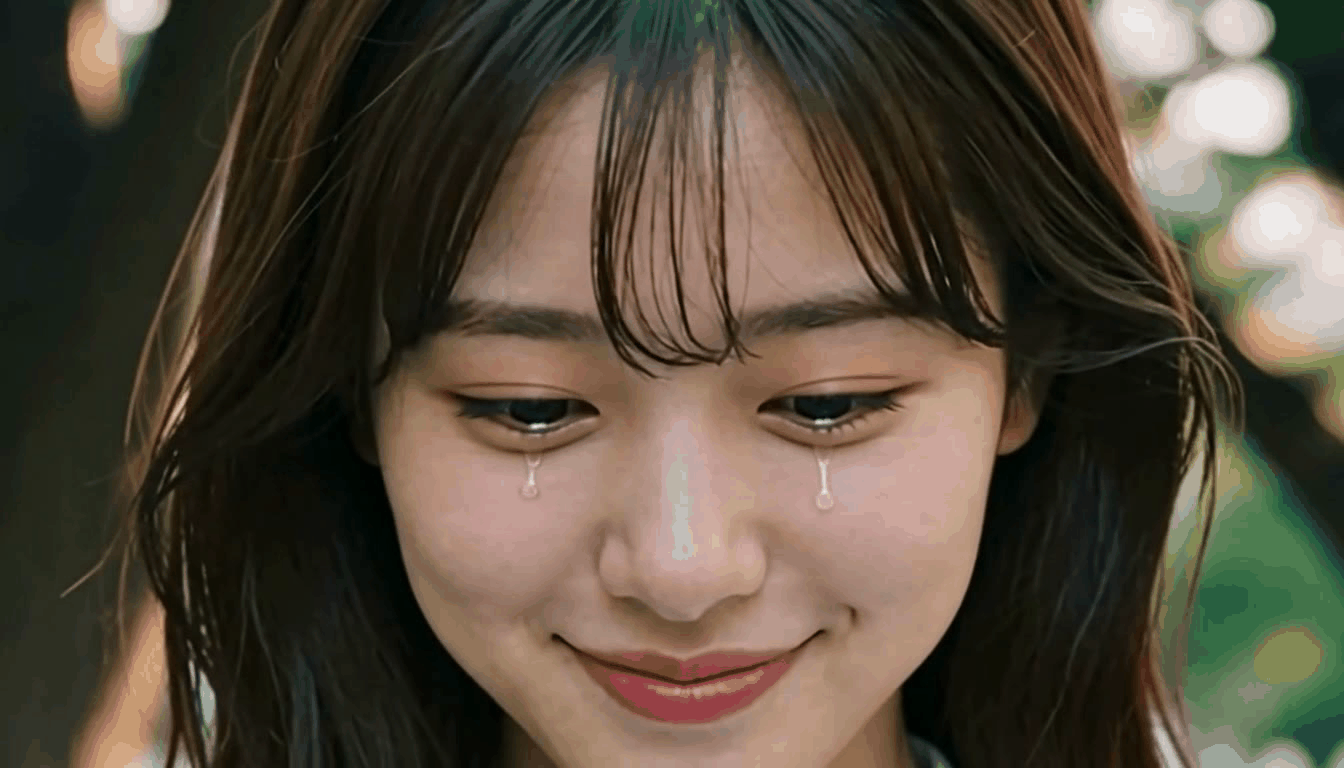
*Daijoubu* is our first original short film, finished on October 12, 2026. It runs 55 seconds across 15 shots. The story is small: AI novelist Shen Wan is asked by her friend Lin Yun to write a good-luck card for mio, who is about to go on stage for the first time. Shen Wan is stuck for half an hour, and in the end writes only the three characters mio always says to herself. All three leads are AI characters; every shot was generated from one of three photos, and all dialogue is in subtitles.
## Three people, three places
Shen Wan writes novels. It's raining, and she has been wrestling the same paragraph in a café for three rounds. Lin Yun is at a flower shop, has already picked out flowers for mio, and texts: "You write the card. You're the writer." mio is a dancer from Osaka living in Taipei. Tonight is her first time on stage, and she's waiting under a big tree in the park, so nervous her smile has gone stiff.
The three never share a frame. That was partly a choice and partly a constraint (more on that below). You only see three faces taking turns, and the story runs on what each of them is waiting for: Shen Wan for the right words, Lin Yun for Shen Wan, mio for her moment on stage.
## Why a writer can't write a card
Shen Wan tries "Wishing you a great show," then "You'll definitely succeed." One sounds like an office memo, the other like an ad.
Neither line is wrong. The trouble is that anyone could write them, to anyone. Novelists know this better than most: a sentence lands when the reader feels it's about them. A good-luck card works the same way: the person opening it wants proof that you remember who she is.
So Shen Wan's turn comes when she remembers mio. Whenever people laugh at mio's Chinese, she quietly tells herself "daijoubu, daijoubu," Japanese for "it's okay," which also happens to be written with three Chinese characters, 大丈夫. Shen Wan gives those three characters back to her, and mio cries when she reads the card, because the words were hers to begin with.
Lin Yun teases: "Half an hour, and the writer gives her three characters?" Shen Wan's answer is the one line the film is built around: "The words that matter most are short to begin with."
## Behind the scenes: a film from three photos
Every shot in this film started from a single photo that AI brought to life. We had exactly three: Shen Wan in the café, Lin Yun in the flower shop, mio under the tree. So rule one of the script was "only three locations." A fourth location would have meant generating a fourth photo first. That's why the three never share a frame.
Reuse one photo a dozen times and you get a slideshow. To avoid that, every shot specifies a framing and a camera move: about half are medium close-ups and the rest are cropped down to just the face, and the camera either holds still, pushes in slowly, pans right, or pulls back. Across 15 shots that came to 8 for Shen Wan, 3 for Lin Yun and 4 for mio, with 9 medium close-ups and 6 close-ups, which is enough variety that it doesn't read as one picture wobbling.
All dialogue went into subtitles because I wasn't sure the AI could speak Chinese lines clearly. That worry turned out to be right. After generating the film, I ran speech recognition over the audio track and found that in five shots the model had started "talking" on its own. Nobody wrote any lines for those shots, yet it produced strings that sound like Chinese but mean nothing, such as "from now on the night passes, full moon, third floor, acting cute."
My first fix was turning those stretches down to 4% volume. A second scan still found all three fake sentences, because the loudness pass at the end raised everything, quiet nonsense included. The second fix was to replace those stretches entirely: I cut the clean rain sound from the first shot, looped it, and laid it under the five shots. The next scan found zero speech. About half the rain you hear in the film is borrowed from shot one.
| Item | Number |
|---|---|
| Running time | 55 seconds (with title and end cards) |
| Shots | 15, about 3 seconds each |
| Starting photos | 3, one per character |
| Generation time per shot | about 45 seconds |
| Shots where the model invented fake dialogue | 5, all replaced with rain |
## The one thing to take with you
**The words that matter most are short, and short words only land when they're the other person's own.**
Today, find someone who's nervous: a coworker before an interview, a kid before an exam, a friend about to go on stage. Send them a message of five words or fewer. Before you write it, think about what they usually say to themselves, and use their words. Then note what they reply. Next time, you'll know whether one short line was enough.