# The Wind Must Be Deep Enough: A Roundtable Two Days Before the Bell, and the Phrase 'The Math Maths'
> BG2Pod recorded two days before the SpaceX IPO: Brad Gerstner, Clark Tang, Gavin Baker and Andrew Fox break the company into launch, Starlink, AI compute and orbital data centers — and discuss how Fable 5 and long-running models have made snapshot benchmarks obsolete. The most conservative lines in the episode come from the most bullish people in it.
Published: 2026-08-04
Locale: en
Tags: bg2, podcast-notes, ai-capex, compute, valuation-discipline, english-finance-media
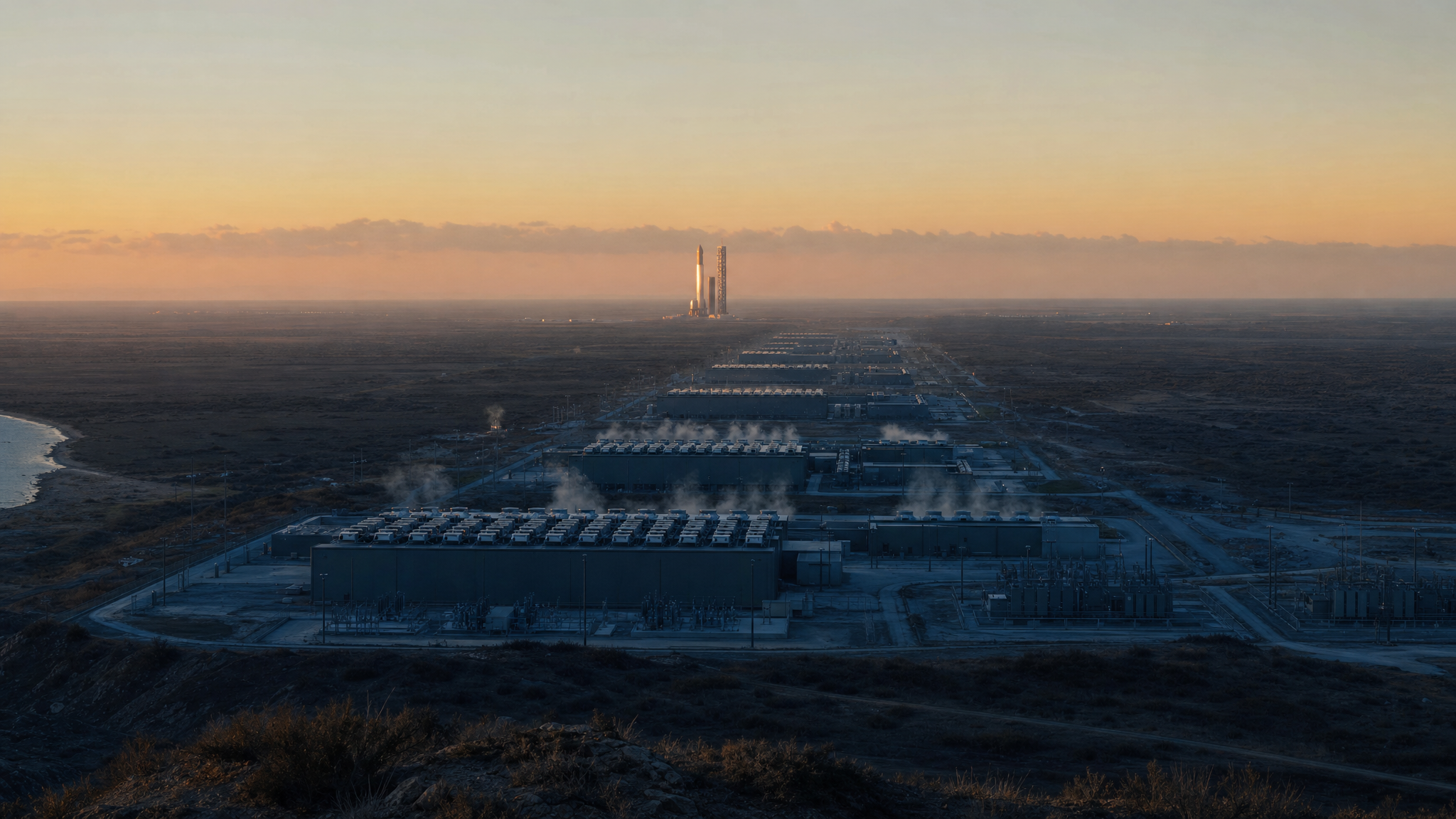
> *If the accumulated wind is not deep,*
> *it has no strength to bear up great wings.*
> —— *Zhuangzi*, "Free and Easy Wandering" (4th c. BC)
## What this episode is about
This BG2 episode is a four-way roundtable: host Brad Gerstner, his Altimeter partner Clark Tang, plus Gavin Baker and Andrew Fox from Atreides.
The timing is unusual — two days before the SpaceX IPO, with all four men at the table holding shares. They say so up front.
Three threads: how to break the deal into variables you can estimate separately; what Fable 5 and this new class of long-running models actually mean; and a check on capex and the market.
**Original episode**: BG2Pod, "The SpaceX IPO, Fable 5, AI Capex Update & Market Check w/ Gavin Baker, Andrew Fox & Clark Tang" (2026-06-11)
## The notes I took
**They break the company into four pieces**: launch, Starlink, AI compute sold to others, and their own model. The ordering is explicit — **launch is the foundation**, because only once reusability drives cost per kilogram down do the other three make economic sense.
**"Rapid reusability" is the phrase that recurs most.** Booster recovery is done; the second stage is only being attempted this year, with a re-flight targeted for next. Why it's the dividing line: amortising the cost of a vehicle over thirty to fifty flights is a completely different cost structure from amortising it over one. Fox's analogy — the old rocket industry was like boarding a plane to California and having the plane explode after you got off.
**The Starlink story is penetration.** Under 1% of global households, plus direct-to-cell. The measuring stick they use is deliberately crude: even a multi-fold increase in revenue is a fraction of a percent of the global telecom market — **that isn't proof they'll get there, it's a statement that the ceiling isn't the binding constraint yet.** Gavin adds the counterweight himself: that requires rapid reusability, and rapid reusability is genuinely hard.
**The real surprise is compute.** In thirty days the company went from not being on the list of AI clouds to being the fourth largest, by selling compute to other people. Their comparison: the monetisation rate implied by widely reported revenue forecasts is roughly $14bn per gigawatt per year, while the two contracts just signed land at $22–23bn and $50bn. Gavin's verdict is blunt: if you borrow at 6–8% and invest in something returning 55%, **the math maths.**
**Clark's observation is that the market keeps treating data centers as commodities.** None of the four agrees. The same person re-engineered a rocket from first principles and an electric car from first principles, so he probably re-engineered the data center the same way — which is where 122 days comes from. And in a supply-constrained world, speed is money for everyone upstream: the sooner GPUs are energised, the sooner suppliers of land, power and turbines get paid, which tells you who gets to the front of their queue.
**The orbital data center arithmetic is laid out cleanly.** On the ground, a gigawatt-scale site costs roughly $20–25bn once you exclude the silicon itself — land, shell, power, cooling. Their space version comes to around $5bn, conditional on second-stage reusability driving cost per kilogram from ~$1,500 down below $250, and on satellite and chip failure rates not being wild. **But they volunteer the important caveat: orbital compute is not a precondition for the investment case, it's an option on top of it.** The terrestrial pieces already carry the numbers that are circulating.
**On Fable 5, Gavin's takeaway isn't the scores.** He points at Noam Brown's observation that snapshot benchmarks are losing meaning — the x-axis should become time, or compute, or tokens, because a frontier model given long enough will solve most of what you throw at it. Then comes the line I think is worth keeping: **we don't actually know how smart these models are, because nobody has ever run one continuously for a year** — and we won't have time to find out before the next one ships.
He follows it with a thought experiment: an intellect that never eats, sleeps, gets distracted or ages, thinking about one problem continuously for a year.
**One detail carries more information than its own content**: the Pareto curve they use to compare model efficiency went out of date twice within twelve days of being made.
**On open source versus frontier, he offers a "two things can both be true" structure.** Frontier models capture the overwhelming majority of the revenue — his number is over 90% — while open-source models may account for the overwhelming majority of tokens consumed. The failed inference of the past few years was translating *volume* directly into *value*. He adds a second-order point: **if open source does well, that's bullish for compute suppliers**, because margin the frontier labs don't capture flows to the hardware end instead.
**Marking capex to reality.** The 2027 consensus estimate has been raised toward $1.1tn, and the table thinks the real figure, including what isn't being counted, is closer to $1.5tn. The denominator against it is roughly $300bn of combined AI lab revenue. Their answer comes in three parts: gross margins may be 60–70%; a third or so of the spend is training the next model and was never meant to generate current revenue; and they think $300bn is low.
**Another underrated denominator is users.** The estimate cited on the show: fewer than 0.2% of people on Earth are using AI agentically.
**The most conservative passage is the market check.** Semis ripped this year, but internet is down 16% and software down 8% — enormous dispersion. Gavin's metaphor is a runner: the market spent the last two months not climbing a hill but going straight up a cliff, and the runner is tired. The only question is whether it rests at the top or has to come back down a stretch first. He also says something uncomfortable for anyone doing research for a living: **the game of finding the next bottleneck is over.** The host's own response has been to dial exposure from large down to medium-small.
**On post-IPO volatility they offer no answer.** The statistic on the table is that across twenty large listings the average maximum drawdown exceeded 50%. Gavin's reply is that this situation is unprecedented — employees and early investors have had roughly twenty liquidity windows over the past decade, so whoever still holds has *chosen* to hold. But he says plainly that this is a guess, that he doesn't know what happens short term, and that the only advice is to work through each variable yourself.
**One last number.** Because of those new contracts, the company's revenue multiple went from roughly 100x to roughly 39x in a month.
## What I took away
**1. When the denominator can halve in a month, the multiple isn't an anchor.**
100x to 39x, with no change in price — what changed was the denominator. That exposes the limits of the tool rather completely: **a multiple is a numerator over a denominator, and when the denominator is being rewritten quickly, the multiple carries almost no information.**
Which is why the useful move in this episode isn't a view on the headline valuation but a decomposition into four pieces, each with its own estimate and its own probability. My own discipline runs the same way: first ask what assumptions hold up the denominator, then ask whether those assumptions are falsifiable, and only then look at the multiple.
**2. "The math maths" is a conditional, not a conclusion.**
The phrase recurs throughout, and every instance has a set of premises hanging off it. The honest version is to write it as a receipt: it works *because* X, Y and Z hold — then ask which one reality breaks first.
The episode supplies its own falsification list: whether second-stage reusability lands, on-orbit failure rates for satellites and chips, land and power procurement, and the termination terms in those long contracts. **All of those are observable and have dates attached.** "2028 revenue," by contrast, isn't something you can check an answer against — it's the output of everything above it.
**3. The bottleneck didn't disappear. It moved somewhere a screen can't reach.**
Gavin says the bottleneck-hunting game is over. But the episode's own content contradicts the literal reading: the discussion migrates from chips to power, land, transformers and gas turbines, and then to *who can stand a site up in 122 days*.
That difference matters enormously. **The earlier items can be screened with capacity and financial data; the last one is execution capability, and it appears in no column of any dataset.** So the correct update isn't "stop looking for bottlenecks" — it's "this round's bottleneck is becoming unscreenable," which is precisely the category a quantitative framework misses wholesale.
**4. The death of snapshot evaluation is both a methodological warning and a trap.**
Put time on the x-axis: that warning transfers directly to investing. Judging something that only unfolds over time by a single quarter's EPS or a single day's signal will systematically understate it.
But the reverse matters just as much — **a claim that "you'd have to run it a year to see how good it is" is unfalsifiable on any reasonable horizon.** Unfalsifiable things can't be reasons to hold; they can only be things to watch. You have to hold both halves at once.
**5. How to use an insider's words: check their facts, recompute their probabilities.**
All four are shareholders, two days before the listing. They disclose it, and they repeatedly say do your own work and make your own decision. Taleb's skin-in-the-game principle says people who bear consequences are more credible — but the principle assumes **they genuinely bear the cost of being wrong**, and at certain moments the payoff from speaking and the cost of being wrong aren't symmetric.
So I split it: take their **facts** (cost structures, contract terms, engineering timelines) and go verify them; take their **probabilities** and recompute them myself. The most honest passage in the episode is the host describing his own habit — the future is a distribution of unknown probabilities, so don't tell me "it could happen," give me the distribution: 20% or 30%?
**6. Two things can be true at once, and many arguments are just volume mistaken for value.**
Frontier takes 90% of the revenue; open source may take 80% of the tokens. That sentence pattern is worth memorising on its own, because it's the antidote to a whole family of bad inferences: **market share isn't profit share, usage isn't value capture, penetration isn't profitability.**
And the corollary — that open source doing well is bullish for compute suppliers — is where this kind of discussion earns its keep. It isn't a restatement of a position; it's a second-order claim you can go and test.
**7. The most conservative lines come from the most bullish episode.**
All four are close to unanimous on long-term direction. But when the conversation turns to how they're actually positioned, one has moved exposure from large to medium-small and the other says the runner needs a rest.
There's no contradiction there. **Directional judgement and position sizing are two separate decisions**, and my own most frequent error is translating "I think this trend is right" straight into "I should own more of it." This episode keeps them cleanly apart, which I think is its most useful lesson.
## Further reading
- The episode: BG2Pod, "The SpaceX IPO, Fable 5, AI Capex Update & Market Check w/ Gavin Baker, Andrew Fox & Clark Tang" (2026-06-11)
- Noam Brown's public post, referenced on the show, on why the evaluation axis should be time
- The participants are shareholders in the company discussed and disclose that on air; every figure here is public information as cited in the episode
- The couplet from *Zhuangzi* is my own footnote to the episode, not part of it
---
**Disclaimer**: This is a listener's reflection and general education, **not investment advice, an offer, or a solicitation**. Companies, institutions and figures mentioned come from the public episode and public sources; nothing here recommends any security or offers a price target or entry point. Investing carries risk — judge for yourself against your own circumstances, and consult a qualified professional if needed. Copyright in the original episode belongs to its producers; please go listen and support them.